Request Your Free Quote!

Fall Light and Knockdown Texture: Picking the Right Depth
September afternoon light rakes across knockdown texture and exposes its depth. How Orange County homeowners pick light, medium, or heavy splatter.
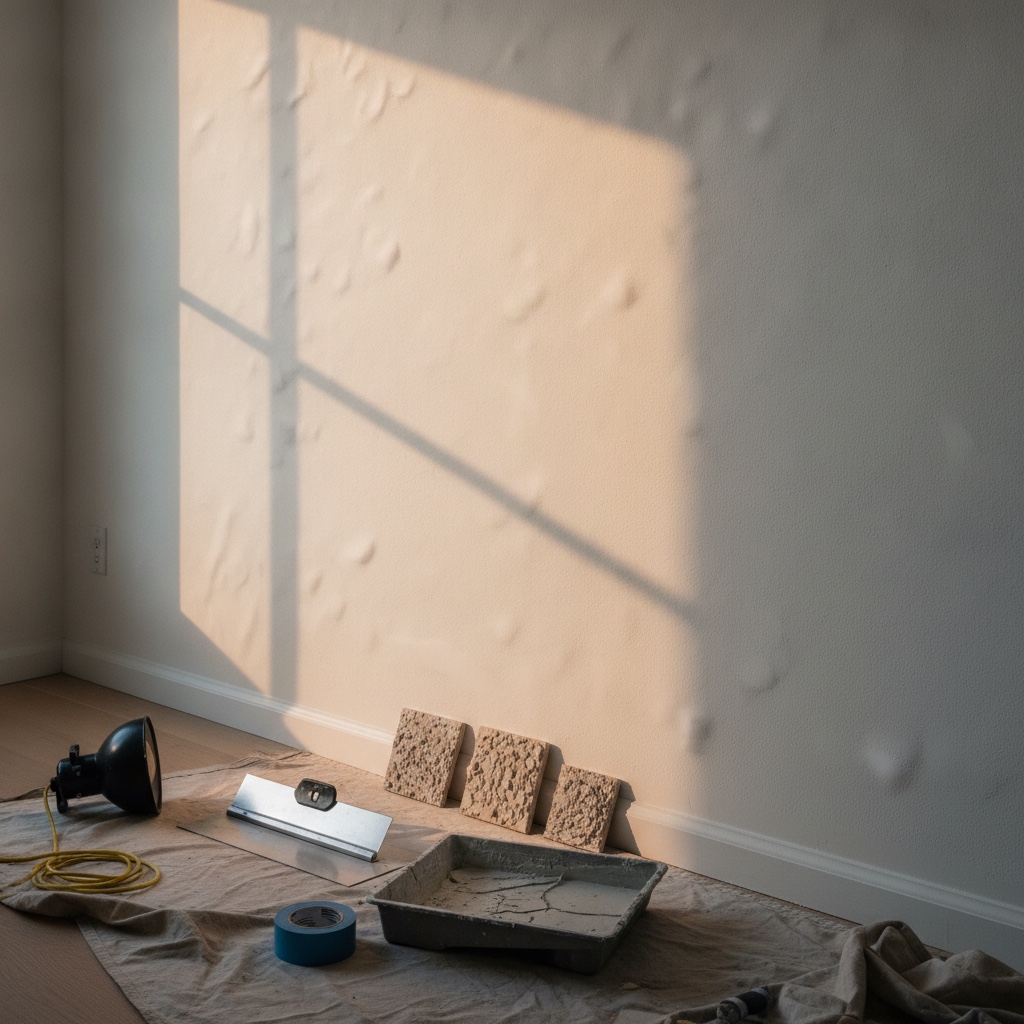
Walk into a west-facing Tustin living room at 4:30 in September and the wall tells on itself. The sun sits lower than it did in July, and it rakes across the drywall almost sideways instead of pouring down from above. Every peak in a knockdown texture throws a small shadow. Every low spot fills with warm light. A wall that looked calm and even in June suddenly reads busy, blotchy, and about ten years older than it is.
That is not the wall changing. That is the light changing. Fall in Southern California is when texture depth stops being a design detail and starts being the thing homeowners actually notice. If a knockdown finish is going on a wall this season, the depth of that texture matters more than the pattern name on the sample board.
Why September Light Is the Honest Test
Summer sun in Orange County comes in high and flat. It washes a wall evenly, which flatters heavy texture and hides a lot of finish sins. By mid-September the sun angle drops enough that afternoon light hits interior walls at a shallow angle. Contractors call that raking light. It is the same trick a finisher uses with a work lamp held flat against a wall to find every ridge before final sanding.
The practical result: a texture that looked subtle at noon in August can look like a stucco ceiling at 4pm in October. West and southwest facing rooms take the worst of it. North facing rooms barely change. Before committing to a depth, stand in the room at the hour the family actually uses it. A Rancho Santa Margarita family room that fills up at 5pm on a Sunday should be judged at 5pm on a Sunday, not on a Tuesday morning walkthrough.
The same rule applies in reverse. Rooms with weak natural light, like an interior Long Beach hallway or a north facing San Diego office, need a little more depth to keep the wall from reading dingy and flat under lamp light. Depth is a light problem before it is a taste problem.
Light, Medium, and Spanish Lace: Three Real Depths
Knockdown is not one finish. It is a family of finishes separated mostly by how much compound goes on the wall and how long it sits before the blade flattens it. The three depths that come up most on SoCal jobs:
- Light splatter knockdown. Thinned compound sprayed on at low volume, knocked down early, leaving flat plateaus with maybe 1/32 of an inch of relief. Reads as a faint mottle. Holds up fine in raking light and stays quiet in a west facing room.
- Medium knockdown. The default on most Orange County tract homes built between 1992 and 2006. Roughly 1/16 of an inch of relief, clear plateau edges, visible pattern from across the room. This is the depth most people picture when they say knockdown.
- Heavy splatter, sometimes called Spanish lace. Thicker mud, longer set, aggressive relief close to 1/8 of an inch. Dramatic under soft light. Loud under September afternoon sun, and a magnet for dust along the top edges.
Stomp and skip trowel patterns run alongside these as separate techniques, but the depth question is the same. How far does the surface travel from its lowest point to its highest? That number decides how the wall behaves when the sun drops.
One honest note about where design is heading. The 2026 finish conversation has swung toward quiet, restrained surfaces: limewash, Roman clay, soft plaster looks in sand and taupe. Heavy 1990s splatter is not what buyers walk in and admire. A light or medium knockdown sits comfortably inside current taste. Spanish lace mostly makes sense when matching an existing wall that already has it.
What Each Depth Costs in Orange County
Texture is a small line on a drywall bid, but depth moves it. Statewide, drywall installation runs roughly $2.50 to $4.50 per square foot of wall area for hang, tape, and finish. Orange County sits at the upper half of that range, and skilled drywall labor in California averages near $32 to $38 an hour before overhead, well above the $24 national median.
Within a finished job, expect texture to add roughly $0.35 to $0.60 per square foot for a light or medium knockdown on new rock. Heavy splatter runs closer to $0.60 to $0.95 because it burns more compound, takes a second pass, and demands better masking. A 400 square foot family room with 9 foot walls carries about 1,100 square feet of wall surface, so the spread between light and heavy texture on that room lands somewhere near $275 to $385. Not enormous. Not nothing either.
The bigger money sits underneath. Any knockdown depth still needs a sound level-4 finish beneath it, and skipping that step to let texture hide bad taping is the single most common shortcut in this trade. Raking September light finds it every time. A wavy butt joint under medium knockdown shows up as a long soft shadow that no amount of paint fixes.
One timing note worth real money. Contractor pricing in California typically climbs 5 to 15 percent through peak spring and summer demand. September and October sit in a softer window before the holiday crunch, which is a practical reason to book texture work now rather than in April.
Matching Depth on a Partial Repair
Most texture calls are not whole rooms. They are a patched ceiling in Mission Viejo after a slow shower leak, or a four foot section of wall in Irvine where a media console came off the studs. On a partial repair, depth is the entire ballgame. Pattern shape can be a little off and nobody notices. Depth being off by 1/32 of an inch produces a patch that glows under afternoon light like a bruise.
The method that works: take a raking light to the existing wall first, at the same hour the room gets its worst light. Photograph the shadow pattern. Then spray test boards at three thinning ratios and knock each one down at a different set time, usually 8, 12, and 16 minutes depending on humidity. Coastal Huntington Beach humidity stretches those windows. Inland Corona in a dry September shortens them hard, sometimes by half.
Hold the test boards flat against the wall in that same afternoon light and pick the match by shadow, not by color. Color comes later with paint. If none of the three match, the honest answer is to texture the full wall corner to corner rather than feather a patch that will never disappear. That conversation belongs in the quote, not on the last day of the job.
Making the Call Before the Holidays
A single room of new texture, primer, and paint runs about four to six working days in a lived-in house, including cure time between coats. Whole-house texture on a 2,200 square foot home is closer to two and a half weeks. Counting backward from Thanksgiving, mid-October is the last comfortable start for anything larger than a single room, and calendars in Orange County tighten fast once the first cool week hits.
The right depth is the one that stays quiet in the light that room actually gets, at the hour the family actually lives there. That is a five minute test with a work lamp and a sample board, and it is the difference between a finish that looks intentional in year eight and one that looks dated by spring.
JNL brings sample boards to the house and holds them on the wall in your own afternoon light before anything gets sprayed. The in-home assessment is free, it takes about half an hour, and it ends with a written scope and a number. Give us a call and we will get on the calendar while the fall window is still open.
Morning-context sources used: https://www.angi.com/articles/what-cost-install-drywall.htm (Angi drywall installation cost, 2026 data), https://drywallinstallationcost.com/drywall-cost-california/ (California drywall cost per square foot, 2026), https://www.homeyou.com/ca/drywall-los-angeles-costs (Los Angeles drywall costs, August 2026), https://feltright.com/blogs/news/modern-wall-texture-trends-2026 (modern wall texture trends 2026), https://www.bobvila.com/articles/knockdown-texture/ (knockdown texture techniques reference), https://www.globalgypsum.com/news (Global Gypsum industry news, July 2026 wallboard producer review)