Request Your Free Quote!

End-of-Year Drywall Invoices: What OC Homeowners Should Keep
What a year-end drywall invoice in Orange County really affects, what the quote should cover, and the five documents to file before the last payment.
A Villa Park homeowner called on December 18 last year with a simple question. The garage conversion was done, the walls were smooth, and the final invoice sat on her kitchen counter. She wanted to know whether paying it that week instead of the first week of January changed anything. It did, though not in the way she expected. Her tax bill did not move at all. What moved was the stack of paperwork she will need in eleven years when that house sells.
September is when these questions start showing up. Crews across Orange County are booking through the holidays, homeowners are closing out projects that started in August, and final invoices land in the months when everybody is already counting money. Here is what actually matters on a drywall invoice at year end, what the quote should have settled before the first sheet went up, and which documents belong in a folder instead of the recycling bin.
The Date on the Final Invoice Is a Records Question, Not a Deduction
Start with the part most homeowners get backwards. Work on your own primary residence is not deductible. Paying a drywall invoice on December 29 instead of January 5 does not create a write-off either year. The federal energy credit that covered insulation, windows, and qualifying HVAC expired for work placed in service after December 31, 2025, so a 2026 project earns nothing there either. Drywall never qualified for that credit in the first place.
What the date does affect is your cost basis file. The IRS treats a capital improvement, meaning work that adds value or extends the life of the home, as an addition to what you paid for the property. That higher basis shrinks the taxable gain when you sell. Repairs do not count. Patching a single crack is a repair. Converting a garage, finishing an ADU, or re-hanging and finishing an entire wing after a leak is an improvement, and the invoice for it is worth real money later.
So the rule is simple. Keep the contract, the invoice, the proof of payment, the permit paperwork, and the photos, and keep them until three years after you file the return for the year you sell. For a Tustin house bought in 2014 and sold in 2038, that folder covers twenty-four years of work. Nobody remembers a $9,400 garage package that long without paper. Talk to your CPA about which of your projects count as improvements. JNL hangs and finishes drywall, and does not give tax advice.
What the Quote Should Have Settled in September
A year-end invoice only goes sideways when the quote was vague in the fall. A written scope for drywall work in Orange County should name six things: hang, tape, finish level, paint, cleanup, and haul-off. Leave any one of them unstated and it becomes an argument in December, usually about who owns the pile of scrap board in the driveway.
Current Orange County pricing runs $2.50 to $4.50 per square foot of wall and ceiling surface for board hung, taped, and brought to a level-4 finish. Level 5, which adds a full skim coat across the whole surface, adds roughly $0.95 to $1.35 per square foot. On a 640 square foot ADU with about 2,200 square feet of surface, that spread between finishes is $2,100 to $3,000. That is not a rounding error, and it is the single line most worth pinning down in writing before anyone orders board.
Smaller jobs follow different math. A standard patch runs $300 to $500. Crack repair lands between $350 and $1,000 depending on length and whether the corner bead has to come out. Most outfits, JNL included, carry a trip minimum of $125 to $200, because the truck, the mud, and the drive from Anaheim to San Clemente cost the same whether the hole is the size of a doorknob or a door. Ask for that number up front so it never shows up as a surprise line.
Scope Changes in the Last Weeks of the Year
Material pricing has been moving all year. In the latest NAHB Remodeling Market Index, 74 percent of remodelers reported that suppliers raised material prices since March, with an average increase of 6.7 percent over that stretch. The August CPI released this morning put overall prices up 3.4 percent over the last twelve months, with shelter up 3.0 percent. A quote written in July and signed in November is quoting a different market. Good contractors put a validity window on the page, usually thirty days.
The bigger year-end surprise is what sits behind the wall. Open a 1968 Fullerton hallway and the framing may be wet from a supply line nobody knew was weeping. That changes the job from finish work to remediation, and the drywall waits. Pre-1980 popcorn ceilings need an asbestos test before scraping, which runs $75 to $150 and takes a few days to come back. Old 3/8 inch board on a ceiling will sag where 1/2 inch would not, so matching it is sometimes the wrong answer. Each of these is a real change order, not a contractor padding an invoice.
California law sets the payment structure around all of this. Under Business and Professions Code 7159.5, a home improvement down payment cannot exceed $1,000 or 10 percent of the contract price, whichever is less. On a $28,000 remodel that means $1,000, not $2,800. Progress payments cannot run ahead of the value of the work actually performed and materials actually delivered. If a bid asks for half up front in December because the crew wants the deposit before the holidays, that bid is out of step with the law. Get every change order in writing, with a price and a signature, before the work happens.
The Folder to Build Before You Pay the Last Dollar
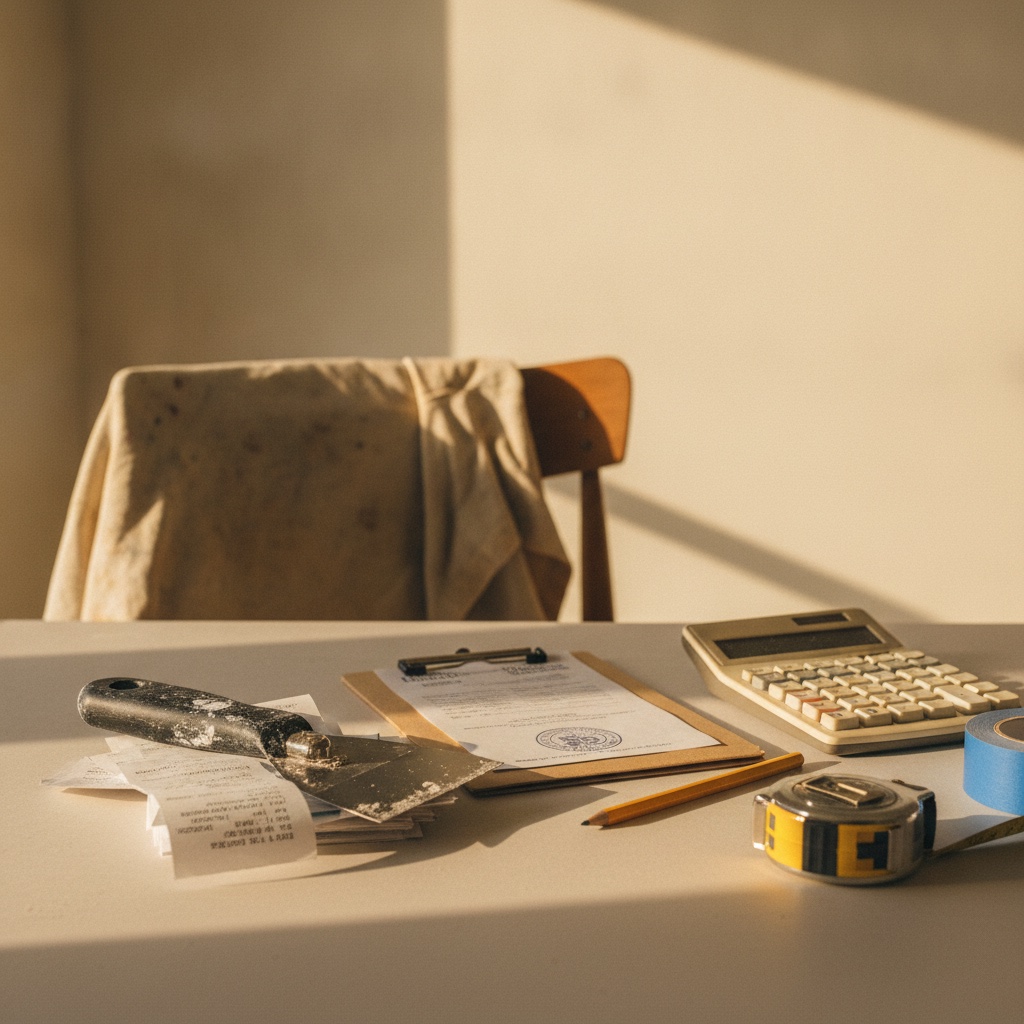
Five documents make up a complete file. The signed contract, which must carry the down payment notice in at least 12-point boldface type. Every signed change order. The final invoice, itemized by the same six line items the quote used. The permit card and final sign-off when the job pulled a permit. And an unconditional lien release, signed by the contractor, handed over when the final payment clears.
Add two more things that cost nothing. Photos of the open wall before the board goes up, showing framing, wiring, and plumbing, because the next person who opens that wall will thank you. And one page of plain notes: finish level, texture name and depth, paint brand, sheen, and color code. A knockdown texture matched to a 2026 hallway is nearly impossible to recreate from memory in 2031, and the paint on a south-facing Orange County wall shifts enough in five years that the original code is the only honest starting point.
Store the whole thing digitally and keep one paper copy somewhere dry. Scanned receipts hold up better than thermal paper, which goes blank in a hot Inland Empire garage inside of three summers. Contractors retire, phone numbers change, and email accounts close. Insurance adjusters and buyers ask for documents years after the crew packed up, and the answer is either a labeled folder or a shrug. Build the folder while the job is fresh, because reconstructing it later never works.
If a project is still sitting on your list for this year, September is the month to price it. Rain arrives in Southern California soon after, the calendar tightens through the holidays, and a quote written now is a quote written before the next round of supplier increases. JNL Drywall offers a free in-home assessment across Orange County, the Inland Empire, Long Beach, and north San Diego County, and every estimate comes back itemized by the six lines above, so the invoice at the end matches the paper at the start. Call for a walkthrough, and get the scope on paper while the weather still cooperates.
Morning-context sources used: BLS Consumer Price Index, August 2026 (released September 11, 2026); CNBC, August 2026 CPI report (September 11, 2026); CSLB Board Meeting Packet, September 2-3, 2026; HousingWire, NAHB Remodeling Market Index Q2 2026 (July 9, 2026); CSLB, Home Improvement Contracts and down payment limits; IRS, Energy Efficient Home Improvement Credit.