Request Your Free Quote!

Drywall Scope Changes: What the Wall Behind the Wall Costs
What happens to a drywall quote when demo reveals bad framing, old wiring, or mold. Real scope-change costs in Orange County and how to plan ahead.
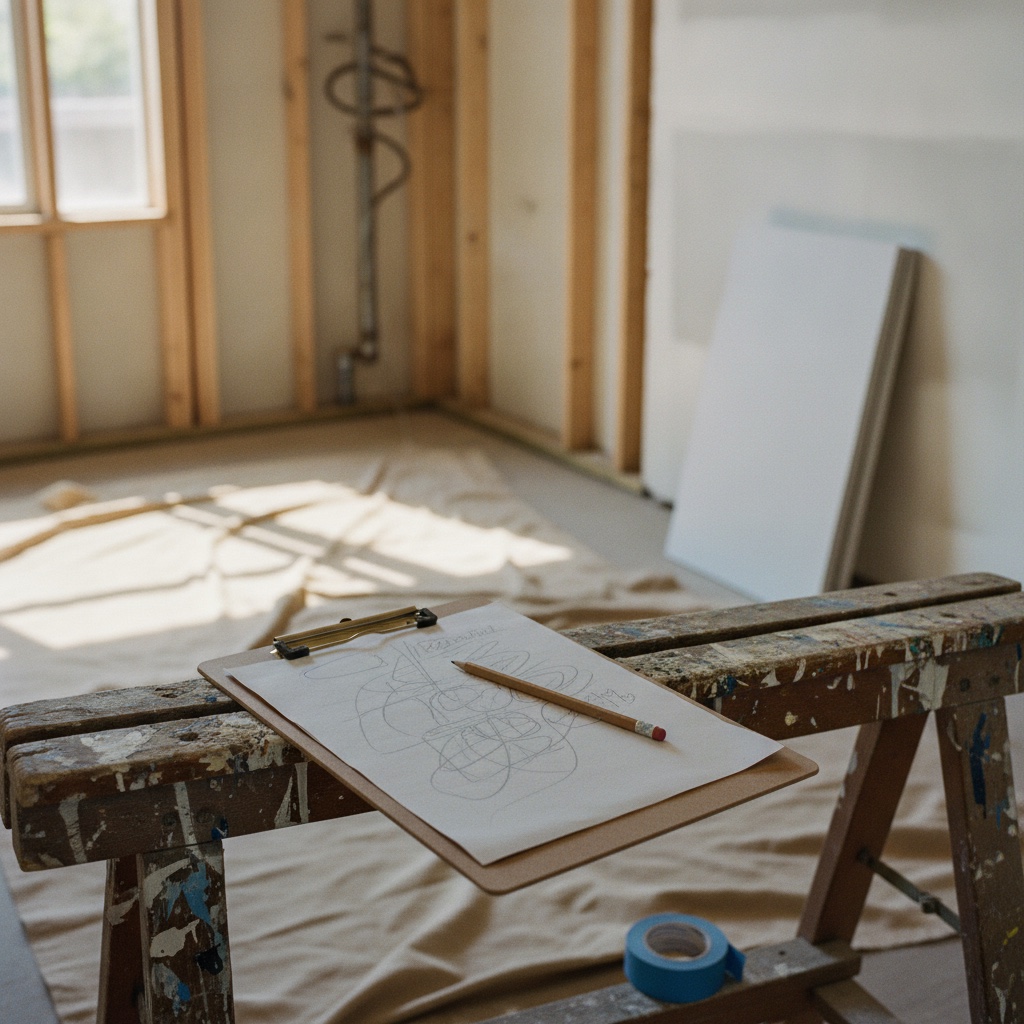
The quote said $6,800. Then the wall came down in a 1965 Fullerton ranch, and behind the drywall sat a corroded galvanized supply line, two junction boxes with no covers, and a sill plate soft enough to press a thumb into. The final invoice landed near $11,000. Nobody lied and nobody padded anything. The wall behind the wall changed the job. That is scope-change math, and every SoCal homeowner signing a remodel contract this summer should understand it before demo day, not after.
Why the Number Moves After Demo Day
A drywall bid prices what the estimator can see. In Orange County, hanging, taping, and finishing new drywall runs roughly $2.50 to $4.50 per square foot for a standard level-4 finish, with level-5 smooth work priced above that. An estimator walking your Costa Mesa living room can measure the walls, count the inside corners, and price that work within a few hundred dollars. What no estimator can price is the condition of the framing, wiring, and plumbing hidden behind the existing board.
Industry cost guides put the premium on mid-project changes at two to five times what the same decision would have cost during planning. The reasons are practical, not sneaky. Materials already cut get wasted. Finished work gets opened back up. Trades get rescheduled, and in a busy Orange County July, rescheduled often means weeks, not days.
That multiplier is why a good contractor talks about unknowns up front. The cheapest possible fix for a hidden problem is the one you priced before anyone swung a hammer. The most expensive fix is the one discovered after the new board is hung, taped, and textured, because now you are paying for demolition twice. Ask your estimator directly what they cannot see, and listen to how specific the answer gets.
The Usual Suspects Behind an Orange County Wall
North County housing stock skews old. Anaheim, Fullerton, and Garden Grove are full of homes framed between the 1950s and the 1970s, and those walls hide predictable problems. Galvanized steel supply lines corrode from the inside out and telegraph rust stains onto the back of the drywall. Older cloth-wrapped wiring and overstuffed junction boxes fail current code the moment an inspector sees them. Termites and dry rot quietly eat sill plates and studs near any slow leak.
Mold changes a schedule faster than anything else on that list. A pinhole drip inside a wall cavity can feed growth for years without a visible stain on the paint side. When demo exposes it, drywall work stops until the affected material is cut out, the source is fixed, and the cavity dries. On a bathroom wall in Huntington Beach, that pause typically adds three to five days before new rock goes up.
Permits add their own trigger. Once a wall is open under an active permit, everything inside it must meet today’s code, not the code from 1968. If the exposed wiring lacks proper grounding or the bathroom circuit has no GFCI protection, the city will not let anyone close the wall until it is corrected. That is not a contractor upsell. That is the building department doing its job.
What Each Surprise Actually Costs
Exact numbers depend on the house, but the ranges hold steady across OC. Sistering two or three termite-damaged studs and treating the surrounding framing usually lands between $500 and $1,500. Replacing a corroded galvanized branch line with copper or PEX inside one open wall typically runs $800 to $2,500 depending on access. Bringing one wall’s wiring up to code, with new boxes and grounding, commonly adds $600 to $1,800.
Stack a couple of those together and the change order gets real. One widely cited 2026 example: demo revealed corroded plumbing and termite damage on a single remodel, and the resulting change order came to about $5,500 plus a two-week delay. That tracks with what we see in Tustin and Orange every month. The drywall itself is rarely the expensive part. The wall behind it is.
There is also a drywall-side cost most homeowners miss. Every extra cavity that gets opened means more board, more tape, more mud, and more texture matching. Feathering a repair into an existing knockdown or orange peel field so it disappears takes real labor. A simple patch that runs $300 to $500 as a standalone repair becomes part of a larger finish bill when three more openings join it, especially if the room is headed for a level-5 smooth finish.
How to Price the Unknown Before You Sign
First, carry a contingency. For homes built before 1980 anywhere from La Habra to San Clemente, we tell homeowners to hold 10 to 15 percent of the contract price in reserve. Newer construction can get away with less. If the money goes unspent, it stays yours. If demo finds something, you make a calm decision instead of a panicked one.
Second, insist on written change orders. Every legitimate scope change should arrive as a document with a description, a price, and a schedule impact, signed before the added work starts. Verbal approvals in a hallway are how $400 surprises become $4,000 arguments. A contractor who resists putting changes in writing is telling you something worth hearing.
Third, know what your quote actually covers. A JNL drywall quote spells out hang, tape, finish level, texture, paint, cleanup, and haul-off as line items, and it names what is excluded. When something behind the wall changes the picture, the change order prices only the new work, at the same unit rates already in the contract. On older homes we will also recommend small exploratory openings during the assessment, a $150 look that regularly prevents a $5,000 surprise.
Scope changes are not a failure of planning. They are what honest remodeling looks like in 60-year-old housing stock. The difference between a smooth project and a painful one is whether the math was explained before the wall opened. If you are planning drywall work this summer, we will walk your project room by room and flag the likely surprises before they cost you anything. The in-home assessment is free, and the hour it takes is the cheapest insurance in remodeling.
Morning-context sources used: https://drywallinstallationcost.com/drywall-cost-california/, https://www.angi.com/articles/how-much-does-drywall-repair-cost-small-holes.htm, https://www.247pro.com/blog/home-remodeling-prices-full-cost-breakdown, https://constructem.com/labor-costs-to-hang-and-finish-drywall-in-2026/, https://www.customhome.us/blog/how-to-avoid-change-orders-remodel/, https://homeguide.com/costs/drywall-repair-cost