Request Your Free Quote!

Matching Paint After a Drywall Patch in Sun-Faded OC Rooms
Why a clean drywall patch still shows in late-summer OC light, how to match color and sheen, and when one wall of paint beats a full repaint.
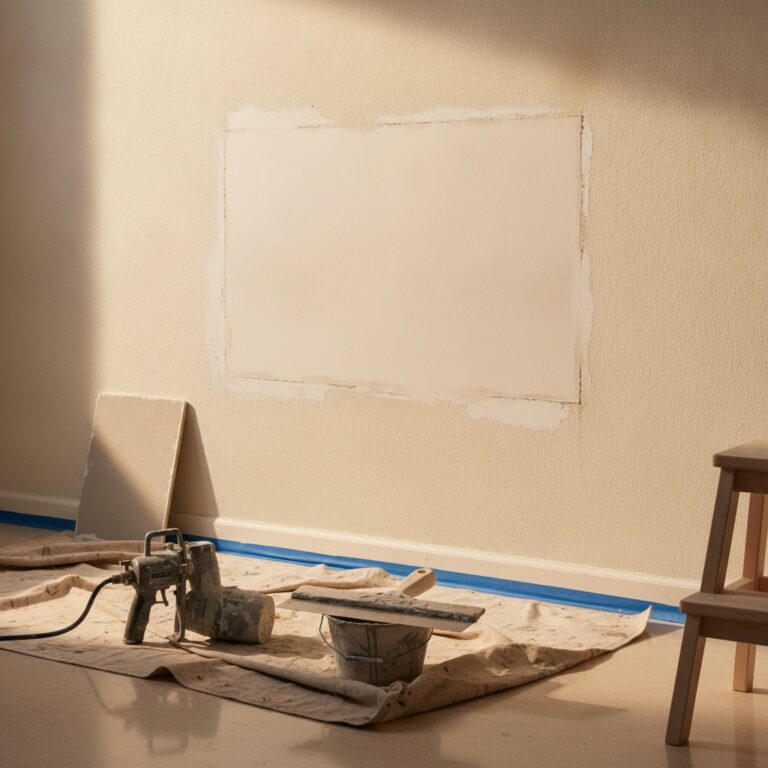
A homeowner in Orange sent over a photo last week of a nine inch patch above a light switch. The drywall work was clean. The tape was invisible, the sanding was flat, the wall read level-4 all the way across. Paint was the problem. That patch sat in the middle of the wall like a pale thumbprint, and the homeowner assumed the repair had failed. It had not. The wall around the patch had quietly changed color over six summers of west-facing afternoon sun.
This is the most common complaint we hear after a small repair, and it has almost nothing to do with drywall. It has to do with two things most people never separate: color and sheen. Get one right and miss the other, and the patch still shows. Here is how to read your own wall before anybody opens a can of paint.
Late summer light is the harshest judge your wall will face
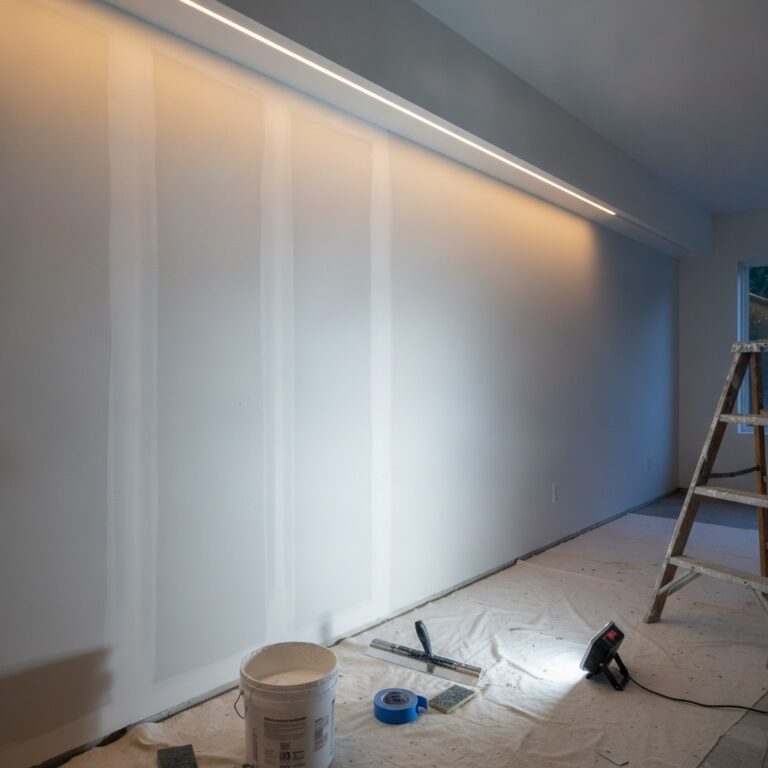
Between about 4:00 and 6:30 in late August, the sun in Orange County drops low enough to rake across an interior wall instead of washing it. Raking light travels almost parallel to the surface. Any change in height, texture, or reflectivity throws a shadow. A patch that looks perfect at noon can read as a visible rectangle at 5:15 on a Tuesday.
Walk the room at that hour before you judge any repair. Stand at the far corner and look down the length of the wall, not straight at it. If the patch disappears when you face it head on but appears from an angle, you are looking at a texture or sheen issue. If it shows from every angle in every light, the color itself is off. Those are two separate fixes with two different price tags.
West and southwest rooms in Huntington Beach, Anaheim Hills, and inland Corona take the worst of this. So do rooms with a slider and no overhang, where the low sun comes straight through the glass and lands on the opposite wall. A north-facing bedroom in Long Beach can hide the same patch for years, which is why two identical repairs in one house can get two very different reviews from the same homeowner.
Color match and sheen match are two different problems
Color is the hue in the can. Sheen is how much light the dried film bounces back. Painters call an uneven sheen result flashing, and flashing is what makes most patches visible even when the color is a perfect match. Fresh joint compound and bare paper are far more porous than a six year old painted wall. They drink the first coat, dry duller, and stop reflecting light the way the surrounding paint does.
Sherwin-Williams and most paint manufacturers point to the same root cause: uneven porosity that never got sealed. Spot priming the patch with a dedicated drywall primer, then rolling the finish coat, solves the majority of flashing cases. Skip the primer and no amount of extra topcoat will even it out. The patch just gets thicker and shinier in a slightly different way.
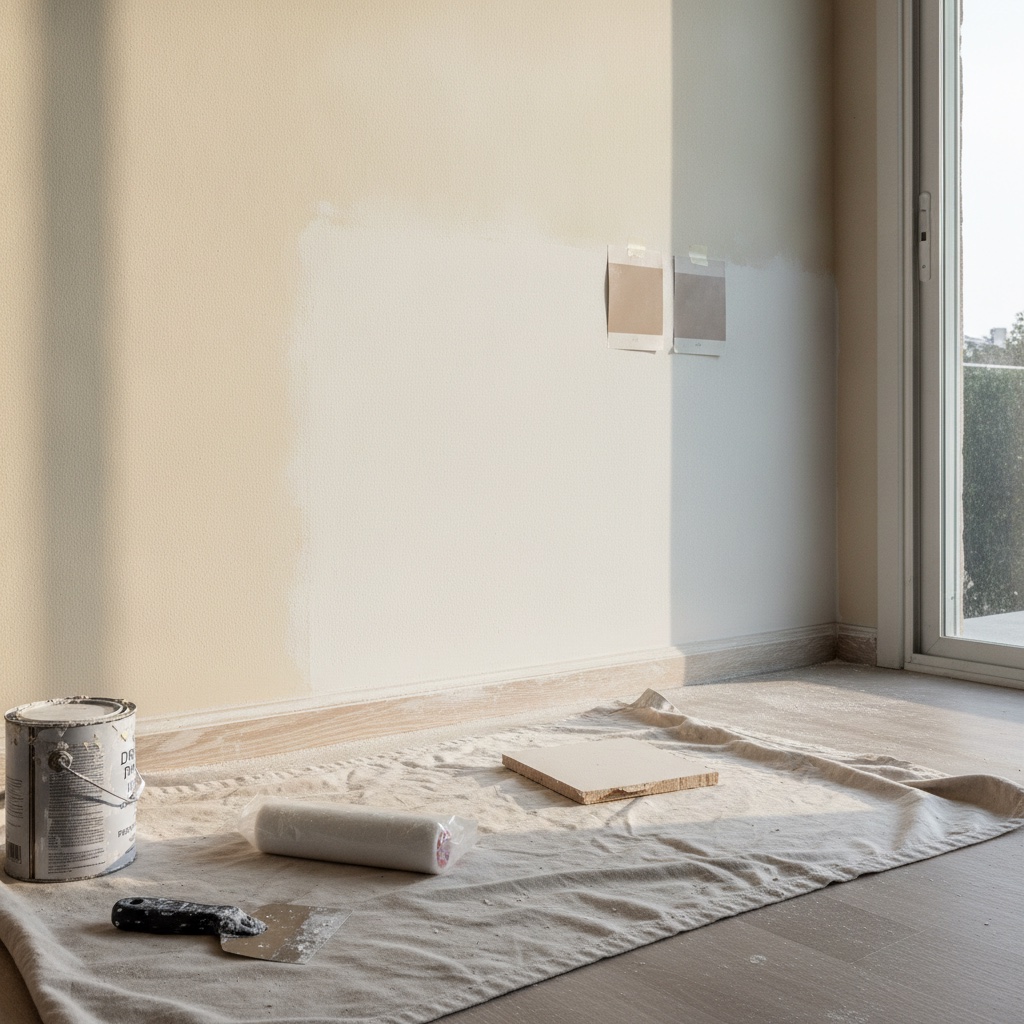
Color has its own trap. Even with the original can in the garage, the paint on the wall is not the paint in the can anymore. UV exposure fades most interior latex a measurable amount over five to eight years, and warm off-whites drift faster than cool grays. A can labeled Alabaster from 2019 will not match a 2019 Alabaster wall that has taken six SoCal summers of afternoon sun.
The fix is a paint store scan. Cut a two inch square of painted drywall from an inconspicuous spot, an interior closet wall on the same run works well, and take the physical chip to the counter. A spectrophotometer reads the aged surface, not the original formula. Bring the sheen information too. Most scanners read color only, and the counter will ask you to name the finish.
The corner-to-corner rule that saves you a full repaint
Here is the working rule our crews use. Paint stops at a break in the plane, never in the middle of open drywall. That means a repaired wall gets painted corner to corner, from inside corner to inside corner, floor to ceiling. Spot painting a two foot circle around a patch in the middle of a twelve foot wall almost always shows, because you have introduced a new edge where the roller stopped.
The good news is that the rule limits the work. A patch in a hallway does not mean repainting the hallway. It means repainting that one wall plane. In a typical Orange County living room with a fireplace wall and three others, a ceiling-height patch on one plane usually means one wall of paint, not four.
Two exceptions worth knowing. Flat and matte finishes are far more forgiving of a spot touch-up than eggshell or satin, because matte scatters light instead of reflecting it. Matte and eggshell dominate interior wall specifications in 2026 for exactly that reason: matte hides small surface imperfections. If your wall is flat and the color is a scanned match, a feathered spot touch-up with a matched roller nap has a real chance of disappearing.
The other exception is texture. If the wall carries knockdown or a heavy orange peel, the roller nap has to match what was originally used or the sheen reads differently even in the same paint. A half inch nap over a three eighths inch original finish leaves a subtle stipple you will see at 5:00 every afternoon.
What this costs in Orange County right now
Cost data for Los Angeles and Orange County this month puts interior painting labor and materials in the range of $3 to $8 per square foot of wall area, with California labor running well above the national average. Drywall repair itself sits in the $2 to $5 per square foot band for patch work, and a single small patch typically lands as a minimum service call rather than a square foot number.
In practical terms for a homeowner: a single small patch plus spot prime and a corner-to-corner repaint of one 12 by 9 foot wall usually runs a few hundred dollars in materials and labor combined. A gallon of quality interior latex covers roughly 350 to 400 square feet, so one wall rarely takes more than a gallon. The expensive version is discovering after the fact that the whole room needs to come back to an even sheen because a spot touch-up flashed.
The single cheapest step in this whole process is the two inch paint chip. It costs nothing, takes five minutes with a utility knife, and it decides whether you buy one gallon or five. Homeowners who skip it usually pay twice, once for the touch-up that flashed and again for the corner-to-corner coat that fixes it. Cut the chip before the drywall crew shows up, not after the paint has already gone on.
If you have a patch that will not disappear, or a repair coming up and you want the paint plan settled before the drywall work starts, JNL Drywall Repair will come out for a free in-home assessment. We will look at the wall in your afternoon light, tell you honestly whether the plane needs a full coat or a touch-up will hold, and walk finish samples with you so the texture matches before anything gets mudded. Call for a visit and get a straight answer on what the wall actually needs.
Morning-context sources used: Sherwin-Williams, How to Fix Paint Flashing; Hyde Tools, Flashing Paint Defects and Uneven Paint Sheen; homeyou, Drywall Costs in Los Angeles, 08/2026; CostFlowAI, California Paint Calculator 2026; Happy Home Painter, 2026 Interior Paint Sheen Guide; A New Leaf Painting, Why Drywall Repairs Show Through Paint.