Request Your Free Quote!

Brown Ring Near the Vent: Reading an AC Condensate Stain
An Irvine ceiling ring near the supply vent in June is rarely a roof leak. Read what an AC condensate stain means and the 48-hour repair window.
An Irvine homeowner texted us last week with one photo: a brown halo on the ceiling, dead center under a supply vent, in a hallway that runs above the air handler closet. The marine layer was still hanging on. The AC had only been running full tilt for about ten days. By the time the ring showed up, the drywall paper above it was already soft to a fingernail. That is the stain we see most in June, and it is the one that ages from a $400 patch into a $2,800 ceiling rebuild faster than any other repair on our calendar.
What that ring is actually telling you
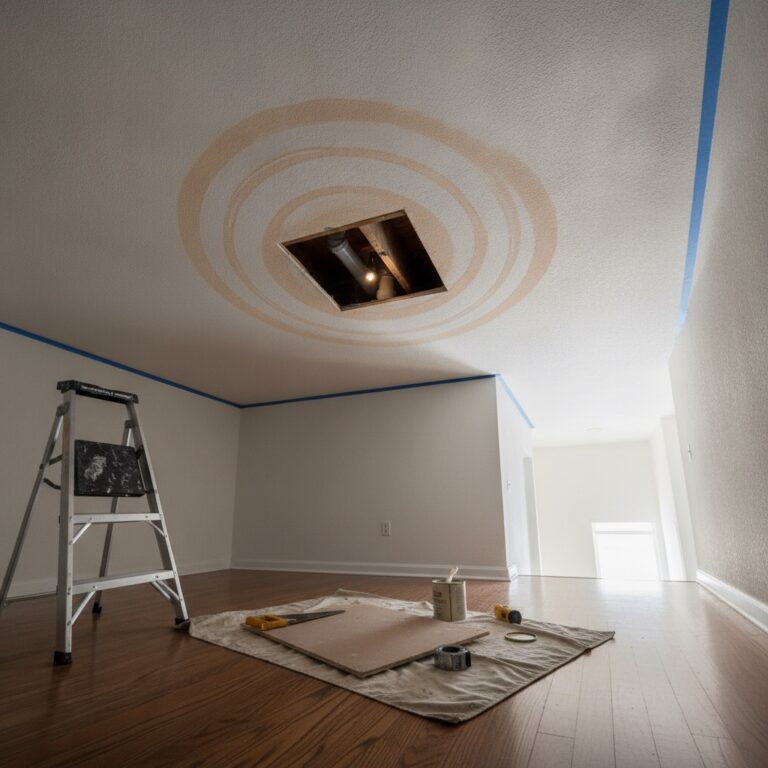
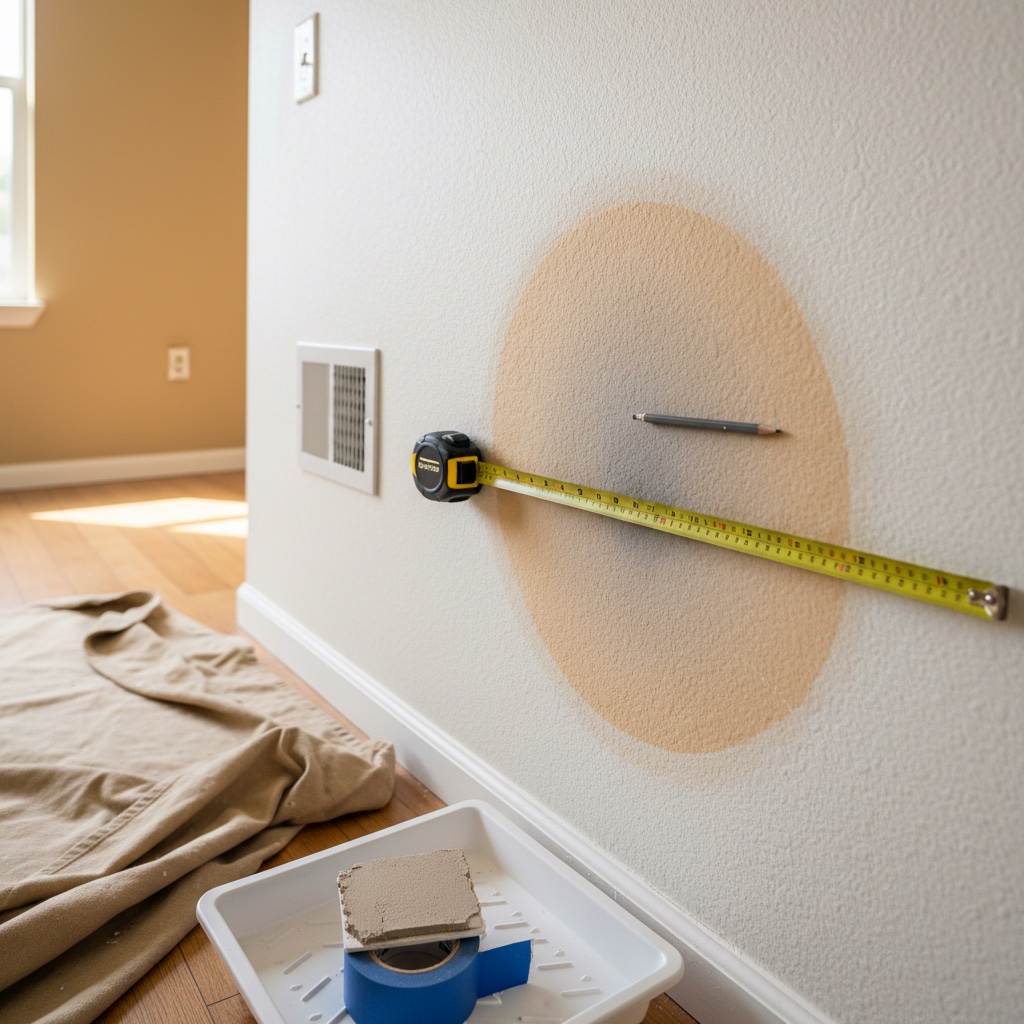
A round or oval stain sitting directly under or beside a ceiling supply vent is almost never a roof leak. Roofs leak in February. Vents leak in June. The shape gives it away. A roof leak tends to trace down a rafter or land at a recessed light can. An AC stain is a soft circle a few feet across, with a darker outer ring where the moisture wicked outward and a paler center where the drywall dried slightly between cycles.
That circle is condensate from the evaporator coil that did not make it out the drain line. A residential AC running through a hot SoCal afternoon can pull ten to twenty gallons of water out of the air per day, and all of that water has to ride a thin PVC line down to a wall stub or a roof gutter. When the line clogs, the pan above the air handler fills, and after a few hours the water finds the drywall. By the time you spot the stain, the gypsum has often been damp for two or three nights.
Where the water is coming from, ranked by likelihood
Five things cause that brown ring, and we see them in this order around Orange County and north San Diego. First, an algae-clogged primary condensate line. The drain pipe runs warm and wet all summer, and a slimy film builds inside the half-inch PVC. By June the slime closes the line, the pan backs up, and the secondary pan or the float switch is supposed to catch it. Often neither does.
Second, a rusted-through drain pan under an older builder-grade air handler. Pans from the early 2000s rust at the seam first. Water leaks straight through the metal even when the line is clear. Third, a frozen evaporator coil from a clogged filter or low refrigerant. The coil ices over, the ice thaws all at once when the system shuts off, and a gallon of water hits the pan in five minutes.
Fourth, a disconnected or sagging secondary drain line in the attic. Builders run a 3/4-inch emergency drain to the exterior, and it gets bumped loose by HVAC service or by attic insulation work. Fifth, supply duct sweat. A flex duct with damaged insulation drips condensation onto the drywall around the vent boot. That last one mimics a condensate stain almost exactly but stays small and shows up at the same spot every summer.
The 48-hour repair-versus-replace decision
The clock starts the moment that drywall got wet, not the moment you noticed the stain. If the paper face is still tight, the surface is dry to the touch, and a flashlight at a low angle shows no sag, the patch is honest and small. A pinhole opened up around the screw line, the panel was lucky, and a level-4 repair plus a primer and paint blend on that ceiling will be invisible.
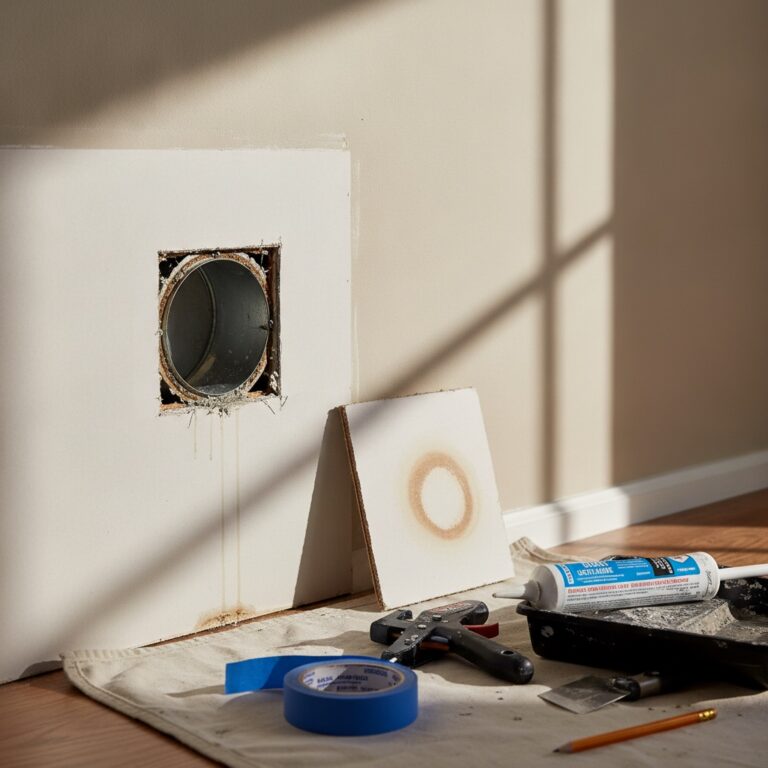
If the drywall has been wet for more than 48 hours, or the paper is soft, or there is any sag, replacement is the right call. Drywall that was saturated holds moisture in the gypsum core for weeks. Mold will start at the joist line above the panel before it shows on the painted face. Cutting back to sound material, drying the framing, and hanging fresh rock is the only honest fix. Anyone selling you a paint-over on saturated board is selling you a callback in October.
The 48-hour line shows up in every restoration guide for a reason. Past that mark, mold remediation is on the table, and a $550 drywall patch turns into a $3,200 remediation bill if the carrier sees mold growth in the cavity.
Real OC and SD cost ranges for June 2026
A clean single-spot repair on a ceiling, level-4 finish, prime and paint blended to the existing texture, runs $300 to $550 in most of Orange County. That assumes a 2-by-2 cut-out, no mold, no insulation soaked, and a flat or light orange peel ceiling. Knockdown ceilings add about $80 for the texture match. Smooth level-5 ceilings, common in newer Irvine and Lake Forest tracts, add $120 to $200 because the feather has to go further to disappear.
Partial replacement, where a 2-by-4 or 4-by-4 section comes out, climbs to $400 to $800 with the same finish work. Full panel replacement, plus framing dry-out, plus a tested re-tape across two joists, lands at $800 to $1,500. Add $300 to $800 for water damage restoration on the drying side if the carrier requires a mitigation invoice. Mold remediation, when needed, sits around $3,200 in Orange County and a little less in north San Diego.
The HVAC side of the fix is separate. A pro drain-line clean, with a wet-vac pull at the exterior stub and an algaecide tablet drop, runs $100 to $250. A new condensate pan, on an older indoor air handler, costs $300 to $600 installed. Catching the leak in the first week saves the difference between those two numbers and the four-figure ceiling rebuild.
The 20-minute check before you call
Three things to do this week, before the next heat run. Walk every supply vent in the house and look straight up at the drywall around the boot. Anything that looks faintly tan, faintly yellow, or shows a ring you have not seen before goes on the list. Then check the air handler closet or attic platform. If the secondary pan under the unit has any standing water, even a quarter inch, the primary drain is failing right now.
Last, run a finger along the exterior condensate stub, the white PVC sticking out of a stucco wall near the AC. It should drip during a hot afternoon. A dry stub on a 90-degree day means the water is going somewhere it should not. That is when to call us, before the ceiling tells you the same story in brown.
If you found a stain this week and want a second set of eyes before you decide what it is, we offer a free in-home assessment across Orange County and coastal San Diego. We pull back the panel where it makes sense, check the cavity, and price the repair against a full replace in writing. June is when the queue starts to fill. The Anaheim, Irvine, Costa Mesa, Yorba Linda, and Carlsbad routes book about two weeks out by late June, so an earlier call buys you a faster fix.
Morning-context sources used: Restoration24 of San Diego AC condensate leak guide (restoration24ofsandiego.com/ac-condensate-leaks-overflow), Keystone Water Damage Restoration San Diego Paradise Hills ceiling guide (keystonewaterdamagerestorationsandiego.com), LA HVAC LC drain line cleaning piece (lahvaclc.com/the-truth-about-ac-drain-line-cleaning), Angi 2026 drywall repair cost data (angi.com/articles/how-much-does-drywall-repair-cost-small-holes.htm), Homeblue Orange County drywall pricing (homeblue.com/drywall/orange-county-ca-drywall-repair-cost.htm), Genzryan 2026 AC drain line cleaning guide (genzryan.com/blog/how-to-clean-ac-drain-line), ACS Comfort AC tune-up summer 2026 (acscomfort.com/blog/ac-tune-up-summer-2026-guide).