Request Your Free Quote!

Six Weeks to a Quiet Home Office Before Summer Break Hits
How SoCal homeowners can soundproof a home office before summer break: STC, decoupling, mass, Green Glue, and realistic OC cost ranges to plan around.
The dishwasher hums under the kid’s Zoom class. The neighbor’s leaf blower hits at 9:47 every morning. The corner home office in a Mission Viejo two-story doubles as a quarterly board call by 1pm. Schools across Orange County, the Inland Empire, and San Diego release their kids between June 12 and June 22 this year. That puts the noisiest stretch of the calendar roughly three weeks out. A soundproofing remodel that lands before that window keeps the household working through summer with the door closed and the meeting actually private.
Home-office soundproofing is not a weekend caulking project. It opens walls, decouples drywall from the studs, adds mass, and re-finishes the room. Done well, the office reads as a sealed pocket of quiet. Done halfway, the homeowner spends $4,000 to $7,000 and still hears the dryer through the shared laundry wall.
Why The Next Six Weeks Are The Window
Today is a Thursday in late May. A consult booked this week lands the assessment in front of a kitchen table by next Tuesday. Demo can start the following Monday on a one-shared-wall job. Six weeks from today, the second-coat finish is dry, the casing is back on, and the room is quiet before the kids are home full time.
Most SoCal cities outside the coastal high-density blocks treat non-structural interior drywall as a no-permit job. Long Beach and parts of San Diego ask for plans when the assembly attaches to a fire-rated wall. Orange County’s unincorporated areas and the Inland Empire generally let the homeowner skip the permit office for a single-wall office soundproof. That matters because permit timelines, when they apply, often add two to three weeks. Six weeks goes to nine.
The other timing pressure is the trades. SoCal drywall crews book heavy from June through August every year. The crew running the resilient channel on a quiet office in May has time to focus on the small acoustic details. The same crew in late July is racing between three jobs and the channel screws get rushed.
Decoupling: Resilient Channel vs Sound Clips
Decoupling is the single biggest move on a home-office soundproof. The goal is to break the path that sound takes through the wall framing. Sound travels through structure like a tuning fork through a table. Cut the connection and the sound drops.
Two methods do the work. Resilient channel is a thin hat-shaped metal strip screwed to the studs. The drywall mounts to the channel, not the studs. Done right, the channel adds roughly STC 5 to STC 10 over standard drywall. Done wrong, with a screw landing through the channel into the stud, the assembly reads as if the channel was not there. A single misplaced screw shorts the decoupling. That is why most acoustic specialists treat resilient channel as a high-skill install.
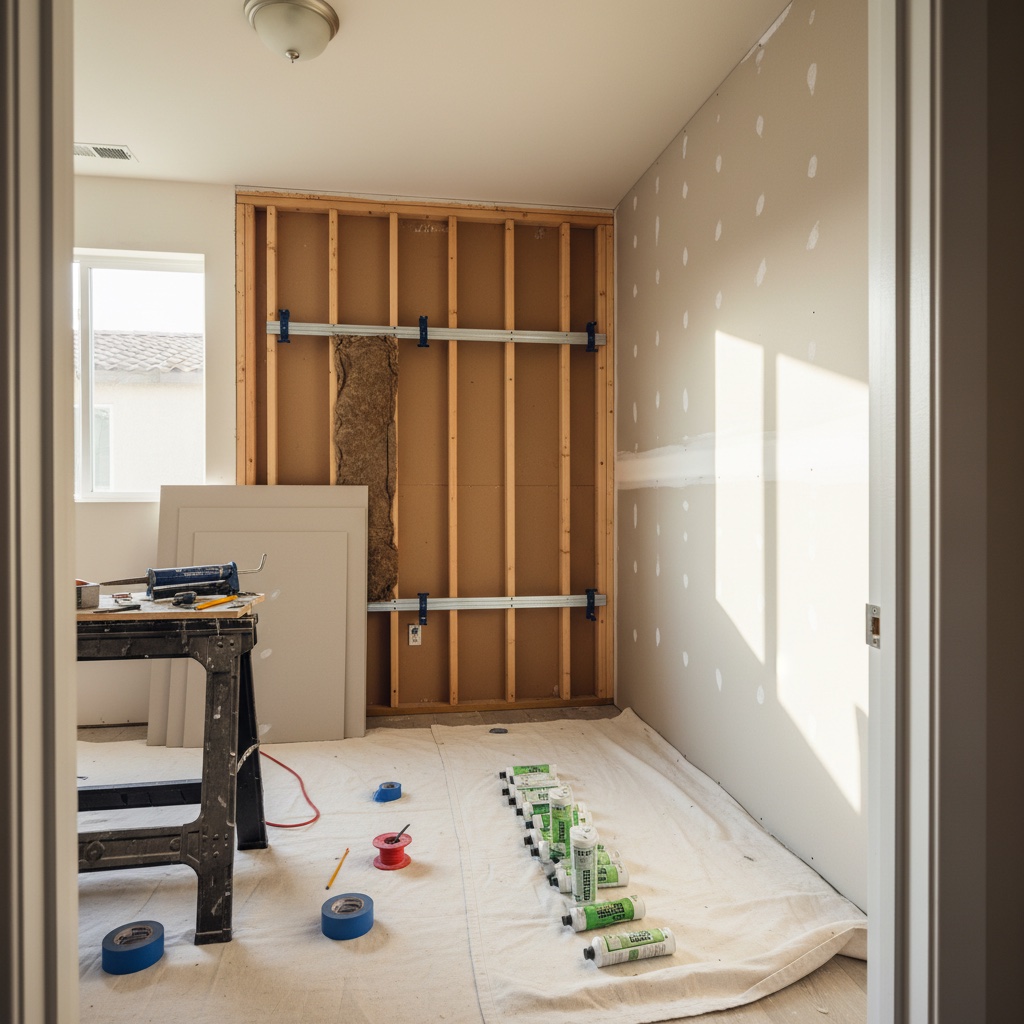
Sound isolation clips, also called whisper clips or resilient sound clips, use a rubber isolator between a steel clip and the framing. A drywall furring channel snaps into the clip. Drywall mounts to the furring channel. The rubber isolator does the decoupling work. Clips cost more per linear foot than resilient channel. The install is more forgiving. For a SoCal home office where the homeowner wants STC 55 or better and only one shared wall is in play, sound clips usually pencil out. The added material runs roughly $400 to $700 for a typical 10 by 12 office. The labor is similar to a resilient channel job.
The rule of thumb on a JNL Drywall consult: clips on the high-stakes wall shared with a noisy room, channel on a budget secondary wall, neither on a perimeter wall that already reads quiet.
Mass and Damping: Green Glue, Double 5/8, Mineral Wool
Decoupling alone is half the answer. Mass and damping carry the rest.
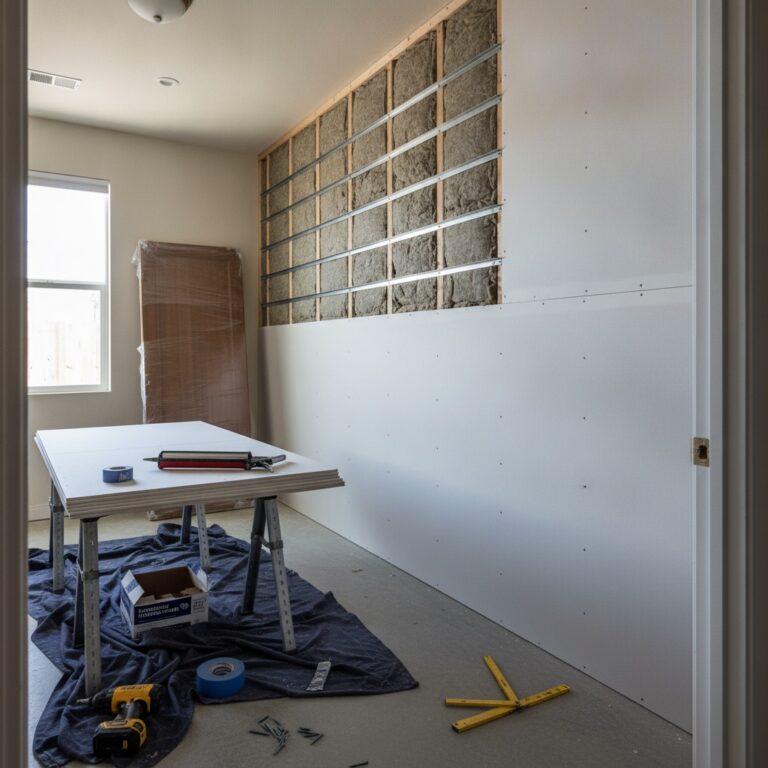
Mass means double 5/8 drywall instead of single 1/2. Two layers of 5/8 weigh roughly four times as much as one layer of 1/2. Weight blocks sound. Published lab data puts a standard stud wall with single 1/2 drywall at roughly STC 33. Add a second layer of 5/8 with a damping compound between the two layers and the same wall hits STC 52. Add isolation clips and the same assembly clears STC 60. That is the difference between hearing the dishwasher and not knowing it is running.
Green Glue is the damping compound most SoCal acoustic jobs use. It goes between the two layers of drywall. Two tubes per 4 by 8 sheet, applied in a random squiggle pattern, then the second sheet screws over the top. Green Glue performs best in the low frequencies that STC ratings underweight. That means actual perceived quiet exceeds what the STC number suggests. Cost runs about $30 to $40 per case, two cases per 4 by 8 sheet, so roughly $60 to $80 of compound per sheet of finished wall.
Mineral wool in the stud cavity does the absorption job. Roxul Safe-n-Sound or equivalent. The cavity needs to be full, not stuffed. Fiberglass also works at lower cost. The acoustic difference between the two is real but small. The bigger sin is leaving the cavity empty. An empty stud bay is a drum.
Acoustic sealant at the perimeter, the outlet boxes, and any penetration matters more than most homeowners expect. A small unsealed gap around an outlet drops the assembly’s real-world performance by several STC points. The job is not done until the caulk gun finishes.
Realistic Cost Ranges for an SoCal Home Office
A single-shared-wall soundproof on a 10 by 12 Orange County home office, with sound clips, double 5/8 drywall, Green Glue, mineral wool, and a level-4 finish, runs roughly $4,800 to $7,200. That figure includes demo, material, install, finishing, and paint on the one wall. The remaining three walls and the ceiling stay as they are.
A full-room soundproof, with all four walls and the ceiling treated, runs $11,000 to $18,000 depending on access, the existing ceiling finish, and whether the door slab and frame need an acoustic upgrade. A solid-core door with an automatic door bottom adds about $700 to $1,100 installed and is usually the single best dollar-for-dollar quiet improvement after the shared wall.
Costs in the Inland Empire run roughly 8 to 12 percent below OC for the same scope. San Diego coastal runs within a few percent of OC. Long Beach is generally on par with OC, with a small bump when a permit pulls into the timeline.
These ranges assume a level-4 finish on the new drywall. Level-5 on a soundproof job is rarely worth the upcharge. A home office takes minimal raking light and the wall is usually furnished with a desk, monitor, and shelving. Level-4 reads clean under the working light a homeowner actually uses.
The Six-Week Calendar From Today
A consult on the schedule this week sets the rest of the calendar. Week one is the in-home assessment, the noise-source walk, and the written scope. Week two is sign-off, material order, and demo planning. Week three is demo on the shared wall. Week four is framing prep, clip or channel install, mineral wool, and the first 5/8 sheet. Week five is Green Glue and the second 5/8 sheet, then tape and first mud coats. Week six is finish coats, prime, paint, casing and baseboard back on, and the final walk.
A free in-home assessment from JNL Drywall covers the noise-source walk, the scope write-up, and a number that holds for sixty days. The next available consult slot before summer break sits inside the next ten business days. A call today puts demo on the schedule for the second week of June and the final paint on a week before most SoCal kids are home for the summer. Bring the meeting back into the office. The dryer can stay loud.
Morning-context sources used: Robert Half remote work statistics and trends for 2026; SurveyMonkey 2026 remote and hybrid work trends; Gable.to remote work trends 2026; Houzz Renovation Nation 9 home remodeling trends for 2026; Soundproofing Company STC ratings primer; TM Soundproofing Green Glue data and comparison; BKL technical note on resilient channel installation.