Request Your Free Quote!

What June Afternoon Light Does to a SoCal Drywall Finish
June afternoons in SoCal rake across west walls and surface every drywall flaw a level-4 finish hides. Here is what shows, what to fix, what it costs.
A west-facing living room in Newport Beach reads spotless at 10 a.m. The marine layer is still in. The light is soft and gray, and the wall behind the couch looks finished. By 2:30 p.m. the layer has burned off, the sun has dropped a few degrees, and a homeowner standing in the kitchen can suddenly see every sanding swirl, every taped seam, and a faint roller mark that the morning light never showed. Nothing changed on that wall. The light changed.
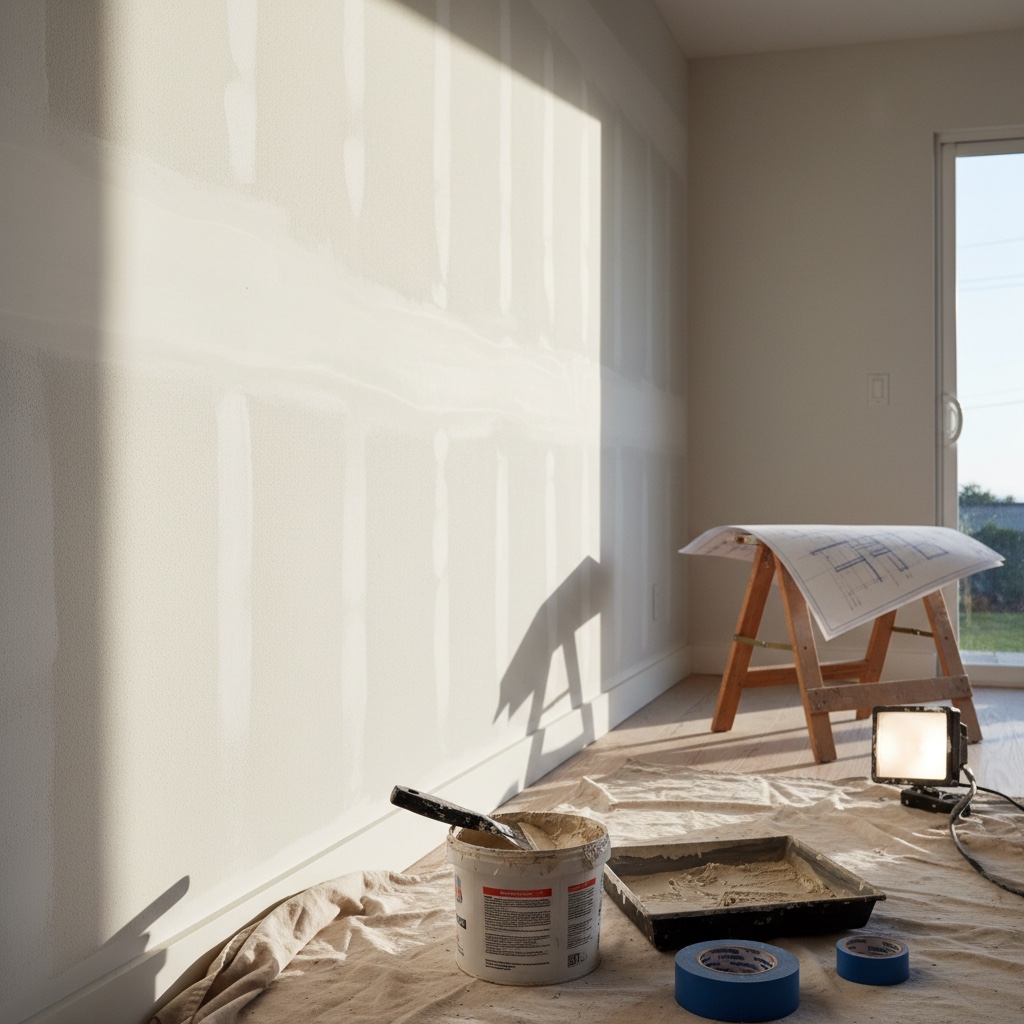
This is the part of summer that catches SoCal homeowners by surprise. The June marine layer typically sits over the coast until early afternoon, then breaks, and the angle of the sun in early June drives daylight almost parallel to the wall plane in west-facing rooms. That sideways light is called critical lighting, and it is the most honest test a drywall finish ever gets.
What the June afternoon does to a wall
Critical lighting means a strong light source aimed roughly parallel to a wall surface. Coastal meteorology guides put the SoCal marine layer at peak strength in early June, with afternoon clearing often pushed past 2 p.m. Once that low gray ceiling lifts, the western sun comes in at a sharp horizontal angle through patio doors, picture windows, and clerestories. Light that was diffuse all morning becomes a flashlight on the side of every wall.
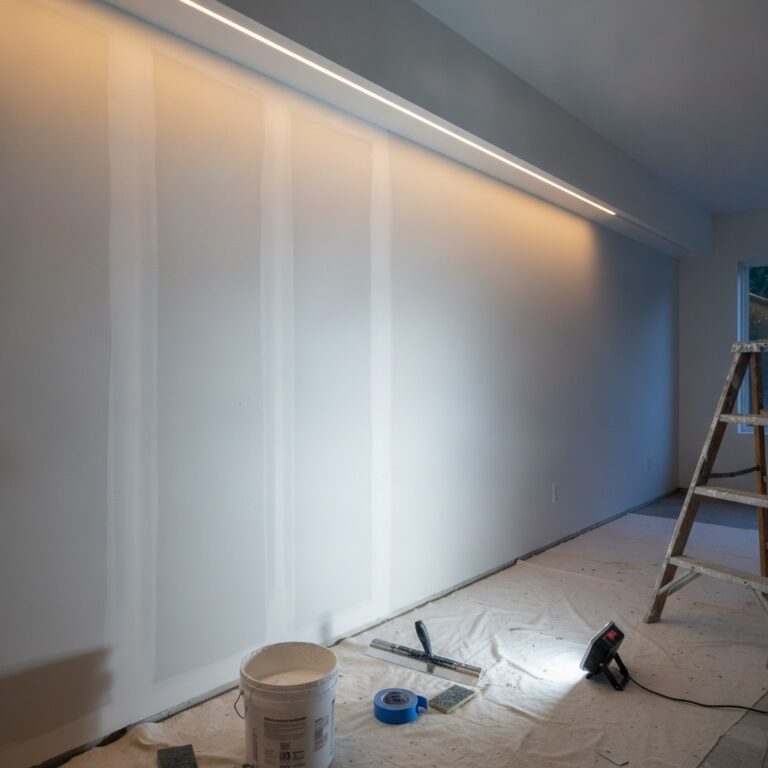
When light hits a wall at a steep angle, two things happen. The smooth areas of joint compound reflect the light cleanly. The paper face of the drywall, which has a slightly rougher tooth, scatters that light differently. Every joint, every sanded scar, every roller line picks up a faint shadow on one side and a faint highlight on the other. The wall stops reading as one surface and starts reading as a quilt.
This is why the wall behind a west-facing sliding door in Huntington Beach or a south-facing kitchen window in Lake Forest can look fine all winter and start to show every patch by mid-June. The defects were always there. Coastal light kept them hidden until the sun rotated.
The flaws that only show up after the layer burns off
Five flaws come out under June afternoon light again and again. Taped seams finished to a competent level-4 standard but never given a final skim show as faint horizontal or vertical lines, usually two feet apart vertically or four feet apart horizontally. Nail and screw pops show as small round shadows the size of a dime. Crown-of-the-bead lines along corners read as a faint vertical highlight running floor to ceiling. Roller stipple from a satin or semi-gloss paint reads as a soft orange-peel pattern on what should be a smooth wall. And anywhere a patch was made and feathered too tight, the patch itself shows as a halo about a foot wider than the original repair.
None of these are emergencies. None of them mean the wall is failing. They mean the finish quality and the light quality finally met each other.
Level-4 vs level-5 and where the line really sits
A level-4 drywall finish is the residential standard. Three coats of compound on the joints, sanded smooth, ready for paint. It is what almost every tract home and most remodels in Orange County get. Most current finish guides agree that level-4 reads clean under typical overhead and diffuse lighting, which is most of the day in most rooms.
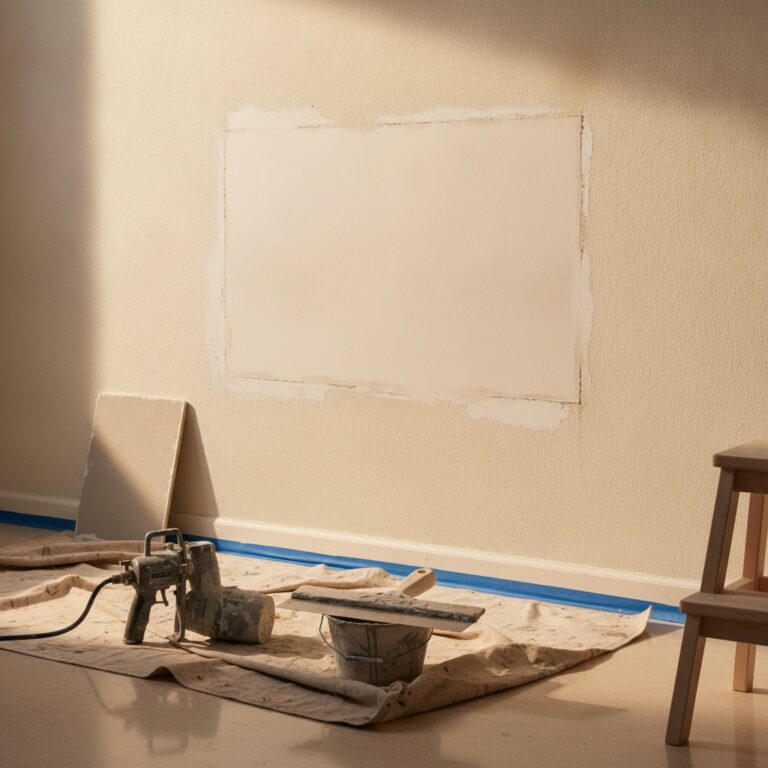
Level-5 adds a thin skim coat across the entire wall, not just the joints. The whole surface becomes one continuous plane of joint compound. That single extra step is the difference between a wall that reads clean at 10 a.m. and a wall that reads clean at 4 p.m. on a June afternoon with sun coming through a west-facing window.
The line, in plain talk: any wall that catches direct low-angle sunlight for more than an hour a day deserves a level-5 finish. Any wall that will get a satin or semi-gloss paint deserves a level-5 finish. Any feature wall the room is built around deserves a level-5 finish. Everything else can live at level-4.
Texture choices that forgive summer light
For walls that are not getting taken to level-5, texture is the next move. Smooth walls are unforgiving in critical light. Orange peel hides minor sanding marks and small patches more honestly than knockdown because the droplet pattern is uniform and the spread is consistent. Knockdown, with its leather-like irregular pattern, hides bigger defects but can read busier when the afternoon sun grazes across it. Industry repair guides this spring make the same point a second way: orange peel is the easier texture to match on a patch, knockdown is harder because the timing of the knife pass changes the pattern.
For west-facing rooms with a lot of late-day sun, the safest moves are a level-5 smooth finish in flat or matte paint, or an orange peel with a careful color and sheen match. A knockdown in a west room with a 5 p.m. sun is the riskiest choice of the three. That does not mean it cannot work. It means the matching and the lighting both have to be planned, not assumed.
What this costs in OC and when to actually fix it
For the 2026 SoCal market, a level-4 drywall finish from a quality contractor runs $2.25 to $3.00 per square foot of wall area, hung and finished. A level-5 finish adds $0.50 to $1.00 per square foot, which puts the total at roughly $2.75 to $4.00 per square foot for the kind of west-room work this article describes. National calculators put the level-5 range a touch lower, but California labor pushes the OC number to the higher end. On a 14 by 18 living room with one west wall taken to level-5, that is usually $700 to $1,200 of finish work on top of any other scope.
The decision threshold is not about perfection. It is about whether the homeowner is going to keep noticing the flaw every afternoon. If the wall is behind a TV and only seen straight on, level-4 stays. If the wall is the first thing visible when walking in from the patio at 4 p.m., level-5 earns its money.
A two-week timeline is realistic for a single-room reskim in a lived-in OC house. Day one is mask and prep. Days two and three are skim coat. Day four is sand. Day five is prime. Days six and seven are paint. The rest is curing, touch-up, and a final afternoon walk in the same light the original problem showed up in. That last walk is the test that matters.
If a west-facing room in your house started showing flaws this month that were not there in March, we are happy to come out and look at it in afternoon light, name what is actually there, and write up the level-4 vs level-5 decision for the specific wall. A free in-home assessment usually takes thirty minutes and ends with a one-page scope you can sit on for a week before deciding.
Morning-context sources used: Q&A Home Inspections, Common Drywall Textures (Jan 2026); DataDrivenAEC, Drywall Finish Levels Guide (2026); Bhumi, Drywall Cost Per Sq Foot 2026; Triforce, Orange Peel and Knockdown Texture Guide (April 2026); CostFlowAI, Drywall Cost Calculator 2026; SD Model Climate and Lighting Calendar 2026.