Request Your Free Quote!

Smooth Ceilings Before the Holidays: A September Timeline
Want popcorn gone before Thanksgiving? Here is the September-to-November timeline, the SoCal asbestos test, and real Orange County smooth-ceiling costs.
A 1978 tract house in Fountain Valley carries roughly 1,400 square feet of popcorn ceiling across the main floor. In September nobody notices it. By the third week of November, with the table extended and every lamp switched on, that ceiling reads like a texture nobody has picked on purpose in forty years. Homeowners who want it gone before Thanksgiving have about nine weeks left. That is enough time. It stops being enough time around the second week of October.
What Smooth Actually Changes in a Room
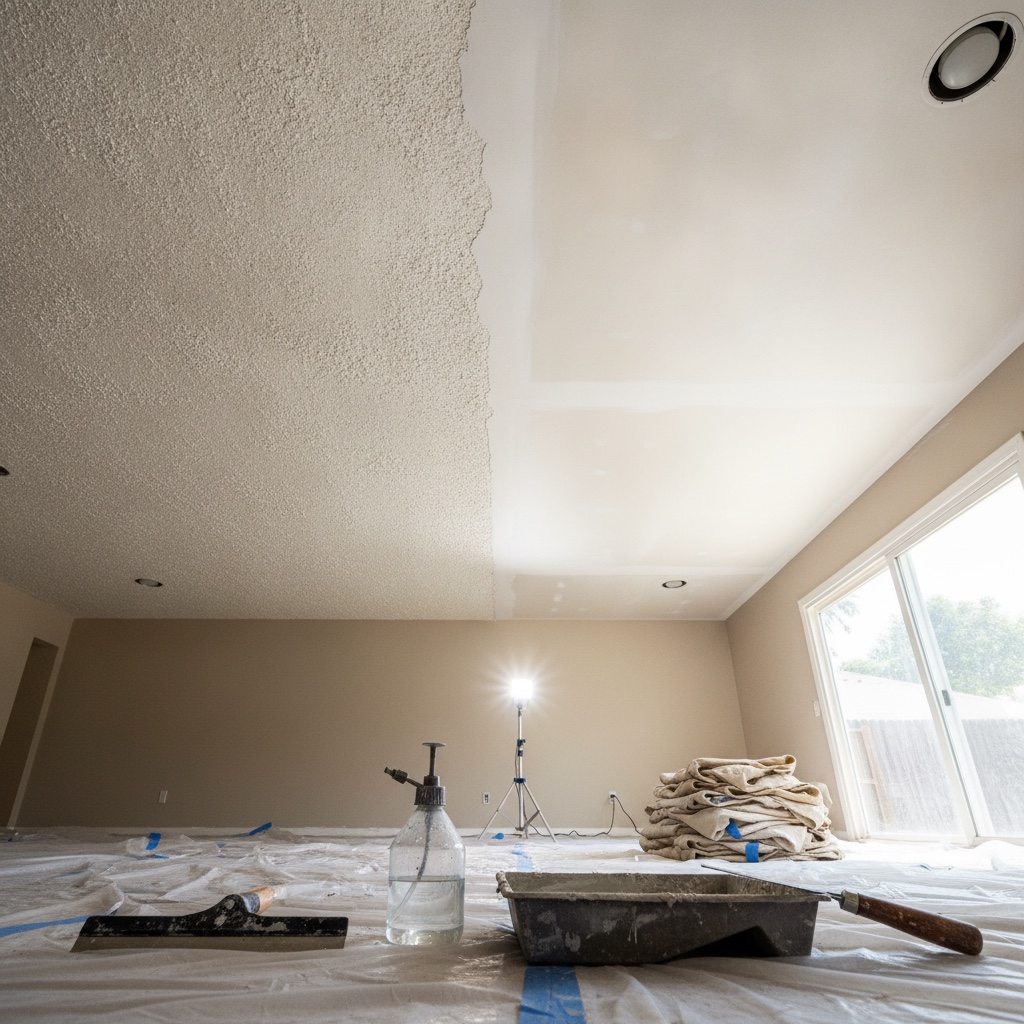
Popcorn is a field of small shadows. Every bump casts one down and sideways, so the ceiling reads soft gray even when the paint is flat white. Take the texture off and the same room picks up light it was already receiving. Recessed cans stop scalloping. A 4pm fall sun coming through a west-facing slider in Costa Mesa hits a smooth ceiling and bounces instead of getting caught in a million little pockets. Most homeowners describe the finished room as brighter. What changed was reflectance, not wattage.
The other change is honesty. Popcorn hides framing waves, bad butt joints, and old patches. A smooth ceiling hides nothing. That is why the finish work matters more than the scraping, and why a cheap smooth ceiling looks worse than the popcorn it replaced. Anybody quoting a scrape-and-paint number without talking about how flat the substrate is underneath has skipped the part that decides whether the room looks right in December light.
The September Calendar Math
Work backward from the date guests arrive. A single-room ceiling in a 14 by 16 bedroom runs three to five working days start to finish: test, mask, scrape, skim, sand, prime, paint. A whole main level of 1,200 to 1,800 square feet runs two to three weeks of crew time, and that assumes no asbestos and no surprise repairs above the drywall.
Then add the parts that are not crew time. An asbestos sample takes two to five business days at the lab. If it comes back positive, abatement adds a licensed contractor, a scheduling window, and often two more weeks. Paint needs to cure before furniture comes back in. Add a week of slack, because there is always a week of slack. Nine weeks out from Thanksgiving is comfortable. Five weeks out means either one room or a January start.
The other reason to call in September is that everybody else calls in October. Harvard’s Joint Center for Housing Studies counted more than 128,000 residential remodeling contractor establishments nationwide in 2022, up a quarter in five years, and even with that growth the fall booking window in Orange County tightens every season. Crews that finish holiday work by the third week of November are spoken for by mid-October. The homeowner who calls after Halloween is not choosing a start date. The calendar is choosing it for them.
Test Before Anybody Scrapes
This step is not optional in Southern California. Popcorn installed before the mid-1980s can carry chrysotile asbestos, commonly in the 1 to 10 percent range by weight. South Coast AQMD Rule 1403 requires an asbestos survey before renovation or demolition that could disturb the material, and Cal/OSHA carries its own requirements on top of that. A homeowner scraping a 1972 ceiling with a garden sprayer and a floor scraper is not saving money. That homeowner is putting a regulated material into the air of a house where people sleep.
A lab sample costs $50 to $175. Three samples from different rooms is the usual ask, because texture often went up in batches and one negative result does not clear the whole house. If the results come back clean, work starts immediately. If a sample is positive, the ceiling still comes down, just under containment by a licensed abatement contractor, which typically adds $3 to $7 per square foot before any drywall finishing begins.
What the Refresh Costs in Orange County
Scraping alone runs $1 to $2 per square foot. Retexture or skim runs another $1 to $2, and prime plus paint adds a similar amount. National 2026 pricing data puts a typical popcorn removal project between roughly $950 and $3,100, averaging near $2,000. Orange County labor sits in the upper half of those ranges, and coastal cities run higher than inland.
Real numbers for a real house: a 320 square foot living room ceiling, scraped, skimmed flat, primed and painted, generally lands between $1,300 and $2,200 in Tustin or Orange. A full 1,500 square foot main level runs $5,000 to $9,000 depending on ceiling height, how many cans and vents need cutting around, and whether the substrate needs float work. Nine-foot flats and vaulted entries push toward the top of that band.
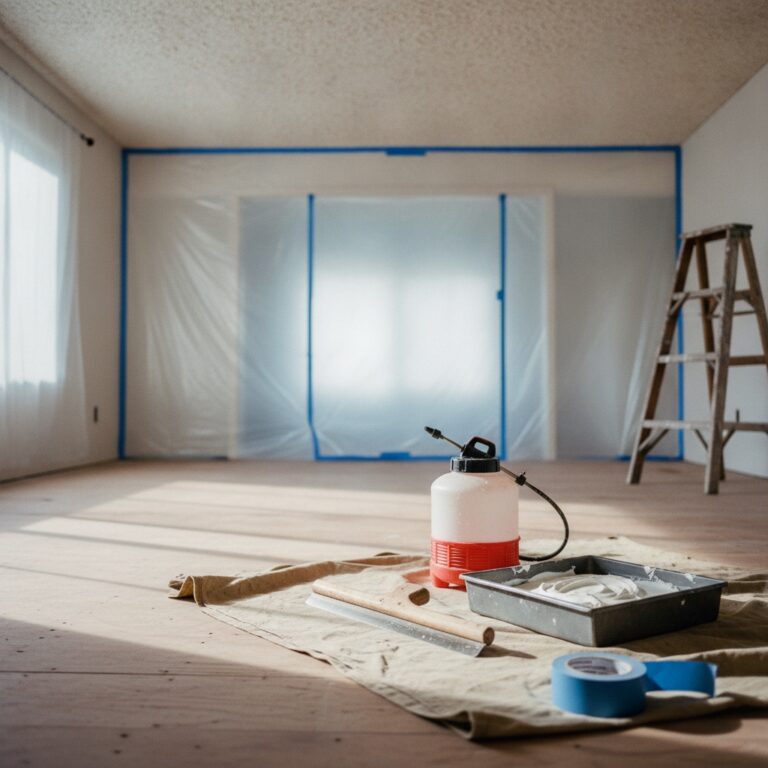
Two costs get forgotten. Furniture has to go somewhere, and dust containment is real labor, not a courtesy. A crew that hangs plastic properly, seals returns, and runs an air scrubber is charging for that time. A crew that skips it charges the homeowner later, in the form of drywall dust living in the HVAC system through January.
Level 4 or Level 5 Overhead
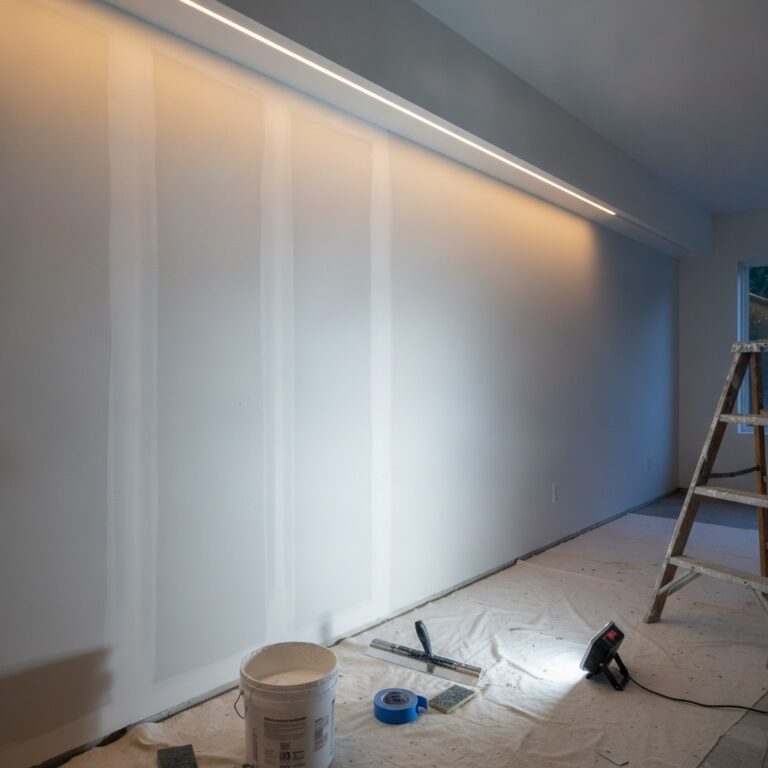
Ceilings are the hardest surface in the house to finish, because light travels along them instead of striking them head on. A level-4 ceiling gets tape, three coats over fasteners and joints, and paint. It looks fine under diffuse light. Put a row of recessed cans washing down that plane and level 4 will show every joint as a soft ridge running the length of the room.
Level 5 adds a thin skim coat across the entire surface, evening out the difference in porosity and texture between mudded areas and bare paper face. Under critical lighting, that is the difference between a ceiling that reads flat and one that reads patched. Expect roughly $0.75 to $1.50 more per square foot. For a dining room that will sit under a chandelier and hold the eye all evening, the upgrade earns its keep. For a bedroom with one center fixture, level 4 is the honest call.
One more decision worth making early: where the smooth stops. Most fall projects do not cover the whole house, and the transition line is what people actually see. Ending at a doorway header, a beam, or a change in ceiling height reads intentional. Ending halfway down a hallway reads like the money ran out. Pick that line during the walkthrough, before anybody masks a single wall, and the phased approach looks like a plan rather than an unfinished job through the holidays.
September is the quiet stretch of the fall calendar and the right moment to make this call. JNL Drywall walks the house, measures actual square footage, and runs a work light down the ceiling plane so a homeowner can see exactly what the popcorn has been hiding, then puts a written scope and a real start date on paper. The in-home assessment is free. Booked in September, a Thanksgiving deadline is a schedule. Booked in November, it is a wish.
Morning-context sources used: https://www.jchs.harvard.edu/blog/bigger-market-more-players-what-20-years-data-reveal-about-remodeling-industry (Aug 20, 2026); https://www.jchs.harvard.edu/blog/unmet-repairs-leave-millions-exposed-extreme-indoor-heat (Aug 26, 2026); https://www.angi.com/articles/how-much-does-popcorn-ceiling-removal-cost.htm (2026 cost data); https://www.ellisenvironmental.com/blog/asbestos-requirements-cal-osha-vs-scaqmd (SCAQMD Rule 1403 vs Cal/OSHA); https://www.certainteed.com/level-5-drywall (level-5 finish standard); https://www.houzz.com/magazine/8-home-remodeling-trends-to-watch-in-2026-stsetivw-vs~184900545 (2026 remodeling trends).