Request Your Free Quote!

Seal These Wall Gaps Before the First Atmospheric River
A record El Nino winter is coming to SoCal. Here are the five wall and roof penetrations that soak drywall, how to read the stain, and OC repair costs.
On September 6 the first measurable rain in months landed on Southern California. Downtown Los Angeles logged 0.70 inches and broke a record set in 1965. Long Beach Airport hit 0.68 inches against an old mark of 0.12 inches. Orange County got off light, a quarter inch to a half inch in most neighborhoods. Two weeks later the calls start anyway: a yellow ring on a hallway ceiling in Fullerton, a dark smudge above a slider in Huntington Beach. Half an inch of rain found something. December is going to find a lot more.
The Climate Prediction Center’s September 10 discussion put the odds of a very strong El Nino this fall and winter above 90 percent, with a 75 percent chance the October through December season runs stronger than any event on record since 1950. Its winter outlook favors above-normal rain for coastal California from December into April, with the wettest stretch landing January through March. LA County has already told residents to clear drains and fix roof leaks now, and reminded everyone that flood insurance takes about 30 days to activate.
Here is the part homeowners miss. Water almost never comes through the middle of a roof or the middle of a stucco wall. It comes through a hole somebody cut on purpose. Every vent, pipe, light, hose bib and mount is a hole with a seal around it, and those seals are what age out. Seal them in October and the drywall behind them stays boring all winter.
The Penetrations That Soak SoCal Drywall
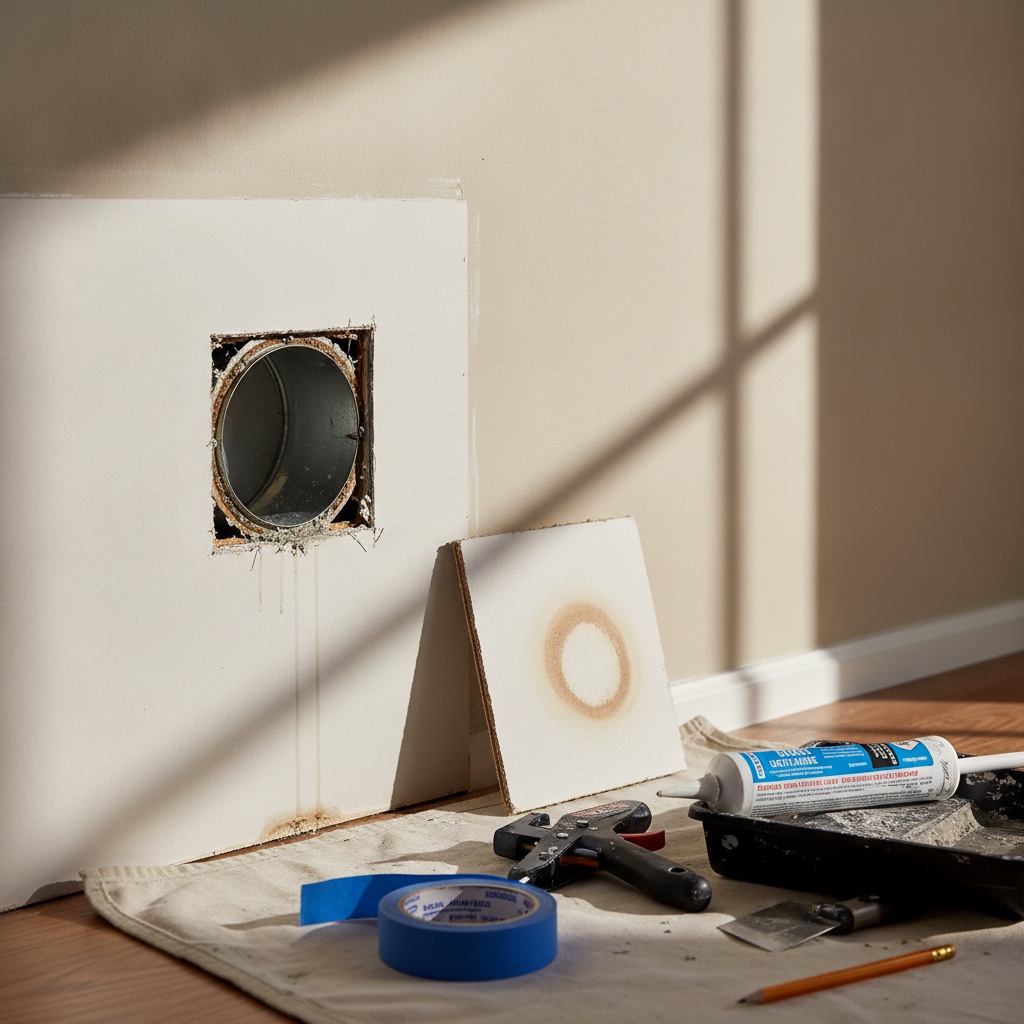
Five spots account for most of the interior water damage seen on tract homes from Costa Mesa to Rancho Santa Margarita. First, plumbing vent boots on the roof. The rubber collar on a 2-inch ABS vent cracks after about 10 to 15 years of SoCal sun, and the leak lands in the ceiling field directly below it. Second, dryer and bath fan caps in exterior walls. Their flappers stick open, the caulk bead at the stucco shrinks, and wind-driven rain walks right in behind the flange.
Third, hose bibs and electrical penetrations. The escutcheon is decorative, not a seal, and the sleeve behind it is often unsealed foam or nothing at all. Fourth, the stucco-to-window transition, especially on west and south elevations that take the most sun and the most wind. Fifth, weep screed at the base of the stucco buried by a raised planter or a new concrete pour. That one wicks upward and shows as a moisture line 6 to 10 inches above the baseboard, usually long after the rain stops.
A tube of high-grade urethane or hybrid polymer sealant runs about 12 dollars and handles most of these. Silicone on stucco will fail and will not take paint, so skip it. The real work is a ladder, an hour, and honest eyes on the four elevations plus the roof penetrations. Do that in October, not in a January downpour with a flashlight.
Reading the Stain Before You Cut Anything
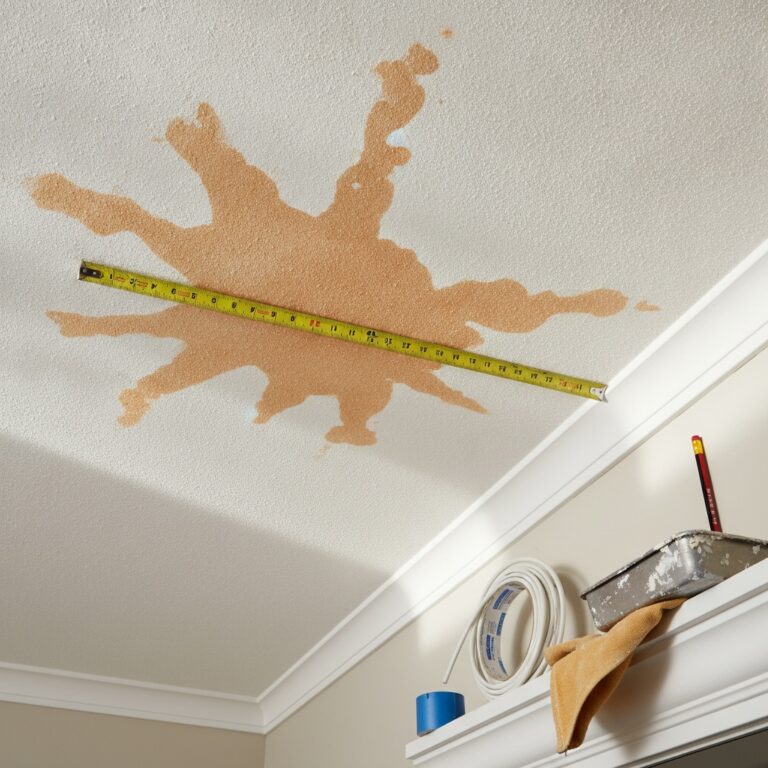
The stain is evidence. Color first. A sharp brown or yellow ring with a crisp edge means slow and repeated wetting, usually months of it, with dissolved paper sizing carried to the drying edge. Gray or dark and soft at the border means the water is still there. Rust-tinted usually means it traveled across metal, a corner bead, a strap, a hanger, or a vent flange.
Shape and location matter more than size. Concentric rings are the signature of a storm-driven leak that wets, dries, and wets again. A stain within 2 to 3 feet of an exterior wall top plate points to wind-driven intrusion at a wall penetration, not a roof field failure. A stain centered in the open ceiling of a room, away from any wall, points up at a vent boot, a roof-mounted unit, or a supply line in the attic.
Then touch it. Press the ceiling with two fingers well away from the darkest point. Firm board with a surface stain is a finish problem. Board that gives, dimples, or feels like wet cardboard has lost its gypsum core bond and will not come back no matter what primer goes on it. Bubbled or lifted joint tape means the joint compound has already released. That is a cut-out, not a touch-up.
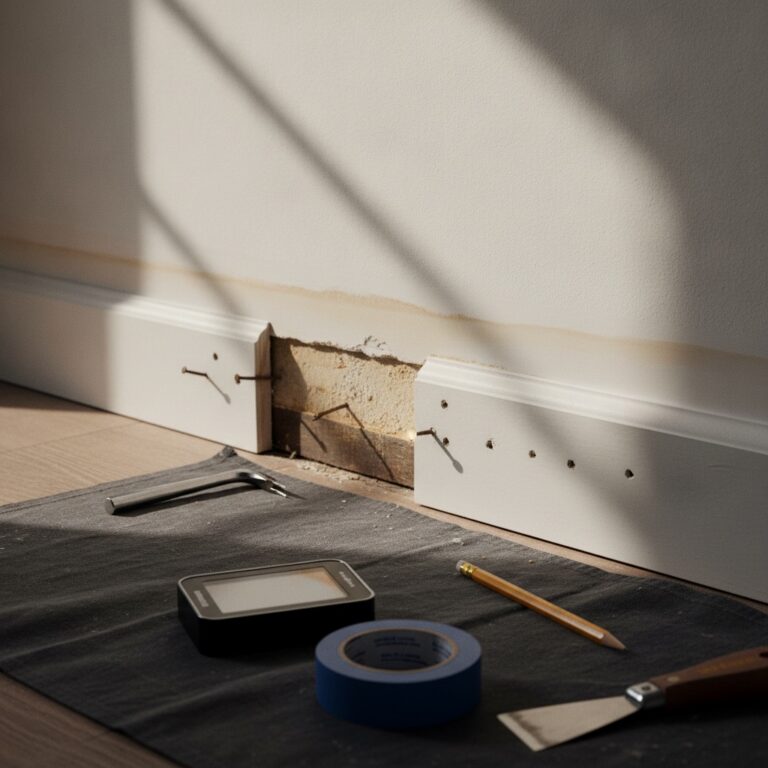
A moisture meter helps, but read it correctly. The absolute number matters less than the contrast between readings. Take six to eight readings across the same wall or ceiling, starting well outside the stain and working in, and write them down in order. A zone that reads consistently higher than its dry neighbors is wet drywall, whatever the display says. One high reading in isolation usually means a stud, a nail plate, or a foil-faced batt behind the board, not water. Pinless meters are fine on smooth walls and useless on heavy knockdown, where the sensor cannot sit flat against the surface.
Plumbing, Roof, or HVAC: Sorting the Three
These three sources get confused constantly, and the fix for each is different. A roof or penetration leak is weather-linked. It shows up during or within a day of rain, it dries between storms, and it grows in rings. If a Huntington Beach ceiling stained on September 7 and nothing has changed since, the source is almost certainly weather-driven.
A supply or drain leak ignores the weather. It stains on a clear 88-degree week in Anaheim. Supply leaks tend to run steady and produce a soft, expanding wet area. Drain and shower-pan leaks show up only when a fixture runs, which is why the stain under a second-floor bathroom grows on Sunday laundry day and rests on Tuesday.
HVAC condensate is the sneaky one. A clogged condensate line backs up and drips onto ceiling drywall directly under the air handler or along the pan’s low corner. It runs in the heat, not the rain, and it is the most common cause of summer ceiling stains in Orange County. If the stain first appeared in August near a closet or attic unit, start with the drain pan and the secondary pan switch before anyone touches the roof.
Source first, drywall second, every single time. A patch over a live leak is a 400-dollar receipt for a stain that returns in six weeks, slightly larger and now with a mold question attached. Any contractor who offers to cut and finish before the source is identified and verified dry is selling a repeat visit. The order never changes: find it, stop it, dry the cavity for two or three days with air moving, then close it up.
Repair, Cut Out, or Replace: What It Runs in OC
Once the source is dead and the cavity is dry, three thresholds decide the work. Threshold one, cosmetic. The stain is smaller than a dinner plate, the board is firm, and the tape is intact. Stain-blocking oil or shellac primer plus a texture touch-up and paint typically lands between 150 and 400 dollars, and a single-color wall often lets a crew stop at the corner break instead of repainting the room.
Threshold two, cut and patch. The board is soft, the tape has lifted, or the stain runs past about 16 inches. Current national data puts a patch of that size around 300 to 465 dollars, and Orange County tends to sit at the upper half of that because of texture matching. Knockdown and orange peel are the difference between a repair nobody notices and a repair everybody notices from the doorway.
Threshold three, replace the section. Sagging ceiling board, delaminated face paper, wet insulation above, or anything that sat wet past 48 hours belongs in a trash bag. Mold colonizes wet gypsum inside 24 to 48 hours, and remediation on a drywall-scale problem adds roughly 150 to 350 dollars on top of the carpentry. Full water-damaged drywall jobs commonly run 600 to 1,550 dollars, and a ceiling that needs new rock hung, taped and finished sits around 2.50 to 4.50 per square foot at a level-4 finish, closer to 3.50 to 6.00 at level 5 where side light will show every imperfection.
The honest math is that sealing a dozen penetrations costs an afternoon and a hundred dollars of material. A January ceiling repair with mold remediation, insulation replacement, texture matching and paint clears 2,000 without trying hard. This is one of the rare cases where the cheap fix and the right fix are the same fix.
If a stain is already up there and the diagnosis is unclear, do not guess and do not paint over it. JNL Drywall does free in-home assessments across Orange County, the Inland Empire and coastal San Diego. We will read the stain, meter the area, tell you plainly whether it is a 200-dollar touch-up or a cut-out, and put the number in writing before anything gets opened. Get it on the calendar before the first real storm makes that appointment urgent.
Morning-context sources used: NOAA Climate Prediction Center ENSO Diagnostic Discussion, September 10, 2026 (https://www.cpc.ncep.noaa.gov/products/analysis_monitoring/enso_disc_sep2026/ensodisc.shtml); NBC Los Angeles, “See September storm rain totals in Los Angeles County,” September 7, 2026 (https://www.nbclosangeles.com/weather-news/la-rainfall-totals-september-2026-storm/3938392/); Santa Monica Daily Press, “County outlines El Nino storm preparations as forecasters warn of historic season,” September 4, 2026 (https://www.smdp.com/county-outlines-el-nino-storm-preparations-as-forecasters-warn-of-historic-season/); NBC Los Angeles, “County, emergency officials brace for possible strong El Nino season” (https://www.nbclosangeles.com/news/local/el-nino-preparations-southern-california/3936514/); Homewyse, “Cost to Repair Ceiling Water Damage,” 2026 (https://www.homewyse.com/services/cost_to_repair_ceiling_water_damage.html); HomeGuide, “How Much Does It Cost to Replace or Repair a Ceiling?” 2026 (https://homeguide.com/costs/ceiling-repair-cost).