Request Your Free Quote!

Wet Ceiling After the Storm? First Find Out If It’s Plaster
Plaster and drywall fail differently when a storm leak soaks them. How to tell which ceiling you have, what to check, and typical OC repair costs.
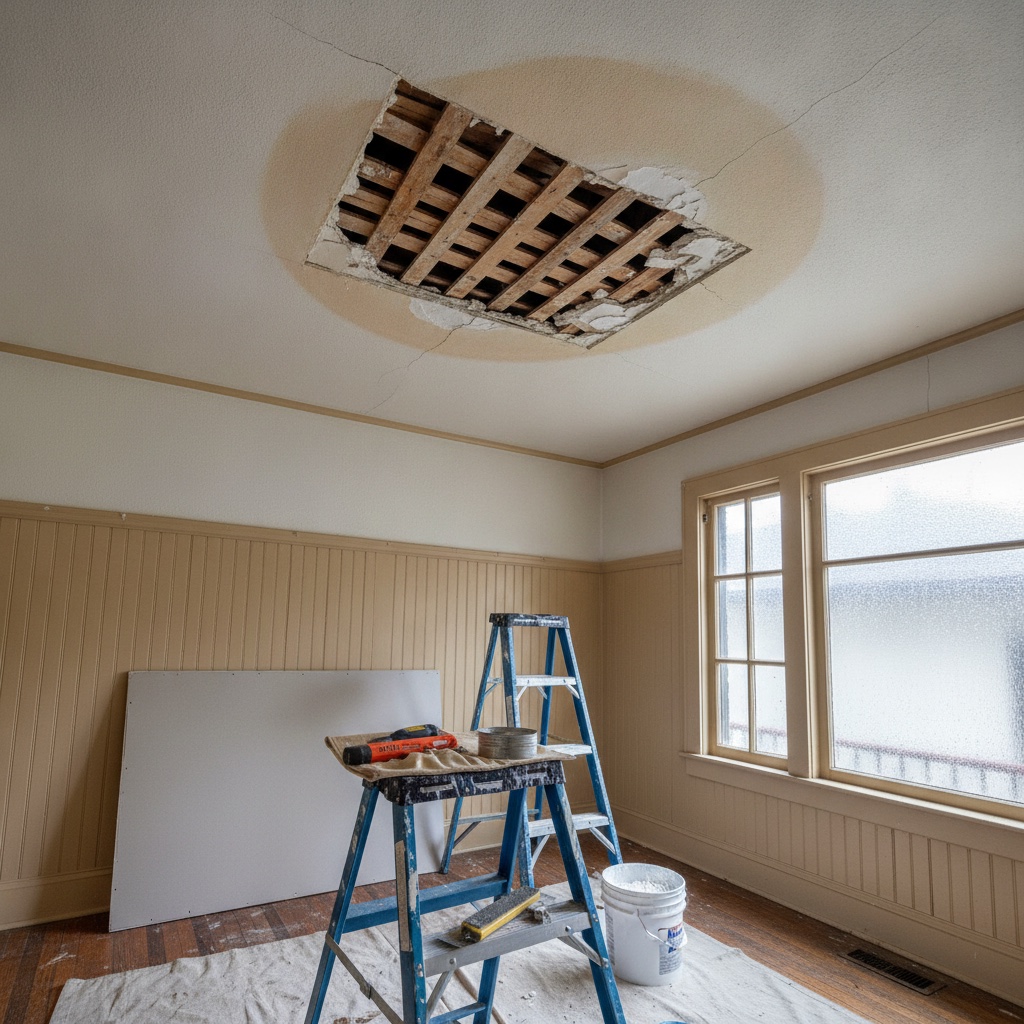
Picture a 1931 house in Long Beach’s California Heights the Friday after last week’s storm. A tea-colored ring has opened up over the dining room, about 30 inches across, and a hairline crack runs from it toward the window. The owner assumes it’s a drywall patch. It isn’t. The ceiling is three coats of plaster over wood lath, and that changes almost everything about the repair, the cost, and how fast it has to happen.
Why the Storm Made This Week’s Question Urgent
The second atmospheric river of the season rolled through Southern California from late Tuesday, November 17 into Thursday. The National Weather Service forecast 1 to 3 inches region-wide and 2 to 5 inches on south-facing foothills, with the LA and San Diego metro areas inside Thursday’s flood-risk zone. Wind gusts of 40 to 60 mph hit the mountains. That combination of wind-driven rain and a long soak finds every tired roof flashing, cracked vent boot, and clogged gutter in the region.
Forecasters are already watching the next system. The Climate Prediction Center flagged a moderate risk of heavy rain for Northern California on November 24 and 25, with a slight risk spreading across the West through November 30. Whether or not it reaches Orange County, the stains from last week are drying right now. That is the moment to figure out what kind of ceiling you have, because plaster and drywall fail in very different ways when they get wet.
How to Tell Which Ceiling You Have
Start with the age of the house. Most homes in Orange County, the Inland Empire, and San Diego built after about 1955 have drywall. Tract neighborhoods in Irvine, Mission Viejo, Tustin, and Corona are almost all gypsum board. Older pockets are a different story: Long Beach’s Bixby Knolls and California Heights, Santa Ana’s Floral Park and French Park, Old Towne Orange, North Park in San Diego, and downtown Riverside all have plenty of plaster still in place.
A few quick tests settle it without opening anything up:
- Knock with a knuckle. Drywall sounds hollow between framing members. Plaster sounds solid and dense almost everywhere.
- Push a thumbtack in. It slides into drywall easily. Plaster resists and chips.
- Look at a light fixture or an attic hatch edge. Drywall shows a single 1/2-inch or 5/8-inch sheet with paper facing. Plaster shows a thicker, layered edge, often 7/8 inch or more, with wood strips behind it.
- Check the cracks. Drywall cracks follow straight seams. Plaster cracks wander like a river map and often spread from corners.
Some 1940s and early 1950s houses used rock lath, which is gypsum board panels with a plaster skim over the top. It knocks like plaster but behaves more like drywall when wet. If the test results feel mixed, that is probably what you have. It usually repairs with drywall methods once the loose skim is cut back to a clean, solid edge.
What Water Does to Each One
Drywall is gypsum pressed between paper. When a leak soaks it, the paper loses strength, the gypsum softens, and the ceiling sags between joists. A soaked sheet that has drooped more than about a quarter inch, or one that feels spongy when pressed, rarely recovers. The paper also feeds mold if it stays damp past 48 to 72 hours. The good news is that drywall is easy to cut out, replace, and blend, especially on a flat or orange peel ceiling.
Plaster takes water differently. The plaster itself is fairly tolerant and can dry without falling apart. The real danger is the bond. Plaster holds to wood lath through keys, the blobs that squeeze through the gaps and harden behind the strips. Water swells the lath, rusts old nails, and breaks those keys. The surface can look fine while the ceiling quietly lets go above it. A bulge, a soft spot that moves under light hand pressure, or a crack that widened after the rain are all warning signs.
Both materials hide what caused the leak. After a wind-driven storm like this one, the usual suspects are roof flashing at chimneys and skylights, cracked plumbing vent boots, and water pushed sideways under roof tile. A stain under a bathroom can also be a slow supply leak that had nothing to do with the rain. The repair only holds if the source gets fixed first.
Repair or Replace: Thresholds and Typical OC Costs
On drywall, the line is simple. A stain that dried firm with no sag usually needs a stain-blocking primer, a texture touch-up, and paint. Expect roughly $250 to $450 in Orange County. A soft or sagging section gets cut back to the nearest joists and replaced. A 4-by-4 patch with knockdown or orange peel matching typically runs $450 to $900. A full 4-by-8 sheet or more, finished to level 4 and textured, lands around $900 to $1,800 depending on ceiling height and how much texture has to be blended out.
Plaster gives you more options and more judgment calls:
- Stain only, bond intact: shellac-based primer and paint, often $300 to $500.
- Loose but not falling: reattach with plaster washers and screws or an injected adhesive, then skim the cracks. Small areas run $450 to $1,100.
- Large failed section: cut out the bad plaster and fill flush with drywall shimmed to match the thickness, then skim to a level 5 finish so the patch disappears. Often $1,200 to $2,500.
- Widespread failure across a room: overlay the whole ceiling with 3/8-inch drywall screwed through to the joists. A 12-by-14 dining room typically runs $2,800 to $4,500 and avoids a messy tear-out.
One extra step matters for plaster and older drywall alike. Homes built before 1978 can have lead in the paint, and some older plaster finishes and ceiling textures contained asbestos. Testing a sample before anyone cuts or sands usually costs under $100 per sample and a few days of lab time. Skipping it can turn a $900 repair into a contaminated house.
What to Do This Week, Before the Next Storm
Photograph every stain with a tape measure in the frame, then again in a few days. Spreading means the source is still active. If you have plaster, press gently near the stain with a flat palm. Movement or a crunching sound means the keys are broken, and that section should not sit over a bed, a crib, or a dining table. Keep the room ventilated, and run a fan or dehumidifier if the area still feels damp.
Call your roofer or plumber about the source before booking ceiling work. Then get the ceiling looked at while the moisture is still readable on a meter, because a dry stain tells less of the story. If you are in Orange County or north San Diego County and can’t tell whether you’re looking at plaster or drywall, or whether it’s a $300 fix or a $3,000 one, our team will come out for a free in-home assessment. We’ll check moisture, test the bond, and give you a written repair plan before the next round of rain.
Morning-context sources used: Watchers, Nov 16, 2026; Watchers, Nov 17, 2026; Insurance Journal, Nov 19, 2026; FOX 11 LA, Nov 13, 2026; This Old House, saving historic plaster.