Request Your Free Quote!

Popcorn to Flat in Eight Days: A Westminster Ceiling Redo
A 1972 Westminster home trades 1,380 sq ft of popcorn for a flat level-5 ceiling in eight days. The asbestos test, the scrape, the skim, and the cost.
The ceiling in this 1972 Westminster single-story had been sprayed with popcorn texture the year the house was built, and nobody had touched it since. Fifty-four years of cooking grease, two roof leaks, and one bad patch over the hall closet had turned 1,380 square feet of ceiling into the first thing every guest noticed. The owners wanted it flat, painted, and done before their family arrived for Thanksgiving. This walk-through is a composite of two recent Westminster tract jobs with nearly identical ceilings, and the eight-day timeline below is what that kind of room actually takes.
Day Zero: The Test Before Anything Gets Wet
Nothing gets scraped until a lab says what is in the texture. Spray-applied asbestos ceiling texture was banned in 1978, but contractors kept spraying existing stock for years after, and a 1972 house sits squarely in the risk window. The crew pulled three small samples from the living room, the hall, and a bedroom, sealed each one in its own bag, and sent them out for PLM testing. Results came back in three business days. All three read none detected, which meant a standard wet scrape with poly protection instead of a licensed abatement job at $3 to $7 per square foot on top of everything else.
The same visit covered the stuff homeowners rarely think to ask about. The crew checked the attic for the source of the old water stains and found a dry, previously repaired flashing detail over the kitchen. They marked every ceiling fixture, smoke detector, and HVAC register. They also flagged a 2-foot by 3-foot patch over the hall closet where a previous handyman had screwed a scrap of 3/8-inch drywall over 1/2-inch board and troweled popcorn over the seam. That patch would come out no matter what. Walking the house before quoting is the only way to find a problem like that before it becomes a change order.
Days One and Two: Protect, Wet, Scrape
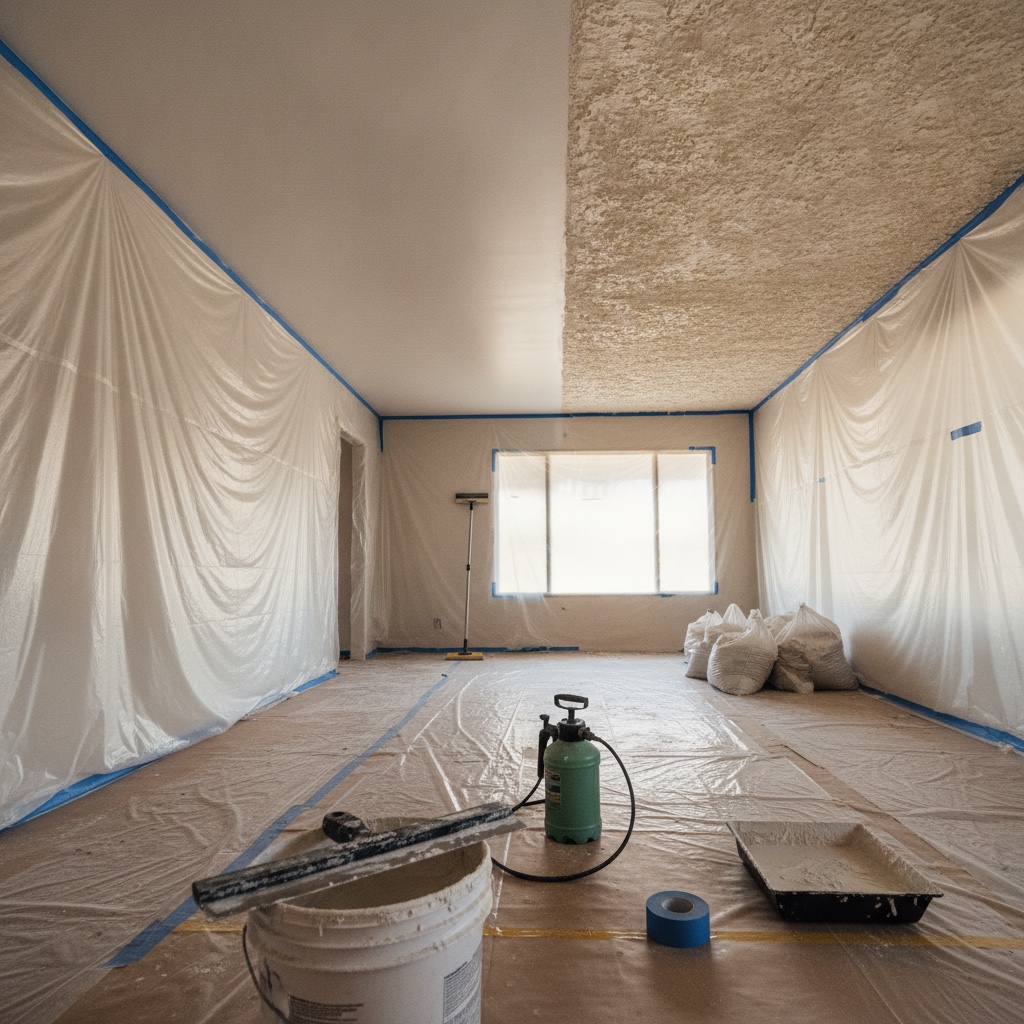
Popcorn removal is 70 percent protection and 30 percent scraping. The owners moved small furniture into the garage, and the crew covered everything left with 6-mil plastic taped to the top of the walls. The floors got a layer of rosin paper under a second sheet of poly so the wet texture could be rolled up and bagged at the end of each day. Registers and can lights were masked off. The crew shut the HVAC down for both days so the return would not pull dust through the house.
Wetting is where most DIY attempts go sideways. The texture needs a light mist from a pump sprayer, then 10 to 15 minutes to soak in, working one 4-foot by 8-foot section at a time. Too much water and the paper face of the drywall bubbles and tears. Too little and the scraper gouges the board. On this ceiling, the living room and dining area came off clean in about 5 hours. The kitchen took longer because decades of cooking film had sealed the texture and needed light scoring first. By the end of day two, the whole ceiling was bare, bagged, and drying.
Days Three Through Five: The Decision That Made the Room
Bare popcorn ceilings never look like new drywall. Scraping reveals every joint, every screw pop, every spot where the original hanger skipped a coat of mud because the texture was going to hide it anyway. The owners had a choice to make here, and it changed the whole look of the house. Option one was a level-4 finish with a light orange peel or knockdown texture sprayed over it. Option two was a full skim coat to a level-5 flat finish with no texture at all. The difference on this job was about $1,600.
The deciding factor was light. The owners were adding six new 4-inch LED wafer lights in the living room and a long west window washes the ceiling with low afternoon sun from October through February. That raking light shows every ridge and dip in a flat ceiling, which is exactly why level-5 exists. A knockdown texture would have hidden more of the ceiling’s age for less money, but the owners wanted the clean, modern look that pulls a 1970s tract house forward. They chose smooth.
Day three went to repairs. The crew cut out the bad hall closet patch and replaced it with a proper 1/2-inch piece backed by blocking. They reset 40-plus popped screws, re-taped two cracked joints near the kitchen, and spot-primed the old stain areas with a shellac-based sealer so they would not bleed through the new paint. Days four and five were skim coats. A thinned all-purpose compound went on with a roller and came off with a 24-inch squeegee knife, two full coats, with a 12 to 18 hour dry time between each one. In late September, Westminster’s mild humidity kept those dry times predictable.
Days Six Through Eight: Sand, Prime, Paint, Walk
Day six was sanding with a pole sander and a shop vac attachment, then a lap around the ceiling with a handheld work light held flat against the surface. Every shadow got circled in pencil and touched up. That work-light pass is the single biggest difference between a level-5 ceiling that looks great and one that looks great until the afternoon sun hits it. The crew found eleven small spots, filled them, and sanded again after lunch.
Day seven was one coat of high-build drywall primer and two coats of flat ceiling white. Flat sheen matters on a level-5 ceiling. Eggshell or satin would have shown every tiny variation under the new LEDs. The electrician came back the same afternoon to set the wafer lights and reinstall the fixtures and detectors. Day eight was the final walk with the owners at about 4 p.m., when the west sun was lowest. The ceiling read as one flat, continuous plane from the front door to the kitchen, and the rooms looked a foot taller than they had the week before.
Scraping and skimming a ceiling like this in Orange County usually lands between $4.50 and $6.50 per square foot with priming and painting included, depending on the ceiling height, access, and how much repair the bare board needs. At 1,380 square feet, this composite came in right around $7,400 before the lighting work. Recent NAHB data shows remodeler input costs up 6.6 percent year over year in the second quarter, so homeowners who wait until spring should expect those numbers to climb rather than hold.
What Popcorn-Ceiling Owners Should Take From This
Three things drove the timeline and the budget on this job. First, the asbestos test came back clean, which saved the owners from a separate abatement contract and at least a week of waiting. Second, the repair list was known before day one because the crew walked the attic and the ceiling before writing a number. Third, the owners made the level-4 or level-5 decision early, based on their lighting and their windows rather than on price alone. Get those three settled and a whole-house ceiling redo becomes a predictable eight-day project instead of a month of surprises.
Timing matters too. With Thanksgiving eight weeks out, most Orange County drywall calendars fill fast through October. A house with 1,000 to 1,800 square feet of popcorn needs roughly one week of work plus three to five days for test results, so the window for a pre-holiday finish closes around the end of October. If your ceiling still has the original 1970s texture and you want it flat before guests arrive, JNL Drywall can pull samples, walk the attic, and give you a real number at a free in-home assessment. Request a quote and we will get you on the calendar while there is still room.
Morning-context sources used: NAHB Eye On Housing, “Q2 2026 Remodeling Market Update: Labor and Nonlabor Input Costs,” September 23, 2026; NAHB Eye On Housing, “NAHB Remodelers: What the Data Says,” September 28, 2026; NAHB Eye On Housing, “With Inflation Uptick, Fed Hikes and Signals More to Come,” September 16, 2026; Harvard JCHS, “Home Improvement Spending Has Shifted Away from DIY,” September 21, 2026; Angi, “How Much Does Popcorn Ceiling Removal Cost? [2026 Data]”.