Request Your Free Quote!

Home Office Soundproofing: STC Math and a Fall Timeline
What STC ratings really mean, how mass, decoupling and damping stack, plus a six-week Orange County soundproofing calendar and real 2026 costs.
A Villa Park homeowner called last February about a 9 by 11 bedroom he had converted to an office. Standard 2×4 wall to the hallway, half-inch drywall on both sides, hollow-core door. His actual problem was a teenager’s bass through the shared wall during a 2 p.m. client call. That wall was running somewhere near STC 33. After the rebuild it landed in the mid 50s. The difference is not subtle. It is the difference between hearing words and hearing nothing.
September is when this project should start in Southern California. NOAA’s Geophysical Fluid Dynamics Laboratory posted its September 8 update showing high confidence in a historically strong El Nino later this fall and winter, with all 30 ensemble members competing with the strongest events on record. That points to a wet winter, and a wet winter means indoor work becomes the only work for long stretches of December through March. The crews that will be hard to book in January are bookable right now.
What an STC Number Actually Buys You
STC, or Sound Transmission Class, rates how much airborne sound a wall assembly stops. It gets calculated from transmission loss measured at 16 standard frequencies between 125 Hz and 4000 Hz, then fitted against a reference curve. The result is a single integer, which is both the number’s usefulness and its trap.
Here is the rough translation for a homeowner:
- STC 30 to 35. Normal speech is audible and mostly intelligible. This is a builder-grade interior wall. Most Orange County tract homes built from the 1970s through the 2000s land right here.
- STC 40. Loud speech is audible but you cannot make out the words.
- STC 45 to 50. Loud speech drops to a faint murmur. This is the practical target for a home office off a busy hallway.
- STC 55 to 60. You stop noticing the rest of the house. Music with real low end still gets through.
The trap is that STC weights the mid and high frequencies where speech lives, so it undercounts bass. A wall rated STC 52 can still pass a subwoofer, a washing machine on spin cycle, or a diesel truck idling in the driveway. If the noise you hate is low, plan for more wall than the rating suggests.
Mass, Decoupling, and Damping
Every real fix pulls one or more of three levers. Stuffing the cavity with insulation is the fourth thing people try on their own, and it is the one that disappoints them, because a rigid stud path carries sound straight through regardless of what sits between the studs.
Mass. Heavier assemblies move less. Going from one layer of half-inch board to two layers of five-eighths buys a handful of points. It is cheap, it is easy, and by itself it is not enough.
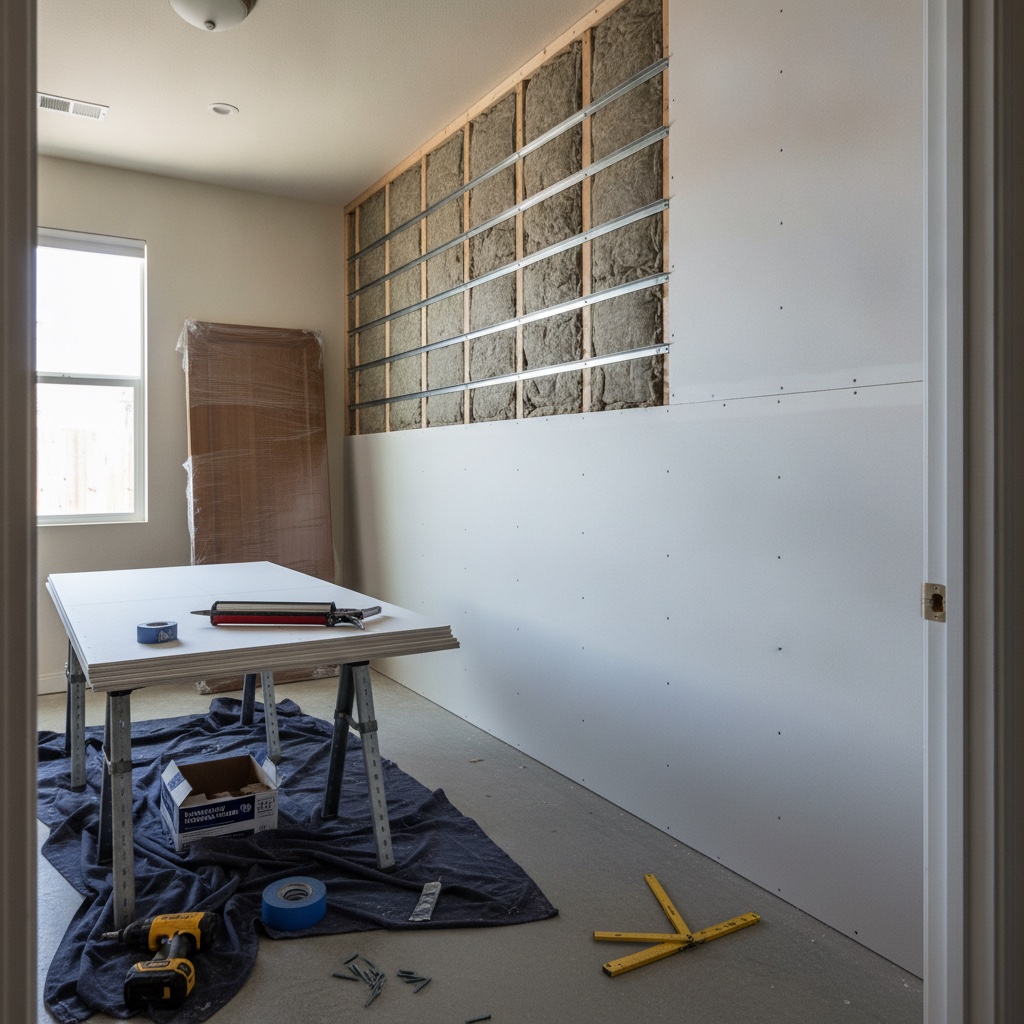
Decoupling. Stop the two faces of the wall from sharing a rigid path. Resilient channel, run horizontally across the studs with the board screwed only to the channel, is the common approach. A 2×4 stud wall with batt insulation, resilient channel, and two layers of five-eighths typically tests in the STC 45 to 52 band. Sound isolation clips with hat channel do the same job with far less risk. Resilient channel fails the moment one screw catches a stud behind it, and on a real job site that happens. Clips are more forgiving of an ordinary crew on an ordinary Tuesday.
Damping. Green Glue and similar viscoelastic compounds go between two layers of board and convert vibration into a trace amount of heat. Published comparison testing puts the gain from a damped double layer somewhere in the 10 to 16 point range depending on the base assembly, with the strongest benefit down low where decoupling alone struggles. Two tubes per 4 by 8 sheet is the standard spread.
The stacking order matters less than the flanking paths. A wall at STC 55 with a hollow-core door is not a wall at STC 55. It is a door at roughly STC 20 with expensive framing around it. Budget for a solid-core slab, a full perimeter seal, and a drop seal at the threshold. Same story with the electrical. Back-to-back outlet boxes in the same stud bay are a hole straight through the assembly. Offset them by one bay and putty-pad the backs.
The Six-Week Calendar From Consult to Closed Door
Soundproofing one room in a house people are living in is not a weekend. Here is the honest sequence for a 10 by 12 office with one shared wall and a bedroom overhead.
Week 1, assessment and scope. Walk the room, find the actual noise source and the path it takes, check whether HVAC ducting runs between the two spaces. Shared duct runs are a common flanking path and a common surprise. Decide whether the ceiling gets treated or only the wall.
Week 2, materials and clear-out. Five-eighths board, clips and hat channel, mineral wool batts, damping compound, acoustical sealant, plus the solid-core door and its hardware. Lead time on a specific door slab can run two to three weeks, and that single item is the most likely thing to push your schedule.
Week 3, demo and rough. Existing board comes off the treated surfaces. Electrical gets relocated and padded. Any duct that needs a lined flex jog or a baffle gets handled while the cavity is open. Dust containment goes up at the doorway. This is the loud week.
Week 4, hang and seal. Clips, channel, first layer, damping compound, second layer, then a bead of acoustical sealant at every perimeter edge. That bead is not optional. An unsealed quarter-inch gap along the floor line can cost you five points of the assembly you just paid for.
Weeks 5 and 6, finish. Tape, three coats of mud, sand, texture match, prime, paint, hang and seal the door, walk the room. Level 4 is the right finish for a painted office wall. Level 5 only if the room takes hard raking light from a west window and you plan on a satin sheen.
Six weeks from first walk to closed door. Start the second week of September and the room is finished before Thanksgiving, with the dusty weeks landing while the weather still lets you open windows and stage material in the driveway. Start in January and demo week competes with the rain.
What It Costs in Orange County
Real 2026 ranges for work in Orange County, north San Diego county, and the Long Beach area:
- One shared wall, roughly 120 square feet of surface, decoupled with clips and channel, double five-eighths with damping compound, taped to level 4 and painted: $2,800 to $4,600. The spread comes down to electrical relocation and whether the existing board comes off to the studs.
- Adding the ceiling, another 120 square feet with the same treatment: $2,600 to $4,200. Ceilings run slower and the clip layout is fussier.
- Solid-core door, frame, perimeter seals, and threshold drop seal, installed: $900 to $1,700.
- The mass-only shortcut, one added layer of five-eighths with damping compound over the existing board and no demo: $1,100 to $1,800 for one wall. It buys real improvement and it is honest work when the budget is fixed, but it will not get you into the 50s.
Material pricing keeps moving. USG issued a joint treatment price adjustment effective September 14, and gypsum indices have drifted upward through 2026 on steady wallboard demand. Harvard’s Joint Center for Housing Studies puts homeowner remodeling spending near $517 billion through the third quarter of 2026, growth it describes as slow but steady. That is another way of saying the good crews stay booked.
Whether the project pencils out is not really a question about the wall. Robert Half’s 2026 data shows fully in-office job postings climbing from 65 percent in late 2025 to 87 percent by the second quarter of 2026, yet 55 percent of job seekers still rank hybrid first. If your house is where two or three workdays a week actually happen, that office wall is infrastructure, not a luxury.
We will walk the room, listen to the noise you are actually fighting, check the ducting, and tell you which of the three levers your wall needs. Some rooms need a full rebuild. Some need a better door and a tube of acoustical sealant. The in-home assessment is free, it takes about forty minutes, and you leave it knowing the honest number before anyone opens a wall. Book it now and the work lands before the rain does.
Morning-context sources used: NOAA GFDL, Sept 2026 El Nino Predictions (Sept 8, 2026); ABC Supply Interiors, 2026 Pricing Updates (USG, Sept 14, 2026); Harvard JCHS, Leading Indicator of Remodeling Activity; Robert Half, Remote Work Statistics and Trends 2026; Soundproofing Company, Understanding STC Ratings; TMSoundproofing, Green Glue Data and Comparison Tests.