Request Your Free Quote!

Drywall Holes by Size: From Pinholes to Anchor Blowouts
A SoCal homeowner guide to fixing drywall holes by size, from pinholes to anchor blowouts, with real Orange County repair costs and when to replace.
A doorknob goes through the hallway wall in Huntington Beach. A floating shelf in an Irvine bedroom lets go and the plastic anchors tear out a chunk the size of a silver dollar. A San Diego renter pulls down a gallery wall and leaves forty pinholes behind. Three different homeowners, three different holes, and the first question is always the same. Is this a tube of spackle and a Sunday afternoon, or is it a call to a pro?
The honest answer comes down to one measurement. Pull a tape across the widest point of the damage. Hole size decides the method, the material, and most of the cost. A quarter-inch pinhole and a twelve-inch blowout are not the same repair scaled up. They are different jobs with different failure points. Here is how the sizes break down, what each one really costs in Orange County and San Diego, and where the line sits between a patch and a tear-out.
Under four inches: pinholes, dents, and doorknob dings
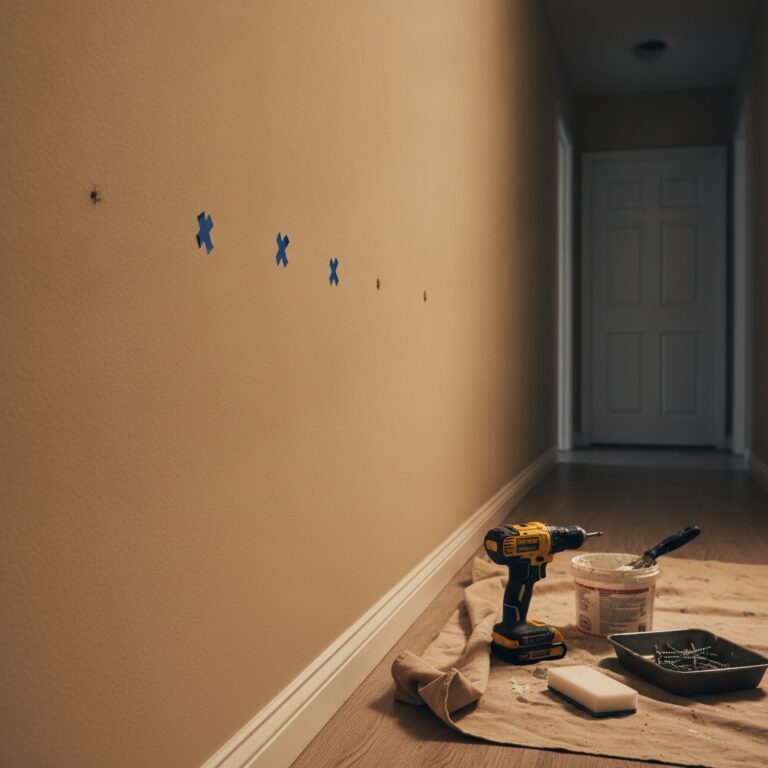
This is the friendliest category. Nail holes, picture-hanger pinholes, doorknob dents, and the small dings that come from moving furniture all live here. For true pinholes, lightweight spackle and a putty knife handle it. Press a thin layer in, let it dry, sand it flush, and spot-prime before paint. A wall with forty pinholes from a gallery layout reads as one small job, not forty.
Doorknob dents are the trap in this group. The hole looks small from the front, but the impact often cracks the gypsum core in a wider ring than the visible dimple. A dab of spackle bridges the surface and hides nothing structural, so the crack telegraphs back through the paint within a season. The right fix is to cut back to sound board, set a small patch, and feather joint compound past the damaged edge.
Cost in SoCal for this tier runs modest on materials but real on labor. National 2026 data puts small-hole repairs at roughly $75 to $150, with many pros charging $100 to $160 once travel and setup are counted. A one-square-foot patch and a six-square-foot patch take almost the same setup time, which is why most contractors price small work as a flat fee rather than by the inch.
Anchor blowouts: small hole, bigger problem
An anchor blowout deserves its own category even when the hole reads under two inches. When a plastic expansion anchor or a toggle bolt rips out of the wall, it does not leave a clean round hole. It leaves a flared, cone-shaped tear with the paper face pushed in and the gypsum crumbled behind it. A flat patch over that crater will sink, because there is nothing solid under the surface to carry the compound.
The fix starts with cleanup, not filler. Grip the remains of the anchor with pliers and pull it straight out, or push it back into the wall cavity with a screwdriver handle so it drops out of the way. Once the face is flat and the loose crumbs are cleared, the hole behaves like a normal small patch. For anything wider than a half inch, a self-adhesive mesh patch or a setting-type compound gives the repair a firm base instead of soft spackle that dents again the first time a shelf bracket goes back up.
The real lesson from a blowout is the anchor choice, not the patch. A shelf that pulled out once will pull out again if it goes back on the same undersized hardware. Heavy items want a fastener driven into a stud, or a heavy-duty toggle rated for the load. Patch the wall, then solve the reason it failed, or you will see us back for the same spot next year.
Four to twelve inches: where the California patch earns its name
This middle band covers most of the holes a homeowner finds alarming. Access cuts a plumber left behind a vanity in a Long Beach condo, a fist-sized impact in a kid’s room in Riverside, a section a leak forced open and then dried out. These holes are too big for spackle and too small to justify replacing a whole sheet.
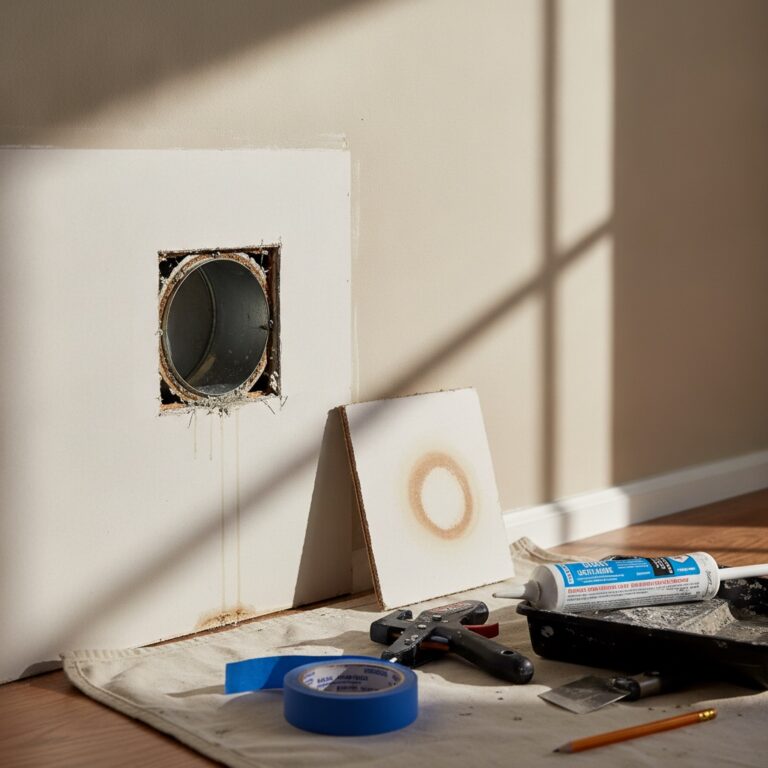
For holes in the four to eight inch range, the California patch is the cleaner method, and it happens to carry the state’s name for a reason most homeowners never hear. The technique cuts a square of scrap drywall larger than the hole, then scores and snaps the back so the paper face extends about two inches past the gypsum core on every side. The insert drops into the hole and the paper flange folds flat against the wall, acting as its own backer. A thin coat of joint compound under the flange holds it, then a skim coat blends the whole area. No wood backing, no metal clips.
Past about six inches, the paper flange stops being enough on its own. The repair wants a backing board, a strip of wood or drywall slipped behind the opening and screwed to the surrounding board so the patch has something firm to bite. Medium holes in this five to twelve inch range land around $150 to $350 in most SoCal markets, before texture matching gets added on top.
Over twelve inches: now you are replacing, not patching
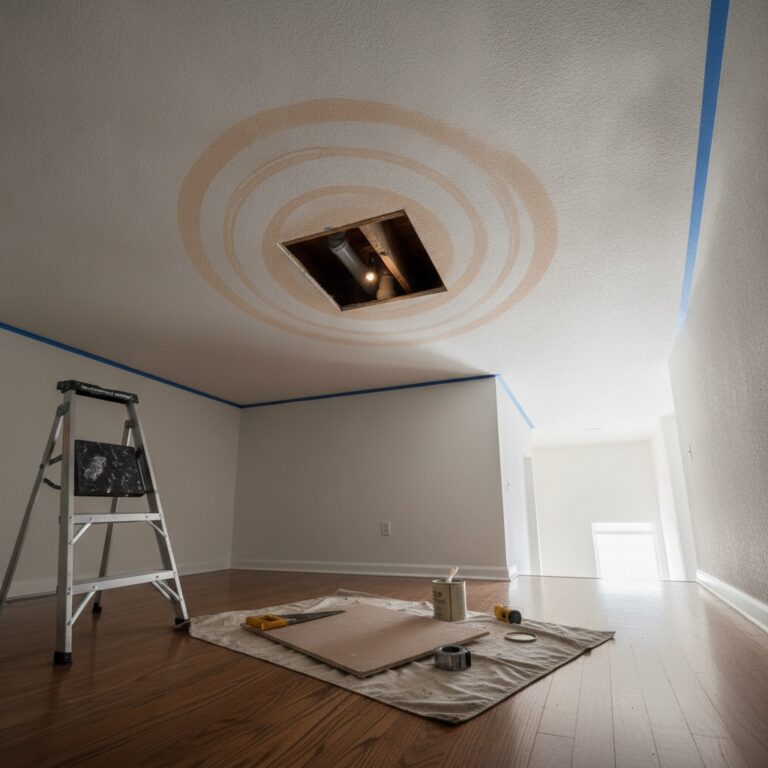
Once damage crosses roughly a foot, or once it spans more than one stud bay, a patch stops being the honest answer. The right move is to cut the opening square, back to the centers of the studs on each side, and screw in a fresh piece of board fastened to solid framing. That is a real hang-tape-finish sequence, not a smear-and-sand. Large repairs that replace full sections commonly run $400 to $1,000 or more, and pros often price work at this scale around $50 to $75 per square foot.
The part that surprises homeowners is that the hole is the cheap part. The blend is what costs. Matching an existing texture is where the bill grows, and SoCal walls are full of textures that fight a quick fix: knockdown, orange peel, the heavy hand-troweled looks from 1980s tract homes, and the smooth level-5 finishes in newer Irvine builds. Texture matching alone adds roughly $100 to $300 per patch, and a mismatched patch on a wide wall reads as a bright flat island the first afternoon the side light hits it.
Finish level matters here too. A level-4 finish, which is standard for most walls, gets the patch flat and primed for typical paint and texture. A level-5 finish, with a full skim coat across the repaired zone, is what you want when the wall is smooth and a raking window light would expose every ridge. On a large patch in a sunny room, asking for the wrong finish level is the difference between a repair that disappears and one you notice every morning.
The quick read: measure first, then decide
Run the tape before you run to the hardware store. Under four inches and not a blowout, spackle or a small patch and a careful prime will hold. An anchor crater wants cleanup and a firm backer, plus better hardware so it does not repeat. Four to eight inches points to a California patch, six and up wants backing, and anything past a foot is a cut-and-replace with texture matching as the line item that moves the price. Average SoCal drywall repairs land near $600, with a working range from about $150 to $2,000 depending on size, texture, and finish level.
If you are standing in front of a hole and cannot tell which side of the line it falls on, that uncertainty is exactly what a free in-home assessment is for. We will measure it, tell you straight whether it is a patch or a replacement, match the texture and finish level to the rest of your wall, and put a real number on it before any work starts. Send a photo or book a walkthrough, and we will give you the honest read on whether this is a quick fix or a real repair.
Morning-context sources used: Angi 2026 Drywall Repair Cost Data, Homewyse 2026 Cost to Repair Drywall Holes, HomeGuide 2026 Drywall Repair Cost, What It Actually Costs: Drywall Repair 2026, The DIY Playbook: California Drywall Patch, Fix a Loose Drywall Anchor.