Request Your Free Quote!

Hairline Crack Above a Doorway: Settling or Structural?
That diagonal crack above your doorway: how to tell normal settling from structural movement, what repairs cost in Orange County, and when to call a pro.
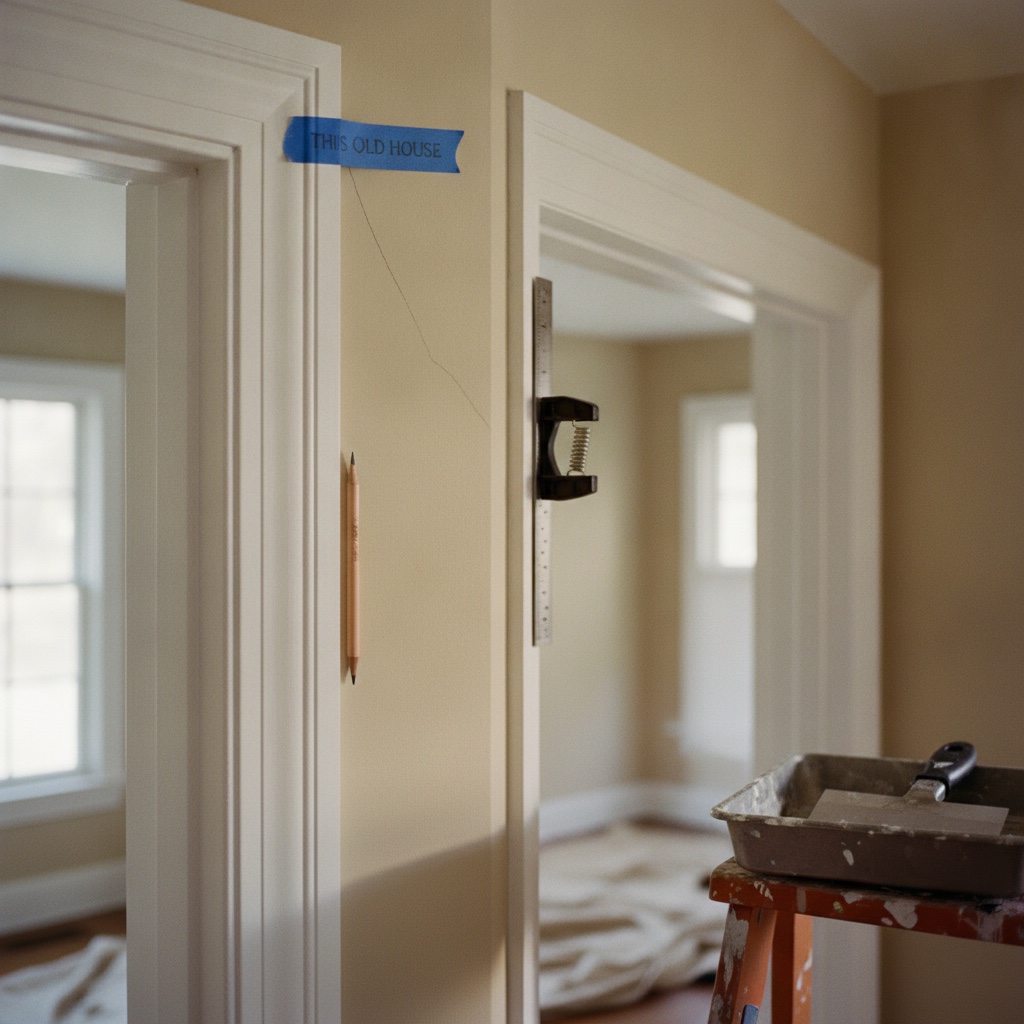
The mid-July heat wave pushed Fullerton, Anaheim Hills, and the inland valleys past 105 for three straight days. Your AC ran around the clock. Then a thin diagonal line showed up above the hallway door, running from the corner of the casing up toward the ceiling. Every SoCal summer produces thousands of these cracks. Most are cosmetic. A few are the house telling you something moved underneath it. Here is how to read yours before you spend a dime.
Why the wall cracks above the door first
A doorway is the weakest spot in a framed wall. The opening interrupts the studs, and all the load above it passes through a header beam and down two trimmer studs at the corners. Drywall hangers also tend to land a joint near that corner. So when anything in the house moves, expansion, shrinkage, or settlement, the stress collects at the top corners of the opening and the wall cracks there first.
SoCal housing stock makes this worse. Most tract homes in Orange County and north San Diego built between the 1960s and 1990s sit on slab-on-grade foundations over clay-heavy soil. Long dry summers pull moisture out of that soil, the slab edge drops a fraction, and the framing above racks just enough to open a hairline at the header corner. The crack did not appear randomly. It appeared at the engineered weak point.
Reading the crack: settling or structural
Start with width. A hairline thinner than 1/8 inch that runs diagonally from the corner of the casing is the classic settling crack. Nearly every home gets them, and they are a drywall repair, not a structural one. Cracks wider than 1/4 inch, jagged cracks, or cracks running horizontally along the wall deserve a professional look, because those patterns track with foundation movement rather than normal seasonal motion.
Then look for company. Foundation trouble almost never shows up as a single tidy crack. Check whether the door below it sticks or no longer latches, whether the same crack mirrors on the other side of the wall, whether the baseboard has pulled a gap at the floor, and whether a patch you made last year has reopened in the same spot. A crack that returns after a proper repair means the structure underneath is still moving.
Finally, put it on the clock. Mark each end of the crack with a pencil tick and today’s date, and note the width at its widest point. A business card is about 0.3 mm thick and works as a feeler gauge. Check it again in 30 days. Stable length and width points to settling. Growth in either direction, especially through the cooler months, is your signal to bring in a structural engineer before any drywall work.
What a triple-digit week does to framing
During the July 14 to 16 stretch, forecast highs ran 95 to 112 away from the coast, and overnight lows stayed warm enough that houses never fully cooled. Attics in Corona and Rancho Santa Margarita ran well past 140. Framing lumber expands in that heat, then shrinks as the AC pulls the indoor humidity down. The drywall does not stretch with it. The taped joint at the header corner takes the strain and lets go.
That is why the same crack often opens in July and tightens up again by December. A crack that breathes with the seasons is annoying, and it is worth fixing right, but it is rarely a structural alarm. The repair timing matters, though. Patch it during a heat spike and the joint is at its widest. Patch it in fall, when the framing has relaxed, and the repair holds through more of the cycle.
What the fix costs in Orange County and San Diego
National 2026 data puts the average drywall repair at about $612, with a range from $150 to $2,000 depending on scope. For a single doorway hairline in OC, expect $250 to $450 for the honest version of the repair: open the crack, remove the failed tape, set new tape in setting-type compound, refloat the corner, then match the texture and blend the paint across that wall section.
Finish level moves the number. A textured wall in Garden Grove, orange peel or knockdown, hides a blended patch well and stays at the low end. A smooth level-5 wall in an Irvine or Carlsbad home shows every ripple in raking light, so the skim and blend takes longer and adds $100 to $200. Ceiling cracks run $250 to $600 because overhead work is slower and harder to blend.
One number to be wary of: the $75 quickie skim. Smearing spackle over a settling crack without re-taping buys you one paint cycle before the line telegraphs back through. If the crack turns out to be structural, sequence matters too. The foundation work comes first, from a foundation contractor or engineer, and the drywall repair comes after the movement stops. Patching before stabilizing just gives the crack a fresh surface to reopen through.
Patch now, watch it, or make a call
Here is the short version. Hairline, diagonal, stable for 30 days, door works fine: schedule a proper tape-and-refloat repair for early fall and stop worrying. Wider than 1/4 inch, growing, horizontal, or paired with a sticking door: get a structural opinion first and keep your pencil marks as evidence. Either way, skip the tube of spackle. The crack picked that spot for a reason, and the repair has to respect the reason.
If you would rather not guess, a 20-minute look usually settles it. JNL Drywall runs free in-home assessments across Orange County and north San Diego, and we will tell you plainly whether you are looking at a $300 repair or a conversation with an engineer. Send a photo of the crack with a card held next to it for scale, and we can often triage it before we even roll a truck.
Morning-context sources used: hoodline.com (SoCal extreme heat watch, July 14-16, 2026), nbclosangeles.com (Southern California cooling centers, summer 2026), angi.com (2026 drywall repair cost data), homeguide.com (2026 drywall repair cost guide), groundworks.com (drywall cracks: when to worry), angi.com (10 types of drywall cracks and when to worry).