Request Your Free Quote!


That August Ceiling Stain Is Probably Your AC, Not the Roof
A brown ceiling stain in August in Orange County is usually AC condensate, not a roof leak. How to read it, rule out plumbing, and what the fix costs.
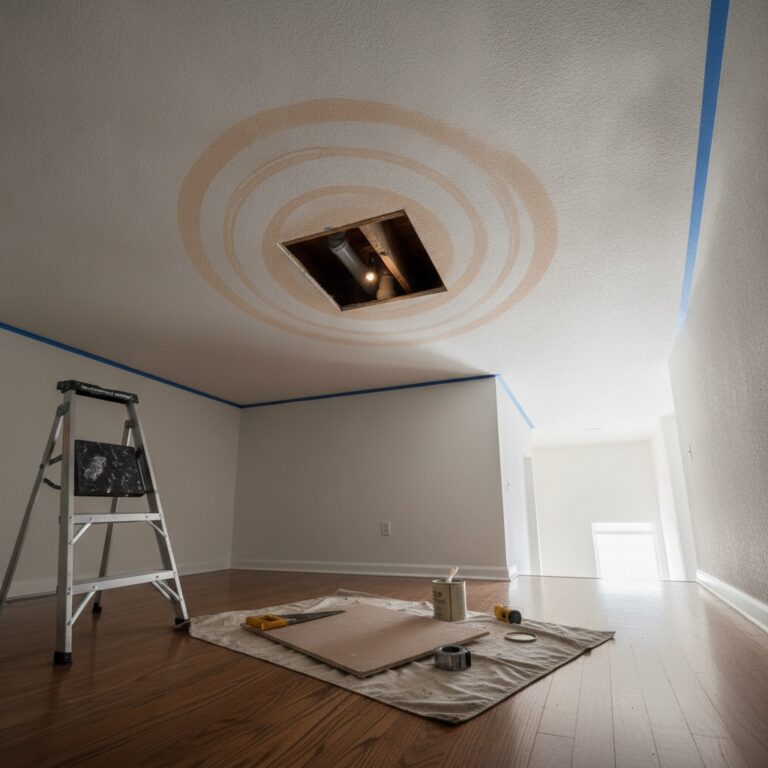
A homeowner in Yorba Linda called about a coffee-colored ring on a hallway ceiling last week. No rain since March. No bathroom overhead. The roof was replaced five years ago. The stain sat about four feet from the attic access hatch, which in most 1990s tract homes out there is exactly where the air handler sits. That location answers the question before anyone sets up a ladder. In late August, a ceiling stain in Orange County is usually condensate, not weather.
This month has been rough on cooling equipment. Southern California ran through a major late-August heat wave with advisories from the coast into the inland valleys, and unusually warm ocean water has kept coastal humidity high from Santa Barbara south. Humid air makes the evaporator coil pull more water out of the house. More water means the drain pan and the condensate line move more volume than they have all year. Systems that were merely marginal in June fail right now.
Why the Air Handler Is the Prime Suspect in August
Most SoCal homes built after 1985 put the air handler in the attic, sitting over a secondary drain pan. The coil sheds water into a primary pan, which drains through a 3/4 inch PVC line to a spot outside, often near a hose bib or into a bathroom sink tailpiece. That line runs almost level. Algae and biofilm build inside it every season. When it clogs, the primary pan fills, spills into the secondary pan, and the secondary pan overflows onto your ceiling.
Older installs in Anaheim, Garden Grove, and Santa Ana frequently have no float switch. A float switch sits in the secondary pan or in the drain line and shuts the system down when water backs up. Without one, nothing stops the cycle. The unit keeps running, keeps making water, and the ceiling below absorbs it for days. That is why condensate stains grow slowly and then all at once.
Read the Stain Before Anyone Touches It
Take a photo and mark the outer edge with a pencil. Do it again in 48 hours. A stain that grows is active. A stain that holds still is old damage that already dried. Then look at the shape. Concentric rings with a darker center mean the ceiling got wet, dried, and got wet again, so the leak repeats on a cycle. One soft blotch with a fuzzy edge usually means a single event.
Press the center gently with two fingers. Paper-faced gypsum that still has strength feels firm. Board that has taken on water feels like a wet cereal box and gives under light pressure. If your finger sinks, stop pressing. That ceiling is holding weight it should not be holding. Half-inch board spanning 24 inch framing sags first, and a saturated ceiling can drop a section without much warning.
A pin-type moisture meter settles most arguments in about ninety seconds. Dry interior gypsum in a Fullerton or Irvine home reads in the single digits on the wood scale. Anything above 17 percent is actively wet, and readings that climb as you move toward the attic hatch point straight at the equipment. Meters run about forty dollars at any hardware store on Harbor or Katella, which is cheaper than guessing wrong and painting over an open leak.
Ruling Out the Roof and the Plumbing
Roof leaks track. Water enters at flashing or a cracked tile, runs down a rafter, and surfaces several feet from the actual failure. Roof stains almost always appear after rain and stay quiet between storms. In August in Orange County that alone rules most of them out, though monsoon moisture has pushed a few thunderstorms into the inland valleys this month.
Plumbing leaks do not care about the weather. A supply line drips at a constant rate and produces a stain that keeps growing whether the AC runs or not. A drain leak shows up only during use, so a stain under an upstairs shower darkens after someone bathes. Condensate splits the difference. It grows during hot afternoons when the system runs hard and pauses on a cool morning. Shut the AC off at the thermostat for one full day. If the stain stops changing, you have your answer.
Patch or Replace: Where the Line Actually Sits
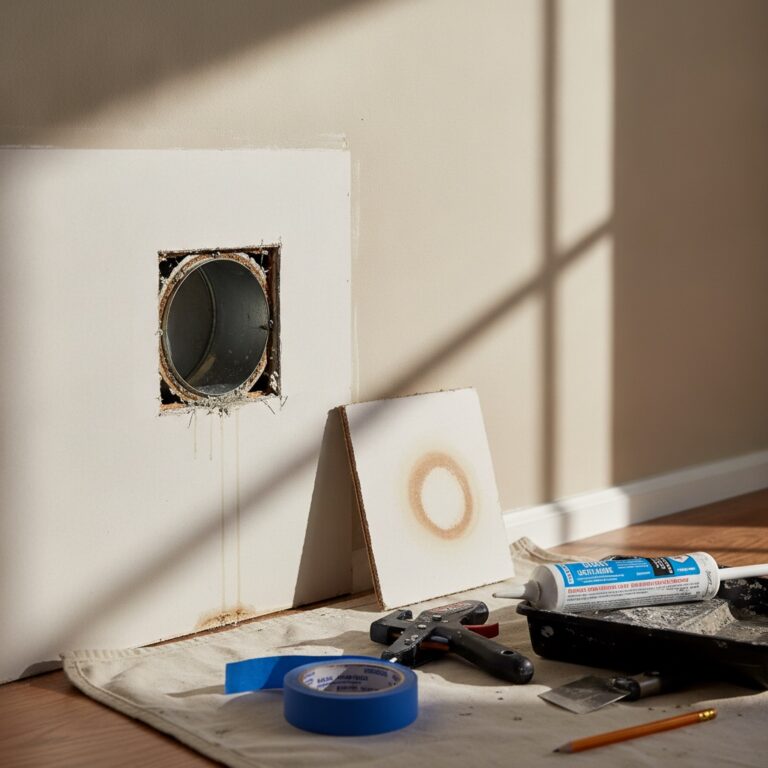
The threshold is not the size of the stain. It is whether the gypsum core lost its strength and whether the insulation above it is wet. A stain smaller than about 12 inches across on board that still feels firm is a patch. Cut out a square, back it with wood, set a new piece, tape it, feather three coats, and texture to match. The insulation above still needs to come out and dry, because wet blown-in cellulose stays damp for weeks and feeds mold.
Board that is soft, sagging, or discolored across more than a couple of feet gets replaced. So does any ceiling where the tape joint released or the paper face separated from the core. On a ceiling replacement, use 5/8 inch board, not half inch. It resists sag and it is what most SoCal inspectors expect over 24 inch framing. Skipping that step is how a repaired ceiling starts waving again in two summers.
Timing matters more than most homeowners expect. Gypsum that stays wet past roughly 48 hours starts growing mold in the paper facing, and paper is the food source, not the core. A stain that appeared three weeks ago in an attic holding 130 degree air has almost certainly gone past that point. Cut it out. A stain caught within a day or two of a clogged line, dried properly with a fan and the insulation pulled back, often survives as a simple patch.
What the Work Costs Around Orange County Right Now
A small condensate patch, roughly 2 feet by 2 feet, with texture match and paint carried across that ceiling plane, runs about $350 to $650 in Orange County and north San Diego. A full room ceiling, say 12 by 14 feet, replaced in 5/8 board, taped, finished to level 4, textured, and primed, lands closer to $2,200 to $3,800 depending on attic access and whether popcorn overhead needs asbestos testing first.
Material pricing has not helped. Gypsum board is up roughly 15 percent over the past year, and a standard half-inch sheet now runs $14 to $24 at retail. Clearing the condensate line is the cheap part, usually $75 to $200 through an HVAC tech, and every dollar of that is wasted if the drywall gets fixed before the leak does.
Texture matching is where most patches get exposed. Orange peel over a large ceiling blends well when the sprayer tip and the mud thinning are right. Knockdown is harder, and a heavy 1990s knockdown ceiling often looks better with the whole plane refinished than with a perfect small patch ringed by original texture. On smooth level-5 ceilings, plan on refinishing corner to corner, because afternoon light rakes across smooth ceilings and shows every high spot.
If a stain showed up on your ceiling this month, clear the condensate line first, then have someone look at the board itself before anybody paints over it. JNL Drywall offers a free in-home assessment across Orange County, Long Beach, the Inland Empire, and north San Diego. We will tell you plainly whether you are looking at a patch or a full plane, and what the texture match is going to take.
Morning-context sources used: https://keyt.com/weather/local-forecast/2026/08/23/more-heat-on-the-way-monday-aug-24th-forecast/ , https://weatherwest.com/archives/43983 , https://www.cbsnews.com/losangeles/news/southern-california-humidity-rainfall-major-heat/ , https://en.wikipedia.org/wiki/2026_North_American_heat_wave , https://www.jmartiniaq.com/blog/your-ac-condensate-drain-is-clogged-why-it-happens-and-how-to-prevent-water-damage , https://homeguide.com/costs/sheetrock-drywall-prices