Request Your Free Quote!

Living Through a Drywall Remodel: Dust Control That Works
OC schools are back in session, opening the cleanest drywall remodel window left this year. Containment, HVAC sealing, and a real day-by-day timeline.
Saddleback Valley and Irvine Unified students went back to class on August 20 this year, and Orange Unified started the day before. Anaheim Elementary and Cypress opened as early as August 6. For a homeowner who has been putting off a drywall project, that calendar shift matters more than any seasonal promotion. From roughly 8 a.m. to 3 p.m., most of the house sits empty. That is the quietest, dustiest work window a lived-in home gets between now and Thanksgiving.
The Back-to-School Window Is the Cleanest One Left This Year
Dust control gets easier when fewer people move through the house. Every door opened between a work zone and a bedroom pushes fine gypsum powder down the hallway. With kids at school and at least one adult often out, a crew can hang, tape, and sand a 400-square-foot room with the containment sealed for six straight hours instead of breaking it open a dozen times. Sanding and the first coat of texture are the two dirtiest hours of any drywall job. Both fit inside a school day.
Scheduling is the other half of the argument. September through November fills fast in Orange County as homeowners chase a finished room before the holidays. Booking a hang-and-finish in late August usually means a start date inside two weeks instead of five. Recent survey data puts a major structural remodel near a five-week average and a cosmetic refresh around three weeks. Drywall-only scopes land under both of those numbers, which is why they slot cleanly into a school calendar.
What Drywall Dust Actually Does in a Lived-In House
Joint compound sands into a powder fine enough to stay airborne for hours. HEPA filtration is rated at 0.3 microns because that is the hardest particle size to catch, and a large share of sanding dust sits right in that range. It does not settle politely in the room where it was made. It rides air currents under doors, up stairwells, and straight into return vents.
The HVAC system is the real problem. One unsealed return inside a work zone turns a central air handler into a delivery route for the whole house. Dust settles in the ducts, then blows back out for weeks, coating rooms the remodel never touched. Homeowners often blame the crew for a dusty job three weeks after that crew packed up. The dust was sitting in the ductwork the entire time, cycling every time the system called for cooling.
Age of the house adds a second reason to care. Homes built before 1978 can carry lead paint under later coats, and sanding those walls falls under federal renovation and repair rules. That turns containment from a courtesy into a requirement. A 1965 Fullerton ranch and a 2004 Ladera Ranch tract home do not get the same setup, and any quote that treats them identically was written without a walk-through.
Containment That Works, and Containment That Does Not
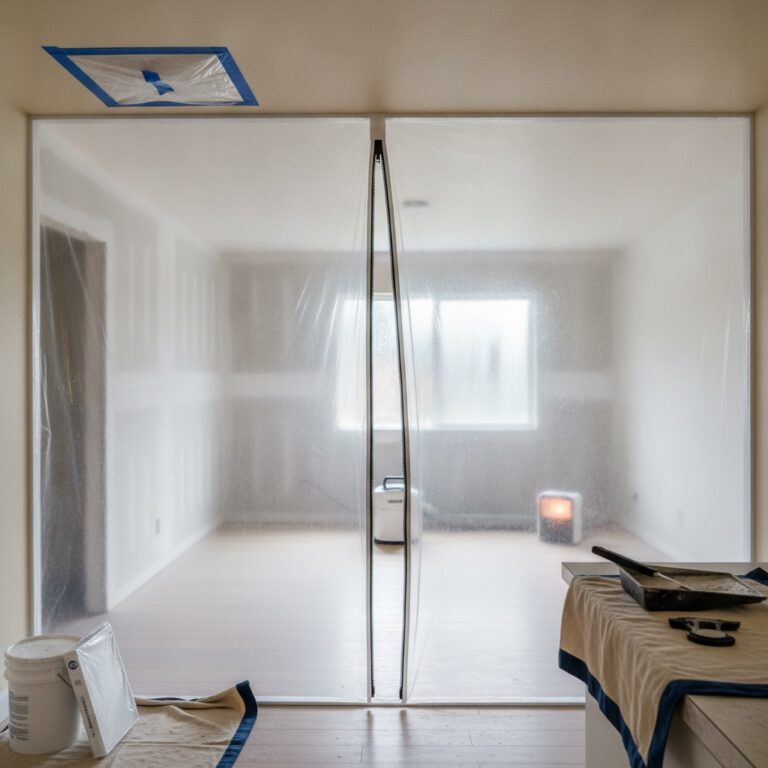
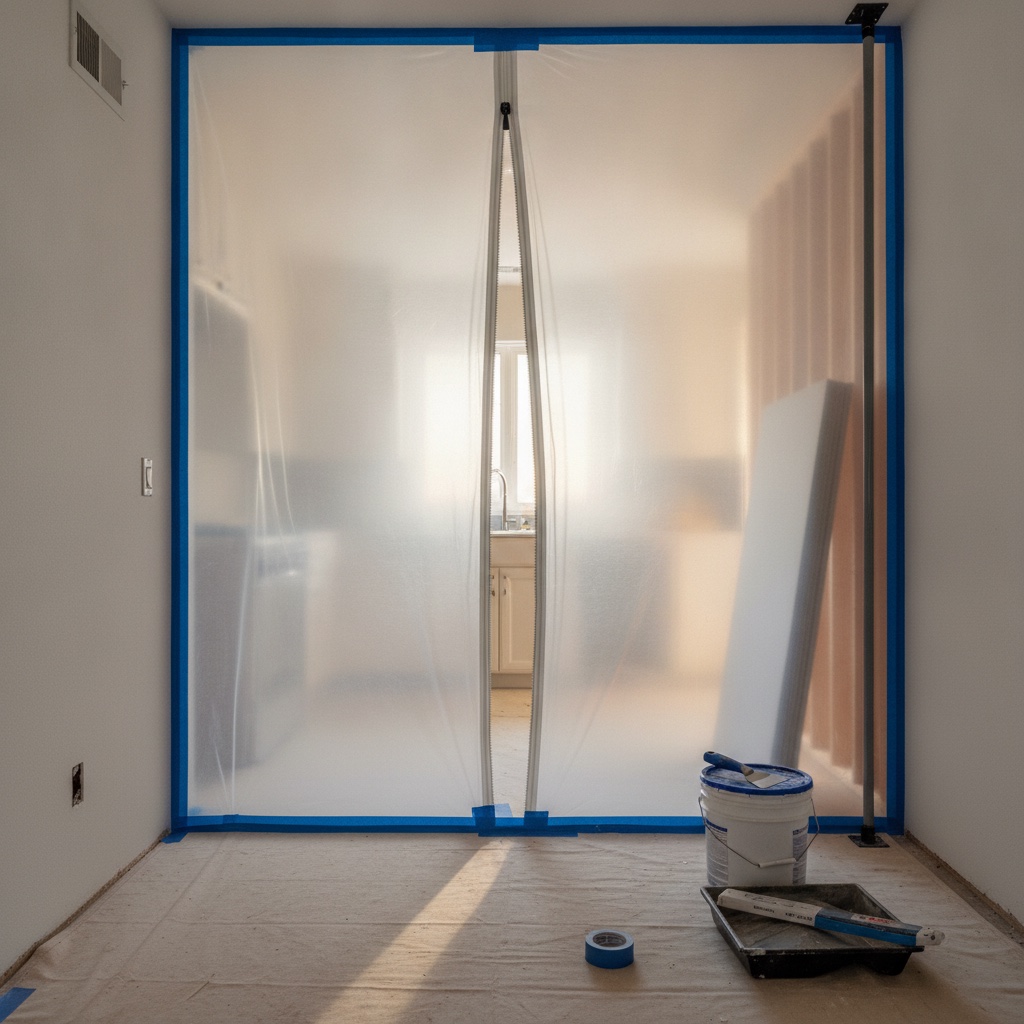
A bedsheet taped over a doorway does nothing. Real containment is 6-mil poly sheeting run floor to ceiling, sealed at every edge, with a zippered entry so the barrier stays intact each time someone passes through. Spring-loaded poles set the sheeting without putting a single hole in the ceiling. Floor protection runs from the work zone all the way to the front door, because dust tracked on boot soles travels farther than dust carried on air.
Then comes the air itself. Sealing every supply and return inside the zone with tape and plastic is step one. Step two puts the room under slight negative pressure, running a HEPA machine that exhausts out a window so air flows into the zone and never back out of it. Restoration guidelines call for four to six air changes per hour. A 400-square-foot bedroom with eight-foot ceilings needs a machine rated well above that room volume to actually hit the number.
Two work habits matter just as much. Pole sanding with a vacuum attachment cuts airborne dust sharply against dry hand sanding, and wet sanding with a damp sponge on smaller patches produces almost none. On a level-5 skim coat, where the whole wall takes a thin finish coat and then a full sanding, the vacuum attachment stops being optional. Level-5 is the dustiest finish in the trade, and it is also the one flat paint and raking window light demand.
A Week-by-Week Plan for a Room You Still Live Around
Here is how a single-room scope usually runs when the family stays put:
- Day 1: free in-home assessment. Scope, finish level, and texture match settled in writing.
- Day 2 or 3: containment built, HVAC sealed, floors covered, furniture wrapped and centered or moved out.
- Day 4: demo and haul-off. The loudest day of the job, best scheduled while school is in session.
- Day 5: hang. Sheets go up, screws set, corner bead on.
- Days 6 to 9: tape and three coats of mud with drying time between each. Quiet days, very little dust.
- Day 10: sanding and texture. The dirtiest day, and the whole reason the containment exists.
- Days 11 to 12: prime, paint, final walk, containment comes down.
Permits change that picture only when structure moves. Patching, re-hanging, matching texture, and soundproofing an existing room generally need no permit in Orange County cities. Pull out a wall, move a window, or add square footage and the project enters plan check, where OC timelines commonly run several weeks. Many neighborhoods stack an HOA or master-association review on top before the city will even accept the plans. Ask about that at the assessment, not on demo morning.
What to Ask Before the First Sheet Goes Up
Four questions separate a clean job from a messy one. Ask whether the quote lists containment and HVAC sealing as line items, because a bid that leaves them out is not cheaper, it is incomplete. Ask which finish level the price covers, since level-4 suits most walls and level-5 costs more for a reason. Ask how the existing texture gets matched, by name: orange peel, knockdown, or smooth. Ask which hours are the dirtiest and when they are scheduled.
California tightened its home improvement contract rules this year. Homeowners now receive the name and contact information of any subcontractor performing more than half the project value, and a signed contract can be canceled within three business days by email. Careful contractors were answering those questions long before the law required it. JNL Drywall works across Orange County, Long Beach, the Inland Empire, and north San Diego, and every job opens with a free in-home assessment where the timeline, the finish level, and the dust plan get settled before anyone cracks a bucket of mud.
Morning-context sources used: OCDE Newsroom, Orange County back-to-school start dates (August 2026); Home Additions in Orange County: Costs, Permits and Process, verified August 2026; 2026 U.S. Houzz and Home Study: Renovation Trends; 2026 State of American Home Renovation and Improvement; Spycor Environmental, Negative Air Machines and HEPA Filtration Guide; Burke Williams and Sorensen, New 2026 Laws Impacting Building Permits.