Request Your Free Quote!

Corner Cracks That Keep Coming Back After a SoCal Summer
That crack above your slider corner reopened during the August heat wave. Why SoCal heat-cycle cracks return, and the OC repair that actually holds.
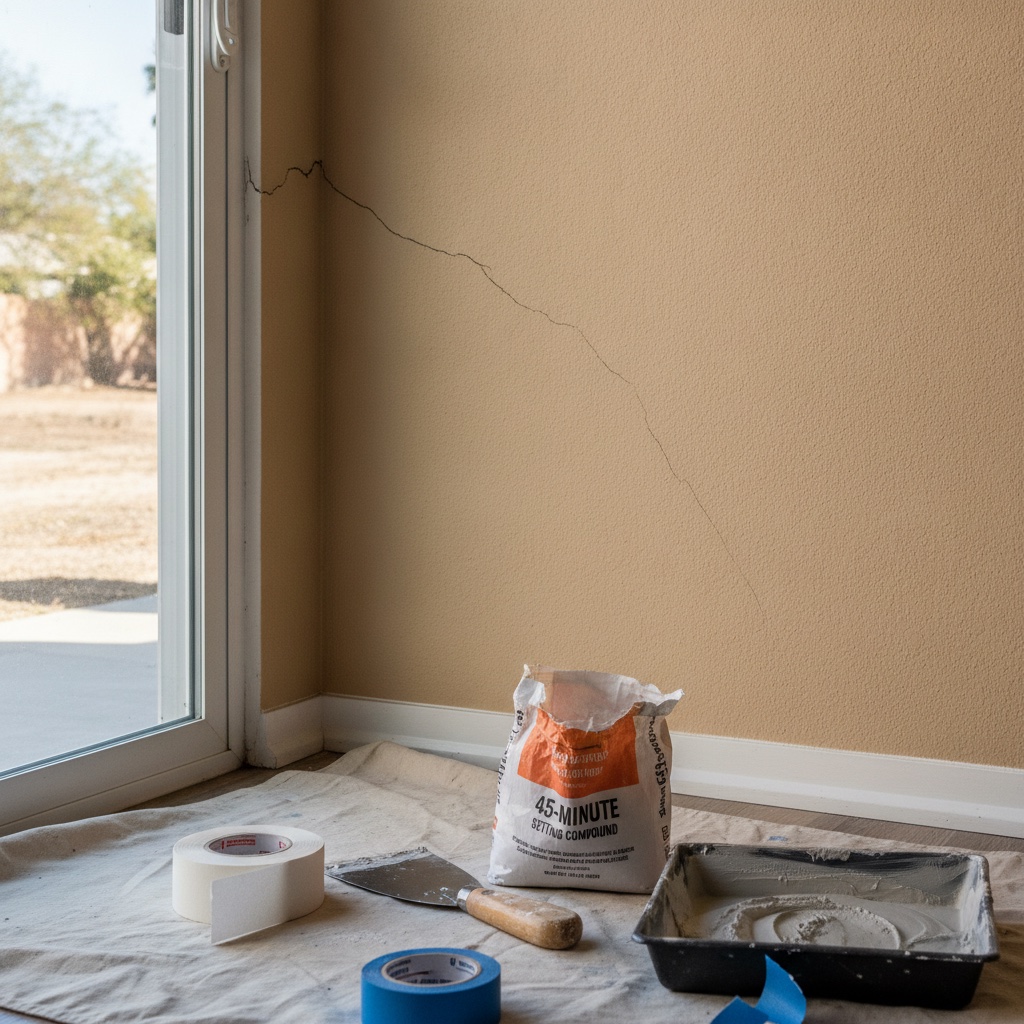
The crack above the slider corner in that Yorba Linda living room was gone in May. Somebody patched it, sanded it, painted it, and the wall looked right for three months. Then the week of August 24 arrived, valley temperatures ran 106 to 112 degrees, and by Friday there was a thin dark line running up and out from the same corner again. Not a new crack. The old one, reopened. That pattern has a cause, and in most SoCal homes it is not the house coming apart.
What a Heat-Cycle Crack Actually Looks Like
These cracks start at the corner of an opening. A slider, a bedroom door, a window. They run up and out at roughly 45 degrees, usually 4 to 18 inches long, and they stay hairline to about a sixteenth of an inch wide. Run a fingernail across one. If the wall is flush on both sides and only the paint film and the joint compound have split, the movement happened in the board and the joint. The framing behind it did not shift.
Now the version that means something else. A crack wider than an eighth of an inch. A crack with a lip you can feel, where one side sits proud of the other. A crack that runs through a corner bead and keeps going onto the next wall. Any of those paired with a door that stopped latching in July, or a floor that reads out of level across the room, and the question moves from drywall to framing and foundation. That is a different call and a different trade.
Why the Same Corner Fails Every Single Summer
Gypsum board, wood framing, and joint compound all move at different rates when the temperature swings. In a Fullerton or Anaheim tract home during the last week of August, the attic above your ceiling can sit at 130 to 150 degrees while the room below holds 78 under the AC. That gradient pulls on the top plate and on the sheets fastened to it. The board wants to move. The taped joints and the corner bead resist. Something has to give.
Openings are where it gives. Drywall gets cut around a door or a window, and every cut corner is a stress riser. The shortest path for accumulated movement runs diagonally out of that corner, which is exactly where you keep seeing the line. Hangers who cut a single sheet so the seam lands flush with the edge of a door frame make it worse, because the seam and the stress point end up stacked on top of each other. Good hangers run the board past the opening and cut the notch out.
Framing lumber adds its own share. Douglas fir studs and plates keep releasing moisture for years after a house goes up, and coastal Orange County humidity swings pull them back and forth on top of that. Homes built between 1975 and 1995, which is most of the inventory from Placentia through Mission Viejo, tend to show this at the same three or four openings decade after decade. The pattern repeats because the geometry never changed.
The Repair That Holds and the One That Reopens
Here is the single biggest reason your corner crack came back: somebody filled it instead of bridging it. Spackle, lightweight all-purpose compound, or a tube of painter’s caulk pushed into the groove will fill the void and look flawless on paint day. None of that adds tensile strength across the joint. The next heat cycle pulls the same distance apart, the filler splits along the exact same line, and you are looking at it again by Labor Day.
A repair that holds looks like this. Cut a shallow V along the crack with a utility knife, about an eighth of an inch deep, and brush the dust out. Embed paper tape in setting-type compound, the kind that comes as a powder and kicks in 20 or 45 minutes, not premixed lightweight mud. Setting compound is harder and shrinks less. Coat it with an 8-inch knife, then a 12-inch, feathering the finish 10 to 14 inches wide so the buildup disappears under raking afternoon light.
Mesh tape gets recommended constantly for cracks, and on a flat field seam bedded in hot mud it does fine. On a recurring stress crack at an opening corner, paper tape wins. It has higher tensile strength, and tensile strength is the whole point here. Finish with a texture match, orange peel or knockdown depending on what the rest of the wall wears, then prime the patch and paint corner to corner. Spot painting a repaired area on a sun-faded wall is how a good patch ends up looking like a bad one.
What This Costs in Orange County Right Now
A single reopened corner crack, cut out, taped in setting compound, three coats, textured and primed, runs about $275 to $450 in most of OC and north San Diego County. Four to six corners in one room, which is a normal count after a summer like this one, lands between $650 and $1,100. Replacing a damaged 4 by 8 section instead of taping it runs $350 to $600 before paint.
The threshold worth knowing: once a wall carries five or more cracks plus a history of mismatched spot patches, patching stops being the cheaper answer. Skim coating that wall to a clean level-4 finish runs roughly $1.75 to $3.25 per square foot of wall surface, so a 14 by 16 room with 8 foot ceilings works out to about $1,400 to $2,600. Push to level-5 and add 20 to 30 percent, which is worth it on a wall that catches direct side light and shows every flaw.
Simple rule for homeowners. If the same corner has been patched twice and split twice, stop buying patches. The joint itself needs to come out and get retaped properly. A third round of filler is money spent on a repair that has already failed you two times. Cutting the joint open and retaping it costs more on the invoice and less over five years, and it is the version that survives the next heat wave.
Get It Closed Before the Rain Shows Up
Timing matters more this year than most. On August 20, forecasters put the odds of a super El Nino at better than 90 percent for the 2026-27 winter, with NOAA pointing toward a wetter than normal California winter and a real chance this event tops every El Nino in the modern record. Southern California sits in the higher-rainfall side of that outlook. An open crack at a slider corner on an exterior wall gives wind-driven rain a path past the stucco and into the wall cavity.
September and October are the honest months to handle it. Crews are easier to book before the first storm, dust control is simpler with windows open, and a repair made in dry weather cures the way it should. If a corner in your home keeps splitting every August, we will come look at it and tell you straight whether it is a taping job or something that needs a framer first. The in-home assessment is free, and the answer costs you nothing either way.
Morning-context sources used: https://www.foxla.com/news/dangerous-heat-wave-southern-california-late-august-2026 (FOX 11 Los Angeles, August 24, 2026), https://www.cnn.com/2026/08/20/weather/super-el-nino-us-winter-forecast-climate (CNN, August 20, 2026), https://ktla.com/news/california/noaa-fall-weather-predictions-california-el-nino/ (KTLA, August 2026), https://www.sfchronicle.com/weather/article/el-nino-winter-rain-california-22398460.php (San Francisco Chronicle, August 2026), https://www.cpc.ncep.noaa.gov/products/analysis_monitoring/enso_advisory/ensodisc.shtml (NOAA Climate Prediction Center ENSO Diagnostic Discussion, August 2026), https://www.trim-tex.com/blog/prevent-drywall-cracks (Trim-Tex, drywall crack causes and control joints)