Request Your Free Quote!


Seal It Now: Your September Window Before El Nino Rain
A strong El Nino winter is forecast for SoCal. Here is the six-week September timeline to seal exterior penetrations before the drywall pays for it.
A homeowner in Anaheim Hills called last February about a brown ring on a hallway ceiling, roughly 14 inches across. The roof was six years old and sound. The water was coming through a cracked sealant joint where an old satellite mount had been lag-bolted into the stucco on the windward wall. Three storms in ten days pushed enough water through that gap to soak the top plate, run along the back of the ceiling board, and surface as a stain almost twelve feet from the actual hole.
That ceiling repair ran $840 by the time the section was cut out, rehung, taped to a level-4 finish, knockdown texture matched, and the whole hallway ceiling repainted so the patch disappeared. The tube of sealant that would have stopped it costs about $12. September is the month when that math still favors the homeowner. Once the first real storm lands, it stops favoring anybody.
What the Forecast Actually Says About This Winter
The Climate Prediction Center kept an El Nino Advisory in force on August 13, and put the odds of a very strong event this fall and winter above 90 percent. For the October through December window, forecasters give a 69 percent chance of an event stronger than anything on record going back to 1950. NOAA’s updated seasonal outlook leans toward above-normal precipitation for coastal California through the core winter months.
That is a tilt in the odds, not a promise. The 2015-16 event carried the same billing and left San Diego with about 8 inches of rain against a normal near 10. Researchers at Scripps make the point plainly: the storms that actually deliver rain here are atmospheric rivers, and those do not take orders from sea surface temperature. What a strong El Nino reliably changes is the number of chances a leak gets to find your drywall.
So the reasonable read is a planning read. Assume more storm days than a normal year, assume some of them arrive back to back, and assume wind comes with them. Wind-driven rain is what turns a hairline stucco crack into an interior repair. A vertical wall that sheds a calm drizzle all day will take water in through that same crack the moment a 30 mph gust drives it sideways.
Where the Water Gets In, and What It Does to Gypsum
Roofs get the attention. Walls do the damage. On a typical Orange County stucco house the leak path is almost never the open field of the wall. It is a penetration: the hose bib, the dryer vent hood, the electrical service mast, a sconce screwed flat to stucco with no backer block, a satellite bracket, or the head above a window that somebody caulked instead of flashed. Every one of those is a hole sealed once, ten or fifteen years ago, with a product that has since shrunk and gone brittle.
The other common failure is grade. Weep screed at the base of a stucco wall needs 4 inches of clearance above soil and 2 inches above paving so the wall can drain. Raised planters, new pavers, and deep bark mulch bury it constantly. Once buried, the wall stops draining and starts wicking, and the first thing to show it is the drywall on the inside of that wall, usually a soft band at baseboard height that announces itself when the paint bubbles.
Gypsum board takes a brief wetting and shrugs it off. What it does not survive is staying wet. The paper facing is food, and mold gets going in the 24 to 48 hour range once a cavity holds moisture. This is also why sealing the outside of an already-wet wall is the wrong move. Fresh sealant over a soaked assembly removes the one drying path it had left. Read the moisture first, dry the cavity, then seal.
A Realistic September Timeline
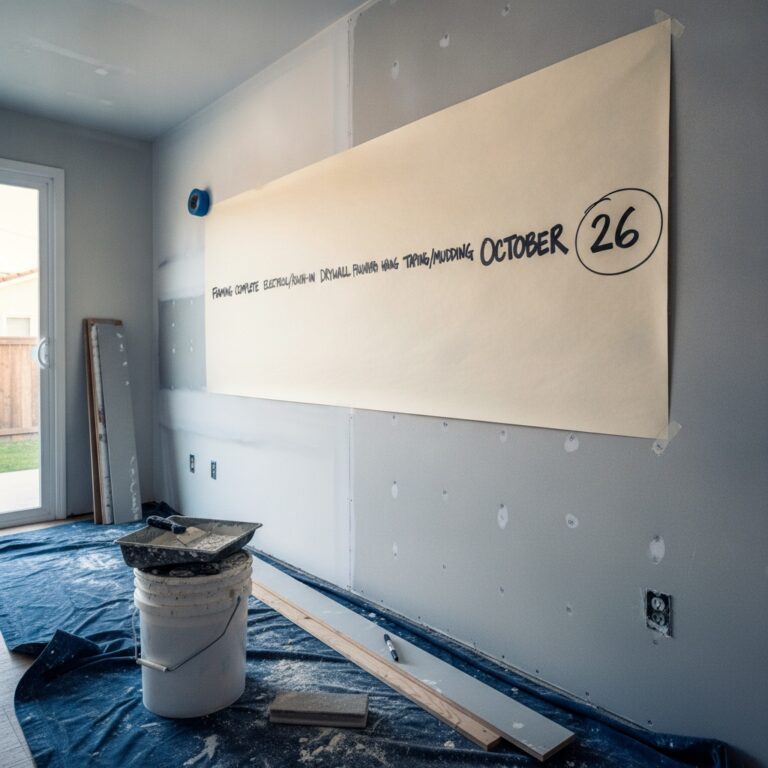
Six weeks is plenty of runway if the clock starts now. That puts the last coat of paint on somewhere in mid-October, which is comfortably ahead of the window most forecasters are pointing at. Here is how the calendar tends to run for a 2,000 square foot single-story in Fullerton, Tustin, or Rancho Santa Margarita, assuming no structural surprises turn up once a wall gets opened.
- Week 1. Walk the exterior with a notepad. Photograph every penetration, every window head, every stucco crack wider than the edge of a credit card, and every spot where soil or hardscape sits within 4 inches of the weep screed.
- Week 2. Moisture read the interior walls and ceilings below those spots. Old stains get checked, not assumed. A stain that reads dry is history. A stain that reads wet is an active leak and changes the whole plan.
- Week 3. Cut out and dry anything wet. Open the cavity, run air on it, and confirm dry readings before a single sheet goes back up.
- Week 4. Seal and flash the exterior. Brittle caulk gets cut out, not covered over. Flashing goes where flashing belongs, above the sealant, not instead of it.
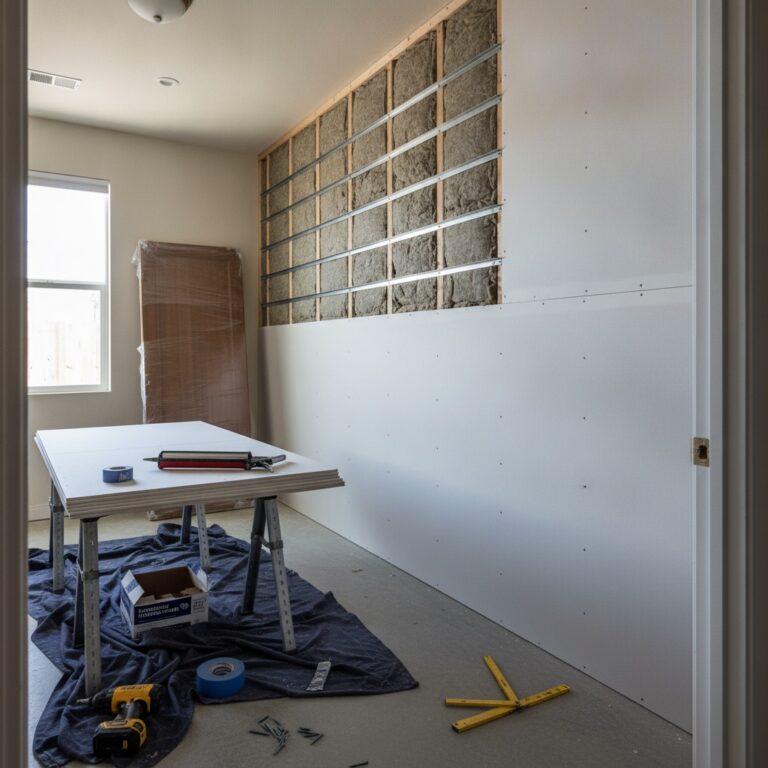
- Week 5. Hang, tape, and finish the interior repairs. Level 4 for wall areas taking texture, level 5 where a smooth wall sits in raking window light.
- Week 6. Texture match and paint. Orange peel, knockdown, and skip trowel each need a sample board and a dry run before anything touches the finished wall.
Two scheduling notes worth knowing. Lead time between signing a contract and starting work commonly runs two to eight weeks, and it stretches every October when the first scary forecast puts everyone on the same phone lines at once. Roofing and waterproofing crews across Orange County fill their books in September and early October. Calling in November means standing in line behind neighbors whose ceilings are already dripping.
What Getting Ahead of It Costs
Preventive exterior work on that same 2,000 square foot house usually lands between $400 and $900. That covers cutting and replacing failed sealant at fifteen or twenty penetrations, correcting a flashing detail or two, and pulling grade back away from the weep screed. For a crew that does this every week, it is a one-day scope.
The reactive version costs more and takes longer. A single stained ceiling patch, cut out and finished to blend, runs $450 to $900 through most of Orange County. A saturated 12 by 14 ceiling that has to come down entirely, get re-insulated, rehung, taped, textured, and repainted lands between $2,200 and $4,000. Add containment and mold remediation and it climbs from there. The difference is not skill. It is timing.
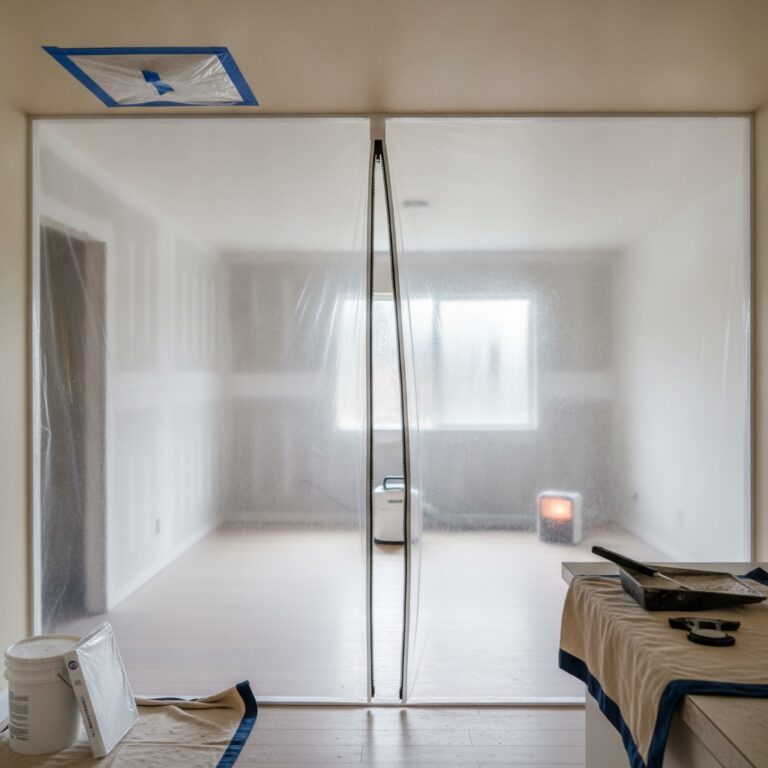
There is a quieter cost too. Winter repairs happen with the house closed up. Dust that would vent out an open slider in September has nowhere to go in January, so containment gets more elaborate, the plastic stays up longer, and the job is harder to live through with everyone home.
If a ceiling stain from last winter is still up there unexplained, or a baseboard feels soft under a thumbnail, or nobody has looked at the sealant on the house since the year it was painted, this is the month to find out. JNL Drywall offers a free in-home assessment across Orange County, the Inland Empire, Long Beach, and north coastal San Diego. We read moisture, trace the path back to the penetration that caused it, and hand over a written scope with real numbers, so the decision gets made in September instead of during the first storm.
Morning-context sources used: NOAA Climate Prediction Center, ENSO Diagnostic Discussion, 13 August 2026 (https://www.cpc.ncep.noaa.gov/products/analysis_monitoring/enso_advisory/ensodisc.shtml); CNN, “This state is likely to get the worst of El Nino,” 25 August 2026 (https://www.cnn.com/2026/08/25/climate/el-nino-california-floods-rain-landslides); Unofficial Networks, “NOAA Releases Updated Winter Weather Prediction For 2026-2027,” 20 August 2026 (https://unofficialnetworks.com/2026/08/20/noaa-updated-winter-weather-prediction/); CalMatters, “How San Diego is preparing for a winter of extreme weather under El Nino,” 1 August 2026 (https://calmatters.org/environment/2026/08/el-nino-san-diego-winter-weather/); New Santa Ana, “How Orange County residents should prepare for a powerful El Nino season” (https://newsantaana.com/how-orange-county-residents-should-prepare-for-a-powerful-el-nino-season).