Request Your Free Quote!

Your Pre-Rain Drywall Inspection: Fix These Before December
A strong El Nino winter is coming to SoCal. Here is the pre-rain drywall walkthrough, what a ceiling stain really means, and repair-vs-replace costs.
A homeowner in Villa Park called last October about a faint tan ring on a hallway ceiling, maybe six inches across. It had been there since the previous winter. Nothing dripped, nothing spread, so it sat on the list behind everything else. By the third storm in December the ring was eighteen inches across and the tape joint under it had let go. The job went from a $250 patch to $1,900 of ceiling replacement. Dry season is when drywall problems are cheap to fix. That window closes in about eight weeks.
Why This September Is Not a Normal Pre-Rain Season
NOAA’s Climate Prediction Center issued its monthly ENSO discussion on September 10 and the language got noticeably firmer. El Nino is strengthening, with a greater than 90 percent chance of a very strong event through fall and winter 2026-27. For October through December, forecasters put a 75 percent chance on a historic event, stronger than anything in the record going back to 1950. Strong El Nino winters in SoCal mean more atmospheric rivers, and more of them stalling over the same coastal counties instead of moving through.
That has already started. An early-season atmospheric river came ashore on September 2, and model guidance for the Prado Dam catchment, which drains a good part of north Orange County, spread between 0.27 and 1.3 inches of rain through that weekend. A one-inch September rain is not a crisis. It is a test. Every leak path that shows itself now is the same path that will run for six hours straight in January.
What a Pre-Rain Walkthrough Actually Checks
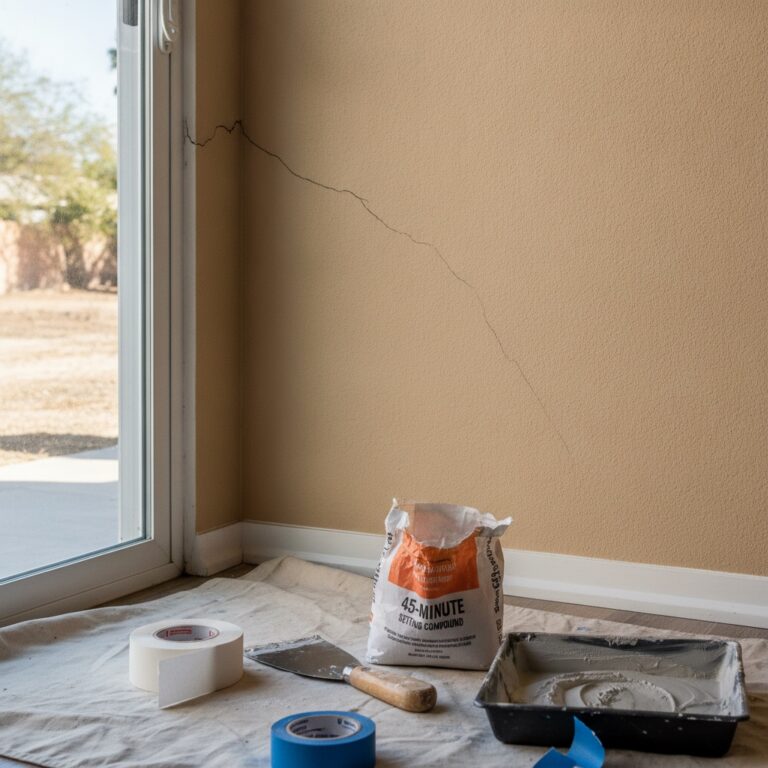
Start inside, not on the roof. Stand in each room around 10 in the morning, when low sun rakes across the ceiling and sidewalls. Raking light shows what flat overhead light hides: a tape seam that has lifted, a shallow dish where an old patch shrank, a hairline running off a door corner. Mark anything questionable with a pencil dot and the date. Two weeks later, check whether the crack passed the mark. Movement means the substrate is still working. A static crack is cosmetic.
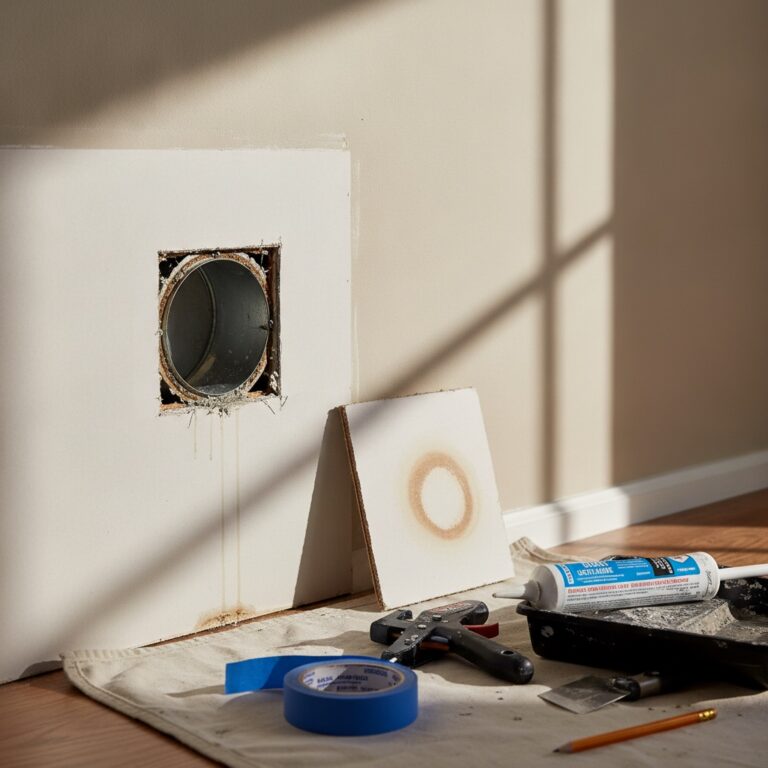
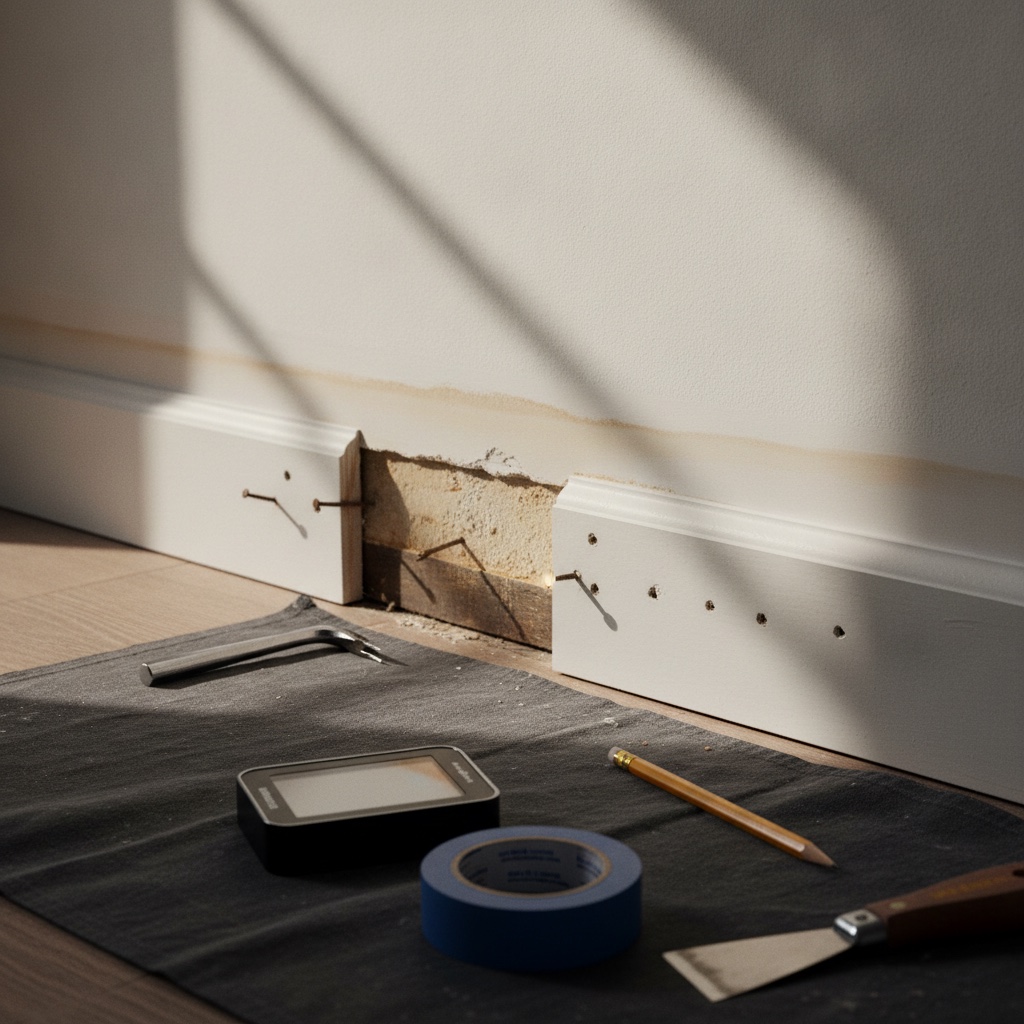
Then check the penetrations. Bath fans, recessed cans, the ceiling ring around a second-story shower drain, the drywall behind every hose bib and dryer vent. Flashing failure causes more residential roof leaks than any single roofing material problem, and flashing sits at exactly those penetration points. Pull a baseboard in any room with an exterior wall facing west or south. A gray or tan tide line an inch up the back of the drywall is old water, and it will be new water again in December.
Five Things Hiding Behind a Ceiling Stain
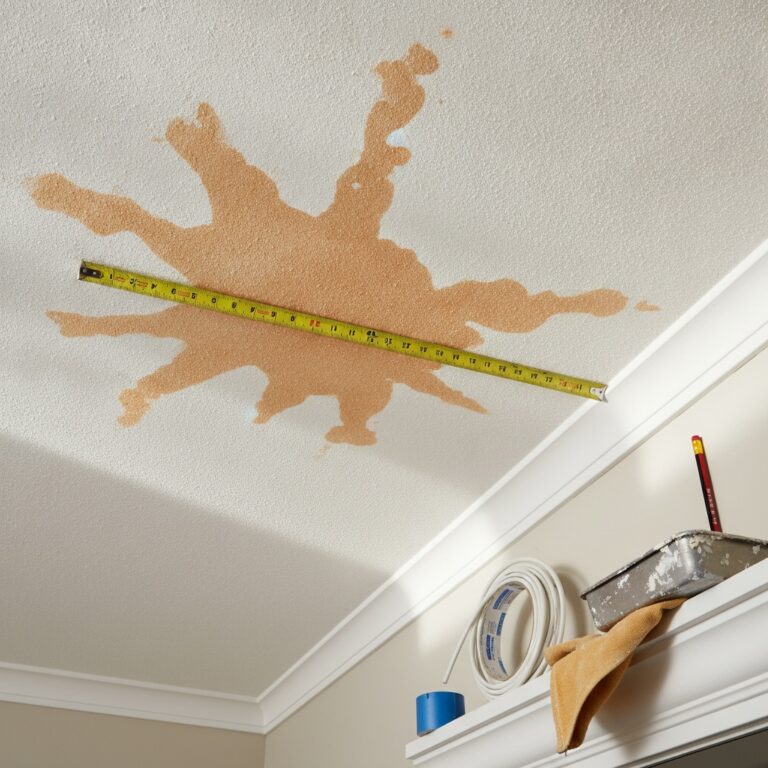
A brown ring on a ceiling is a symptom, not a diagnosis. Water runs along decking, rafters, and pipe runs before it finally drops, so the stain often sits several feet from the point where it got in. Chasing the stain instead of the path is how homeowners end up patching the same ceiling twice. Five sources account for nearly all of these in SoCal housing stock, and they can be told apart before anyone opens a ceiling:
- Roof flashing. The stain sits near a chimney, skylight, vent stack, or a wall-to-roof transition. It grows during or right after rain and not otherwise. Edges are irregular, often with a darker perimeter ring from repeated wet and dry cycles.
- Slow supply or drain leak. The stain is under a bathroom, laundry, or kitchen on the floor above. It grows on a schedule that has nothing to do with weather. A stain that spreads during a dry September week is plumbing, full stop.
- HVAC condensate. The stain is within a few feet of an air handler, a condensate pan, or a line set. It peaks in August and September when the unit runs hardest. Common in Anaheim Hills and Yorba Linda attics where the handler sits in 130-degree air.
- Water backing up behind a clogged gutter. Standing water rides over the fascia and under the roof edge. The stain shows up on the ceiling within two feet of an exterior wall, never mid-room.
- An old stain that already dried. No moisture reading, no growth, crisp edges that have not changed in a year. It needs stain-blocking primer and texture, not demolition.
A pinless moisture meter settles most of this in ten minutes. Read the stain, then read clean drywall six feet away on the same plane. If the two readings match, the stain is history. If the stain reads higher, something is still feeding it. Timing matters more than most homeowners expect. EPA, CDC, and FEMA all put mold growth on damp building materials at 24 to 48 hours, so a stain caught the same day is a different job than one looked at a week later.
Repair or Replace, and What Each Costs
The threshold is simpler than it sounds. Drywall that is still rigid, still bonded to its paper face, and reads dry gets patched. Drywall that goes soft under thumb pressure, delaminates, or sags between joists gets cut out. Paper-faced gypsum loses its structure permanently once the core has been wet and then dried. Skimming over that with joint compound buys a season at most, and it usually fails in the middle of the next storm rather than politely in April.
In Orange County and north San Diego County, a single-source ceiling patch under four square feet, taped, level-4 finished, and texture-matched, runs roughly $250 to $600 depending on access and texture type. Replacing a full 4×8 sheet with water-damaged material hauled out runs $200 to $700 installed, which tracks with 2026 national figures. Once remediation enters the picture the numbers move fast. Water-damaged drywall work involving mold commonly lands between $500 and $2,500, and full water damage restoration averaged around $3,867 nationally in 2026.
Texture match is where cheap repairs announce themselves. Most OC tract housing built between 1975 and 1995 carries knockdown or a light orange peel, while homes from the 1960s often wear a heavier splatter. A patch finished to level-4 and sprayed at the wrong nozzle pressure reads as a bright flat island under the same raking light that found the crack in the first place. Matching the surrounding texture, then priming the entire ceiling plane instead of just the patch, is what makes a repair disappear.
What to Fix First, and What Can Wait
Contractor availability is the constraint nobody plans around. A September or early-October inspection buys a six to eight week window while the weather holds and crews still have openings. After the second real storm that window is gone, every call becomes an emergency call, and pricing follows. Work the list in this order:
- Anything actively wet. Find the source, stop it, then repair drywall. Repairing first guarantees doing the work twice.
- Open penetrations and failed caulk at exterior-wall drywall returns, especially around windows on west and south elevations.
- Soft or delaminated ceiling drywall, whether or not it reads wet today.
- Old dry stains and cosmetic cracks. These hold until spring without getting worse.
Most of that list is checkable by a homeowner with a flashlight and an hour on a Saturday. The part worth a second opinion is the middle: whether a stain is finished or still feeding, and whether a soft spot is four square feet or forty. JNL Drywall walks homes across Orange County, the Inland Empire, Long Beach, and north San Diego County for a free in-home assessment, with a moisture reading and a written scope before anything gets cut open. Booking that before the first real storm costs nothing and usually changes the number.
Morning-context sources used: NOAA Climate Prediction Center, ENSO Diagnostic Discussion, September 10, 2026 (https://www.cpc.ncep.noaa.gov/products/analysis_monitoring/enso_advisory/ensodisc.shtml); The Watchers, “Atmospheric river targets Pacific Northwest as Tropical Storm Marie boosts California rainfall risk,” September 3, 2026 (https://watchers.news/2026/09/03/atmospheric-river-targets-pacific-northwest-as-tropical-storm-marie-boosts-california-rainfall-risk/); The Watchers, “El Nino forecast to reach historic strength ahead of winter 2026-27,” August 17, 2026 (https://watchers.news/2026/08/17/el-nino-forecast-to-reach-historic-strength-ahead-of-winter-2026-27/); NRCIA, “Roof Leak Cause Determination” (https://www.nrcia.org/roof-leak-cause-determination/); Angi, “How Much Does Water Damage Restoration Cost? 2026 Data” (https://www.angi.com/articles/how-much-does-it-cost-repair-water-damage.htm); Roof Replacement CA, “Fall Roof Inspection Checklist for California Homeowners” (https://www.roofreplacementca.com/fall-roof-inspection-checklist-for-california-homeowners-what-to-check-before-winter-rains/).