Request Your Free Quote!

Post-Storm Drywall Cost per Square Foot in OC: Level 4 vs 5
What OC drywall costs per square foot this winter, level 4 vs level 5, with a line-by-line Tustin ceiling quote after a storm leak and scope risks.
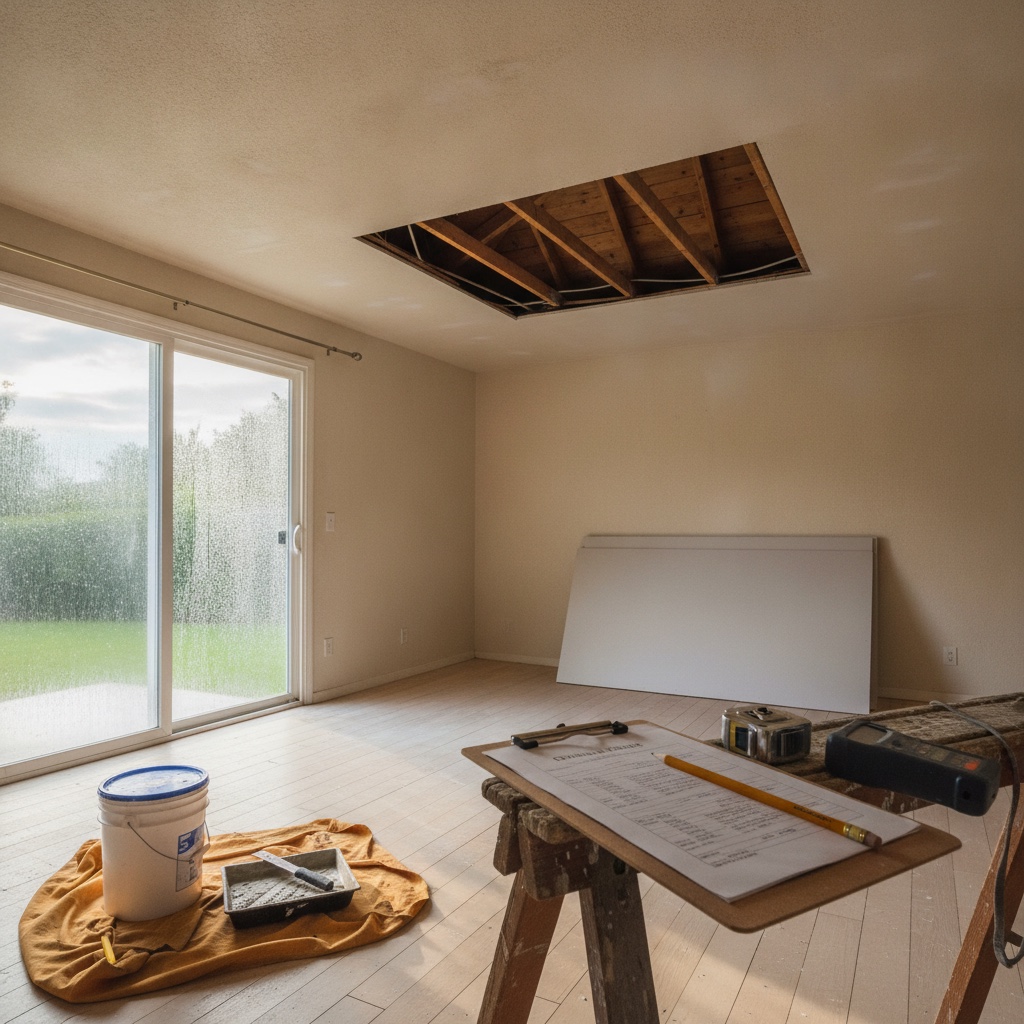
A 14-by-16 family room ceiling in Tustin takes on water during a November atmospheric river. The stain dries to a brown ring, the board sags a half inch at the center, and the homeowner wants one number: what does this cost per square foot to make right? In Orange County this winter, the honest answer for hang, tape, and finish runs about $4.00 to $5.50 per square foot at a level-4 finish. A smooth level-5 ceiling adds roughly $1.75 to $2.50 per square foot on top of that.
What a Square Foot of Drywall Costs in OC Right Now
Most online calculators quote national averages that mix rural garages with high-cost metros. Orange County labor sits at the upper end of those ranges, and ceilings cost more than walls because every sheet goes up overhead. For new board on a ceiling, figure $4.00 to $5.50 per square foot for hang, tape, and a level-4 finish ready for texture. Walls in the same room usually land $0.50 to $1.00 lower. Small repairs follow a different rule. A single patch carries a trip minimum of roughly $350 to $650, no matter how few square feet it covers.
Material prices are not the driver this year. Federal producer price data compiled by the Associated General Contractors shows gypsum building materials roughly flat year over year through September 2026, though still about half again higher than in early 2020. Labor and scheduling move the number more. NAHB reported on November 2 that remodeling spending fell 18 percent year over year in September. Softer remodel demand can mean shorter waits for storm repair crews, but it does not drop the per-foot rate for skilled finishing.
Level 4 vs Level 5 on a Storm-Damaged Ceiling
Level 4 means three coats of compound over the tape and screw heads, sanded smooth. It is the standard base for knockdown, orange peel, or acoustic-style textures, which hide minor surface variation. Most OC tract homes built from the 1970s through the 1990s have textured ceilings, so a level-4 finish plus a texture match is the default storm repair. The texture itself adds about $1.00 to $1.50 per square foot. Matching an existing knockdown pattern so the patch disappears is the skill part of that line.
Level 5 adds a full skim coat of compound over the entire surface after the level-4 work. That thin coat evens out the paper and the mud so the ceiling reads as one flat plane under low-angle light. Homeowners choose it when they want smooth ceilings, when recessed LED cans throw light across the surface, or when a big west-facing slider rakes afternoon sun across the room. It costs more because it is another full coat, another dry time, and another round of sanding. On a typical ceiling, expect one to two extra days on the schedule.
A leak repair is a common moment to make the switch. The old textured ceiling is already partly torn out, the room is already protected, and the crew is already on site. Converting the whole ceiling to smooth while it is open often costs less than doing it as a separate project in a year. If the house was built before 1981, though, any existing popcorn or acoustic texture needs an asbestos test before anyone scrapes it.
Line by Line: A Tustin Family Room Ceiling
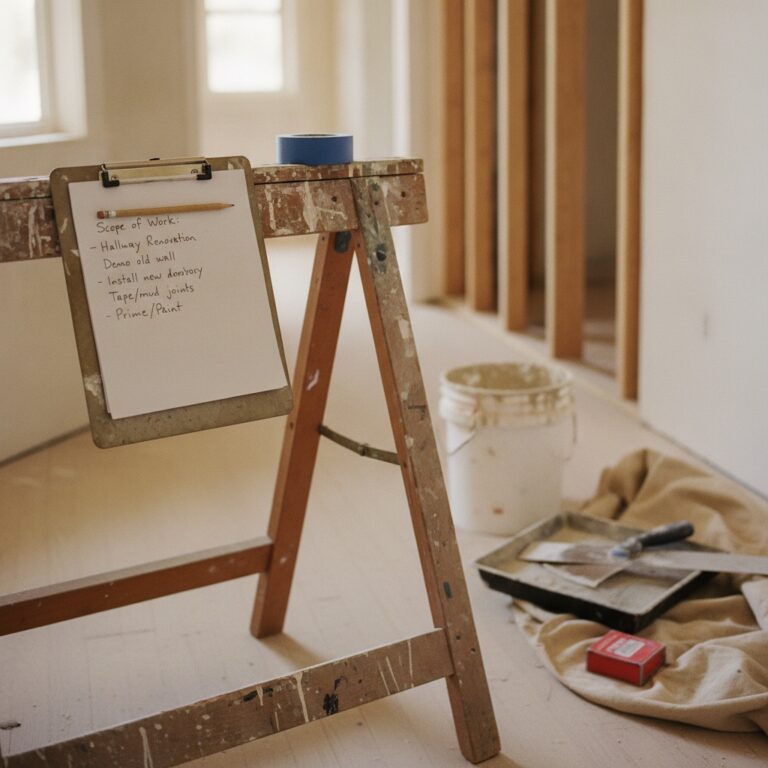
Take a typical job. A 1978 single-story home in Tustin, a 224 square foot family room ceiling, a roof leak at the flashing that the roofer has already fixed. The water mitigation company has run dehumidifiers and the moisture meter now reads dry at the framing. Here is how a JNL quote breaks down for that ceiling with a knockdown texture match at level 4.
- Room protection, floor covering, and plastic dust walls: $150 to $250
- Demo of saturated board and wet insulation, bagged and hauled off: $400 to $600
- Hang 5/8-inch ceiling board, tape, and three-coat level-4 finish on 224 square feet: $900 to $1,230
- Knockdown texture matched to the rest of the house: $225 to $335
- Stain-blocking primer plus two coats of flat ceiling paint: $280 to $390
- Final cleanup and walkthrough: included
That puts the level-4 knockdown version at roughly $1,955 to $2,805. Swap the texture line for a level-5 skim coat at $1.75 to $2.50 per square foot and the smooth version lands near $2,120 to $3,030. Per square foot of ceiling, the whole job runs about $8.70 to $13.50 once demo, protection, and paint are counted. That all-in number is the one worth comparing between bids, because a low per-foot finishing rate means little if demo and paint are left off the page.
What is not in that quote matters too. Roof repair, water extraction, and drying equipment belong to the roofer and the mitigation company. Mold remediation, if the meter or a test finds growth, goes to a licensed remediation contractor before any new board goes up. Moving furniture out of the room is usually the homeowner’s job, though crews will help with a sofa or two.
What Changes the Number After a Leak
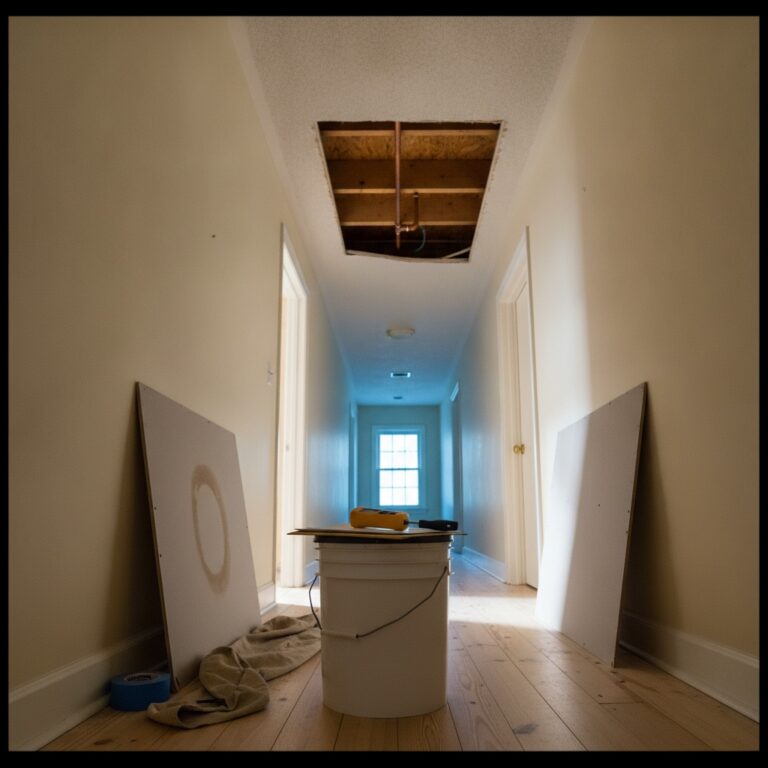
Storm damage hides. The brown ring on the ceiling shows where water pooled, but water travels along joists and down the inside of walls before it shows. Four findings change a drywall quote once the wet board comes down, and a good contractor names each one in writing before starting.
- Wet insulation beyond the stain: replacing batts runs about $1.50 to $2.50 per square foot of ceiling area.
- Water down the wall cavity: cutting a 2-foot strip along the base of an exterior wall and replacing it adds roughly $300 to $600 per wall.
- Asbestos in pre-1981 texture: lab tests run about $50 to $100 per sample, and abatement, if positive, is a separate licensed scope.
- Framing or electrical damage: a soft joist or a wet junction box stops the drywall work until a carpenter or electrician signs off.
The LA Times reported that this week’s storm carried forecasts of 1 to 3 inches of rain across most of Southern California, with Huntington Beach, Long Beach, and Seal Beach handing out sandbags. A wet ceiling may not show its full extent for several days. Waiting for the stain to stop spreading, and for a moisture meter to confirm the framing is dry, prevents the most expensive scope change of all: closing up a wet cavity and doing the job twice.
Getting a Real Number for Your Room
A per-square-foot range is a starting point, not a quote. Ceiling height, texture type, access, and what turns up behind the board all move the final number. A two-story entry with a 17-foot ceiling needs scaffolding. A bedroom with a popcorn ceiling from 1975 needs a test before anyone touches it. A Mission Viejo kitchen with six recessed cans may push the decision toward level 5. Each of those details changes the price more than any calculator can show.
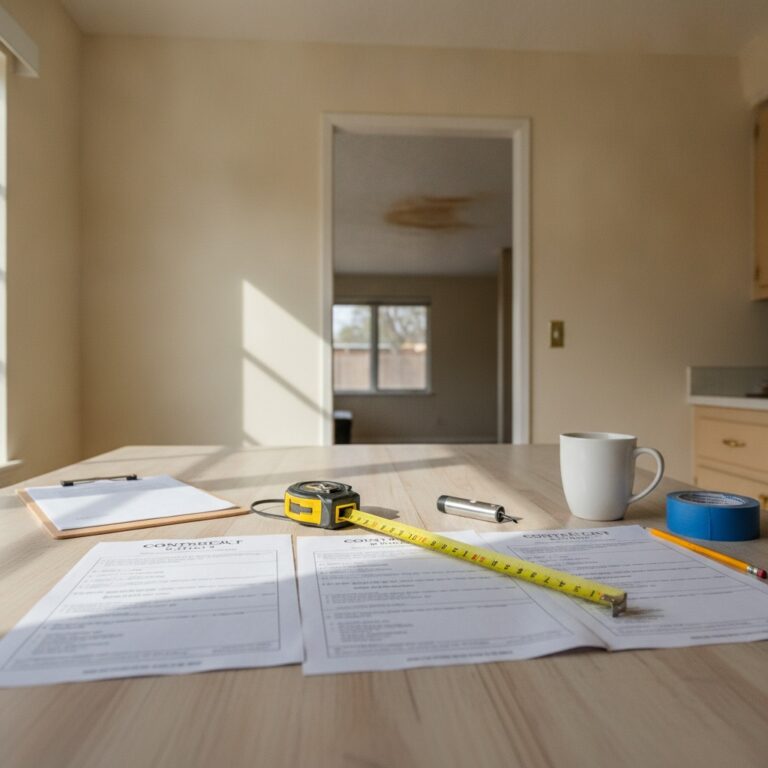
If water got into a ceiling or wall during this month’s storms, the most useful next step is a moisture reading and a written scope. We offer a free in-home assessment across Orange County, the Inland Empire, and coastal North San Diego County. A JNL estimator will meter the area, measure the square footage, identify the texture, and hand you a line-by-line quote with level-4 and level-5 options side by side, so the number on the invoice matches the number you signed.
Morning-context sources used: LA Times via Spokesman-Review, Nov 16, 2026; FOX 11 Los Angeles, Nov 13, 2026; NAHB Eye on Housing, Nov 2, 2026; AGC construction materials PPI, Sep 2026 data.