Request Your Free Quote!


5 Questions to Ask a Drywall Contractor Before El Nino Hits
License, line items, deposit limits, change orders, schedule. Five questions that sort honest OC drywall contractors from storm-season scams this fall.
A Costa Mesa homeowner gets three bids for a 400-square-foot family room ceiling after a slow roof leak finally shows through. One comes in at $1,900, one at $3,400, and one at $3,800. The low bid wants half up front, cash, and can start Monday. With California under a state of emergency ahead of a record El Nino winter, that scenario is about to play out in thousands of Orange County kitchens. Before you sign anything this fall, five questions will tell you more about a drywall contractor than any bid total.
1. What Is Your CSLB License Number, and Is It a C-9 or a B?
In California, any job worth $1,000 or more in labor and materials requires a contractor licensed by the Contractors State License Board. Drywall work falls under the C-9 drywall classification, or under a B general building license when it is part of a larger remodel. Ask for the number, then look it up yourself at cslb.ca.gov. The lookup takes two minutes and shows whether the license is active, whether the $25,000 contractor bond is current, and whether workers’ compensation is on file.
That last line matters more than most homeowners realize. If an uninsured worker gets hurt on a ladder in your hallway, the claim can land on your homeowners policy. The lookup also lists any disciplinary history. A license number that does not match the business name on the bid is a red flag. So is a contractor who says the license is “pending” or “under my partner.” Officials in Los Angeles County have already warned that unlicensed crews target homeowners every El Nino season, advertising cheap roof and water repairs online.
2. What Exactly Is in This Price, Line by Line?
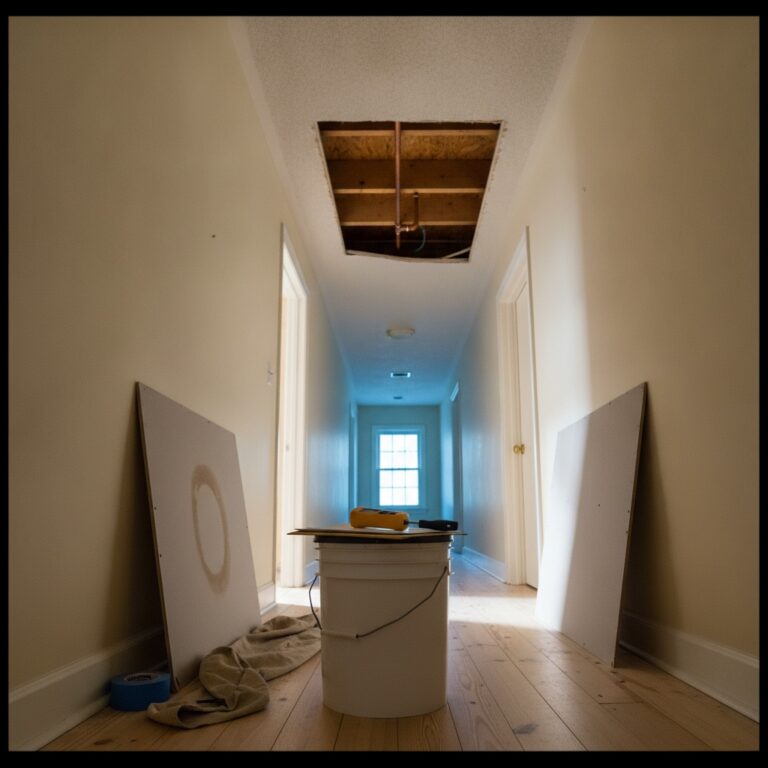
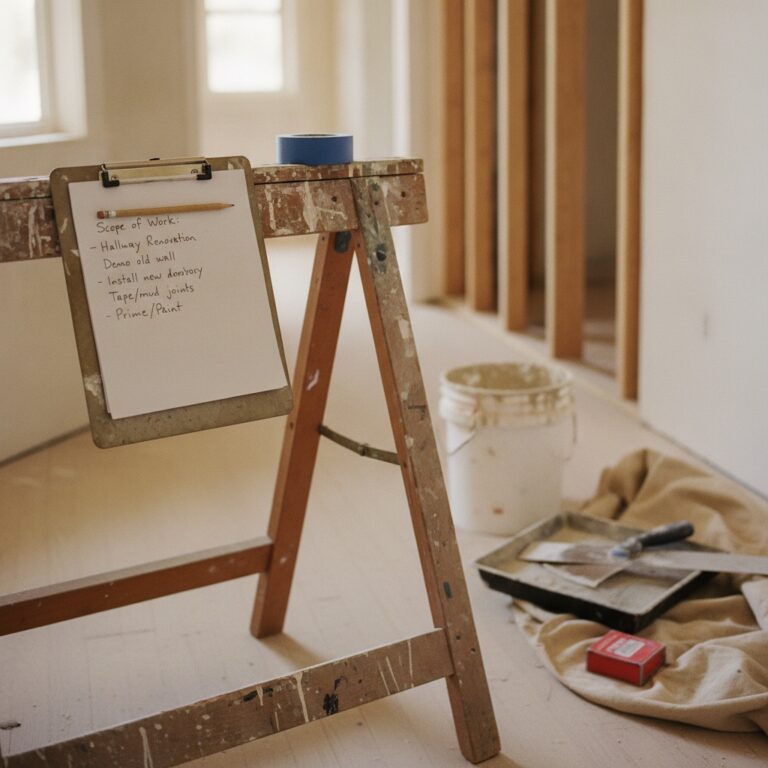
A drywall bid should read like a scope of work, not a single number. For a typical Orange County ceiling or wall repair, a clean quote covers protection and masking, demo and disposal of wet or damaged board, hanging new board, tape and three coats of mud, sanding, texture match, primer, paint, daily cleanup, and haul-off. Right now in OC, hang-tape-finish work runs roughly $2.75 to $4.00 per square foot at a level-4 finish. A level-5 skim for smooth walls under hard side light adds about $0.75 to $1.50 per square foot.
Run those numbers against the Costa Mesa bids. A 400-square-foot ceiling at level 4, with demo, texture match, and paint, lands near the $3,400 bid. The $1,900 number almost certainly leaves something out. Common omissions are paint, texture match, haul-off, and moisture testing before the new board goes up. Ask the low bidder to put every item in writing. If the price jumps once paint and disposal appear, you have your answer. Low bids rarely stay low once the missing items show up as change orders.
3. How Much Do You Need Up Front?
This question filters out more bad actors than any other. California Business and Professions Code section 7159.5 caps the down payment on a home improvement contract at $1,000 or 10 percent of the contract price, whichever is less. On a $3,400 ceiling job, the legal maximum deposit is $340. On a $15,000 multi-room remodel, it is $1,000. After that, progress payments should never run ahead of the work actually finished on site.
A contractor who asks for 50 percent before the first sheet of drywall arrives is breaking state law, full stop. The same goes for requests to pay in cash, by wire, or with gift cards. Recovery advocates working with disaster survivors this month put it plainly: unpaid money is the strongest tool a homeowner has. Hold onto it until the work is done. A tidy schedule looks like a small deposit, a payment after hang and tape, and the balance after final paint and your walkthrough.
4. What Happens When You Open the Wall and Find More?
Every water-damage job carries some risk of hidden damage. A ceiling stain in an Irvine tract home might be a single wet sheet, or it might be wet insulation, a rotted top plate, and mold along three joist bays. Ask the contractor how they handle that moment before you sign. The right answer is a written change order with a price, signed by you, before any extra work starts. No verbal “we’ll figure it out later.”
Ask too whether the bid includes moisture testing. A $30 pin meter reading before the new board goes up is the cheapest insurance on the job. Closing a wall over framing that still reads above 15 percent moisture can trap the problem and bring the stain back by February. If insurance is paying, ask whether the contractor will document conditions with photos at each stage. Adjusters move slowly during big storm weeks, and clear photos of the open wall help a claim get paid instead of stalled.
5. When Can You Start, and What Does Your Schedule Look Like?
Forecasters now describe this El Nino as so strong it has outgrown the usual labels, and the state emergency declaration is already sending homeowners to their phones. Honest contractors will tell you their real lead time, which in OC this fall is often two to four weeks for repair work. Be careful with anyone who can start tomorrow on a big job and pushes you to sign tonight. Door-to-door pitches that mention “working on a house nearby” are a classic storm-season move.
A clear schedule also protects your household. A typical 400-square-foot ceiling repair runs three to five working days: one for demo and hang, two or three for tape, mud, and dry time, and one for texture, prime, and paint. Ask which days the house will be noisy, where the dust barrier goes, and who to call when something comes up. If the contract is signed in your home, California gives you three business days to cancel, or five if you are 65 or older. A legitimate contractor will put that notice in the paperwork without being asked.
These five questions take about ten minutes at the kitchen table, and they sort the pros from the problems fast. If you are staring at a stain, a crack, or a stack of bids that do not line up, JNL Drywall will come out for a free in-home assessment. We will measure the damage, check the framing for moisture, and walk you through a line-by-line quote with our license number right at the top, so you can sign this fall with zero guesswork.
Morning-context sources used: Inside Climate News, “How to Protect Yourself From Disaster Scams” (Sep 28, 2026), https://insideclimatenews.org/news/28092026/how-to-protect-yourself-from-disaster-scams/ ; Inside Climate News, “Incoming El Nino Is so Extreme It Doesn’t Have a Scientific Name” (Sep 29, 2026), https://insideclimatenews.org/news/29092026/record-breaking-el-nino-grows-in-pacific/ ; California Department of Insurance, “Commissioner Lara urges Californians to review insurance coverage before likely historic El Nino storms hit” (Sep 22, 2026), https://www.insurance.ca.gov/0400-news/0100-press-releases/release033-2026.cfm ; Avant-Garde Construction, “California Declares a State of Emergency Ahead of El Nino” (Sep 21, 2026), https://www.avant-gardece.com/california-declares-a-state-of-emergency-ahead-of-el-nino-what-bay-area-homeowners-should-check-now/ ; Los Angeles County District Attorney, “Unlicensed Contractors Targeting Homeowners During El Nino Season,” https://da.lacounty.gov/community/fraud-alerts/el-nino ; CSLB, “C-9 Drywall Contractor classification,” https://www.cslb.ca.gov/about_us/library/licensing_classifications/Licensing_Classifications_Detail.aspx?Class=C-9