Request Your Free Quote!

Heat-Cycle Cracks at Your Wall Corners: Fix or Replace?
That corner crack that reopens every SoCal heat wave is heat-cycle movement. Here is how to tell repair from replace, with real Orange County costs.
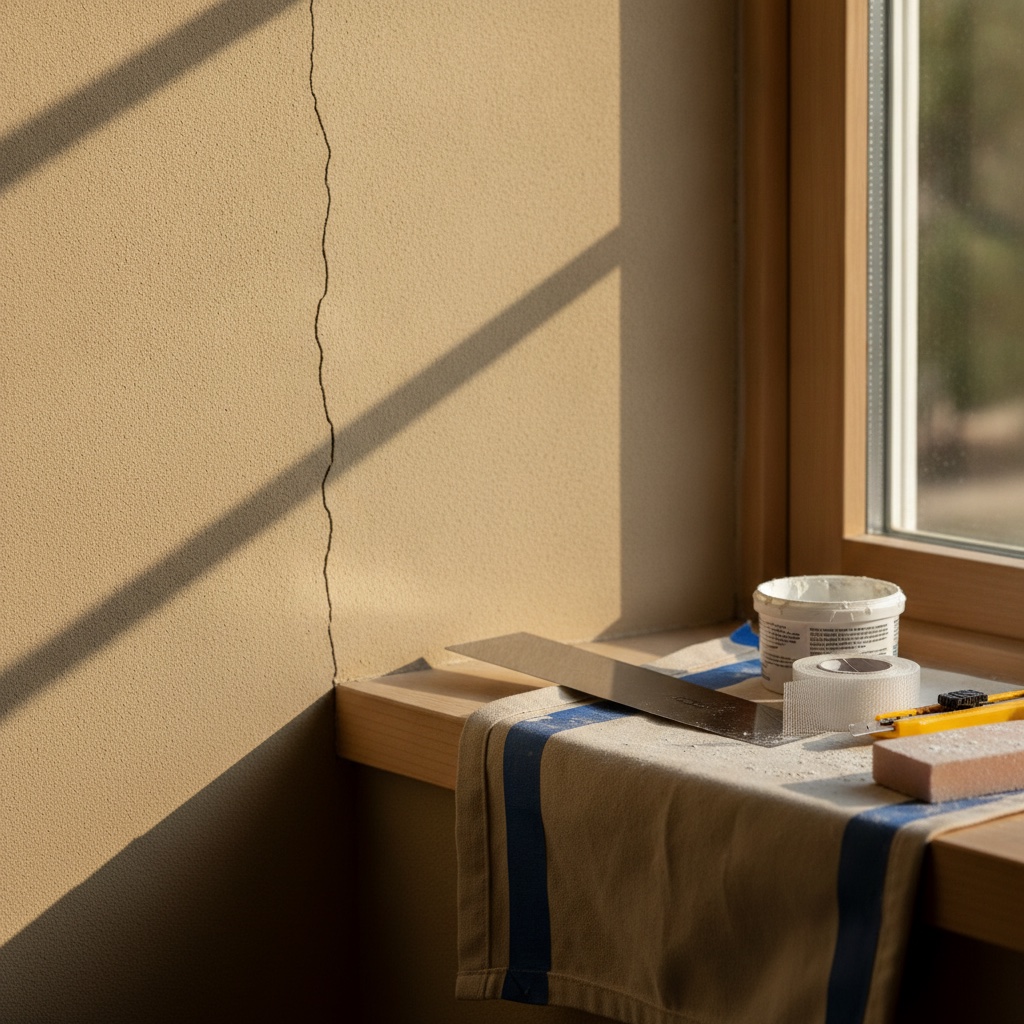
The thermometer hit 104 in Woodland Hills this past weekend, and parts of the San Fernando and San Gabriel valleys sat under a heat advisory into Monday. When SoCal bakes like that, a specific kind of drywall crack shows up. It runs out from the corner of a window, the edge of a door, or the spot where two exterior walls meet. You filled it last August. It is back. That recurring corner crack is not random, and the fix is not the one most homeowners reach for first.
The crack that comes back every heat wave
Heat-cycle cracking has a pattern you can read. It tends to start at a corner, usually the upper corner of a window or door opening, and it follows a roughly diagonal line for six inches to two feet. On exterior wall corners it can run vertically near the bead. The crack is thin in spring, opens wider during a July afternoon, then narrows again when the marine layer cools things off at night.
That open-and-close behavior is the tell. Your framing expands when the wall gets hot and contracts when it cools. Stucco exterior walls in Anaheim, Riverside, and Escondido soak up afternoon sun and push that movement straight into the gypsum board behind them. The drywall and the metal or plastic corner bead expand at slightly different rates, so the weakest joint splits. A weekend of 100-plus degree highs is enough to reopen a crack you thought you closed for good.
Reading what is actually behind it
Before anyone mixes mud, the crack needs a diagnosis. Three different problems leave similar lines on a wall, and only one of them is the simple thermal kind. Get the cause wrong and you pay for the same patch twice. A few minutes of looking before anyone opens a bucket of compound saves the bigger repair later, so walk the crack end to end and check the wall on both sides first.
The first is plain heat-cycle and humidity movement. These cracks are hairline to about an eighth of an inch, they live at opening corners, and the wall on both sides feels flush when you run a hand across it. The second is settling or framing movement. Those cracks are wider at one end, sometimes with one side sitting slightly proud of the other, and they pair with a sticking door or a gap at the baseboard. The third is moisture. A crack that stains brown, feels soft, or smells musty means water reached the board, and no amount of joint compound fixes a leak.
Here is the quick home test. Press a fingertip on each side of the crack. If both sides are firm and level, you are likely looking at thermal movement. If one side flexes or steps out from the other, the framing is moving and the wall needs more than a cosmetic patch. If the area is cool, damp, or discolored, stop and find the water source first. A homeowner in Huntington Beach who patches over a slow window-flashing leak just buys a bigger repair next winter.
Why spackle alone never holds
The reason that corner crack keeps returning is mechanical. Lightweight spackle is rigid and thin. It bridges the gap but it does nothing to absorb the seasonal movement that opened the gap in the first place. The next heat wave flexes the joint, the brittle filler lets go, and the line reappears in the exact same place. You are not failing at the repair. You are using a material that was never built to move.
A repair that lasts treats the joint as something that needs to flex. The crack gets cut open into a shallow V so filler has room to grab, and loose tape comes out. Then the joint is re-taped, and the tape choice matters. Self-adhesive fiberglass mesh handles minor movement better than brittle patches, and on a true expansion corner the right answer is sometimes a zinc or vinyl expansion bead that lets the wall move without splitting. Two or three thin coats go over the tape, each feathered wider than the last, then sanded flush and primed. Skip the primer and the patch flashes a different sheen.
Repair or replace, and what each runs in SoCal
Most heat-cycle corner cracks are a repair, not a replacement. A single recurring corner crack, cut out, taped, and finished to a level-4 match on a painted wall, runs roughly 150 to 350 dollars in Orange County and north San Diego. That covers the cut-out, tape, three coats, sanding, and a feathered prime. Add paint blending of the full wall and you land near the upper end, because a partial repaint rarely matches a sun-faded wall.
Replacement enters the conversation when the cause is bigger than heat. If several cracks share a wall and one side steps out from the other, the framing or the foundation is moving, and the honest move is to address that first before any drywall work. If the board is soft from moisture, the wet section gets cut back to dry framing, the leak gets corrected, and new rock goes in. That is a 400 dollar-plus job once you account for finding the water, replacing board, and matching texture. A level-5 finish on a high-visibility wall costs more again, because every flaw shows when the low June sun rakes across it.
The decision threshold is simple. Cosmetic, stable, dry, and at a corner means a clean repair that holds for years if it is taped to move with the wall. Structural or wet means fix the cause first, then the drywall. The trap most homeowners fall into is paying for the same patch twice because the first crew skipped the diagnosis and went straight to the mud.
Catch it before the next 100-degree week
SoCal summers are stacking heat waves earlier each year, and forecasters are calling for a hot, El Nino-influenced season ahead. That means more expansion cycles and more reopened corners between now and September. The smart window is now, while the crack is narrow and the cause is still easy to read. Walk your exterior-wall rooms in Tustin, Corona, or Carlsbad on a hot afternoon and look at every window and door corner. A thin line you catch today is a 200 dollar fix. The same line ignored through three more heat waves becomes a wider, harder repair.
If you have a corner crack that keeps coming back, JNL can take a look and tell you straight whether it is thermal, structural, or wet before anyone touches it. We bring the diagnosis, the right tape, and a finish that matches your wall. Book a free in-home assessment and get an honest answer on whether yours is a quick patch or something the next heat wave will keep reopening.
Morning-context sources used: CBS News Los Angeles, “June heat wave reaches Southern California”; AccuWeather, “Summer forecast 2026: Heat, severe storms to shape the season”; Fine Homebuilding, “Repairing Stress Cracks”; Trim-Tex, “Drywall Cracks: How to Prevent or Fix Them”; Angi, “How Much Does Drywall Repair Cost? 2026 Data”.