Request Your Free Quote!

Plaster or Drywall? How to Tell Before You Repair That Crack
Plaster or drywall? Three five-minute checks to identify your walls, how each type cracks, and real OC and San Diego repair costs before you patch.
Tap the wall next to the crack. A hollow drum sound means drywall. A dense, dead thud means plaster. That one knock changes everything about the repair: the tools, the materials, the price, and whether a quick patch will even hold. SoCal has plenty of both. A 1941 bungalow in Long Beach carries plaster over wood lath. A 1978 tract home in Mission Viejo has drywall on every stud. A 1955 ranch in Anaheim probably has something in between, and that in-between wall confuses more homeowners than any other.
Getting the identification right matters because the two materials fail differently, get repaired differently, and cost different money. Plenty of Orange County homeowners have paid for a drywall-style spackle patch on a plaster wall, watched it crack again in six weeks, and paid twice. Five minutes of checking prevents that.
Three checks that settle it in five minutes
Start with the year the house went up. Homes built before the mid 1940s almost always have plaster spread over strips of wood lath. Homes built after about 1970 have drywall, full stop. The stretch between is where SoCal housing gets interesting. Builders in the 1950s often used gypsum lath, sometimes called button board, a thin panel nailed to the studs and skimmed with a hard plaster coat. It looks like plaster and cracks like plaster, but it hides panel seams the way drywall does.
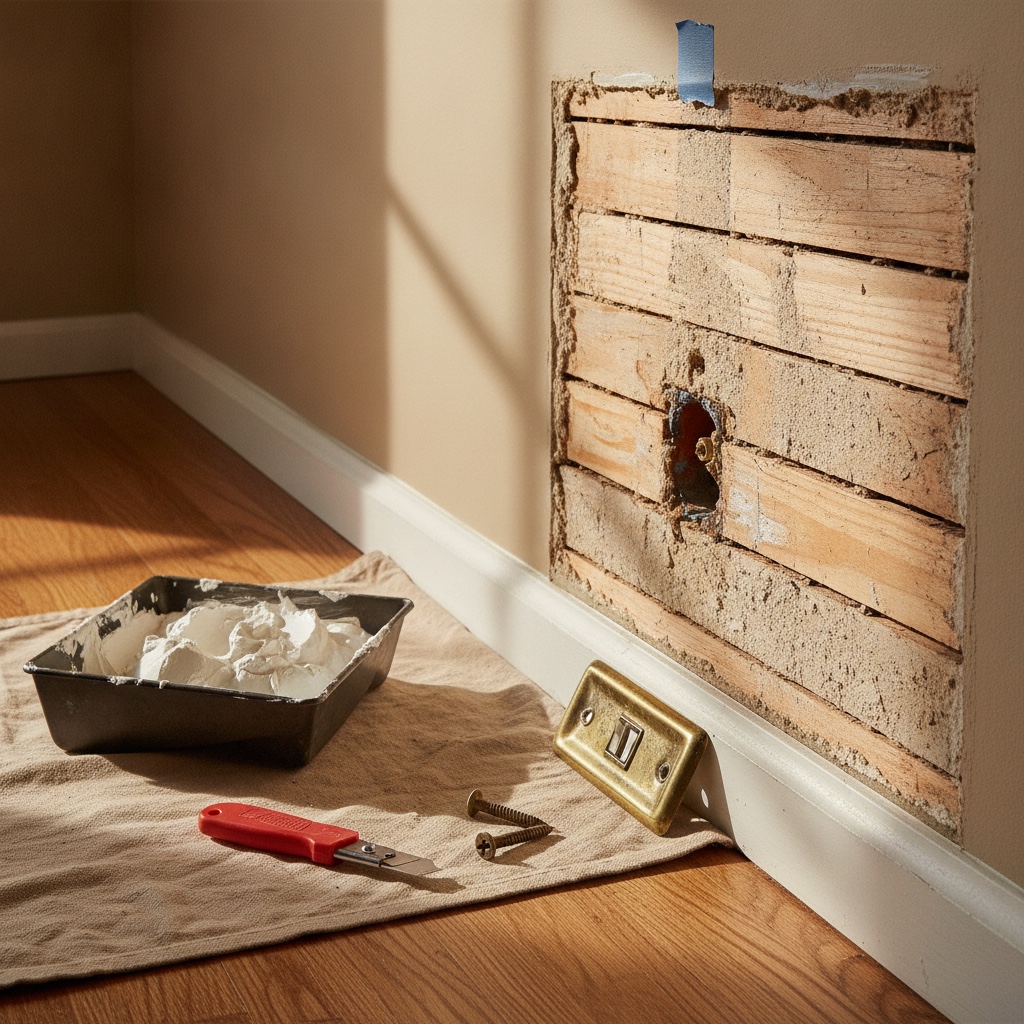
Next, kill the power at the breaker and pull a switch plate. Look at the cut edge around the electrical box. Drywall shows a clean gypsum core wrapped in gray or brown paper, about half an inch thick. Plaster shows layers: a sandy base coat, a white finish coat, and often the edge of wood lath behind it, with total thickness pushing three quarters of an inch or more.
Third, press a pushpin into a closet wall or another spot nobody sees. It slides into drywall with thumb pressure. Plaster fights back and usually bends the pin before it gives. None of these checks leave damage that a switch plate or a dab of filler will not cover, and together they identify the wall correctly almost every time.
Why plaster cracks are a different animal
Drywall cracks follow rules. They run along panel seams, radiate off the corners of doors and windows, and open along tape lines that have let go. The panels themselves rarely fail; the joints do. That is why most drywall cracks in Irvine or Chula Vista trace back to tape, fasteners, or normal settling, and why the standard repair is mesh tape, setting compound, and three feathered coats.
Plaster cracks wander. They map across the open field of the wall in jagged, branching lines because the plaster shell is one continuous slab moving against its lath. The real trouble starts when the keys, the small plaster hooks that grip the lath, snap off. The wall delaminates. Press gently near the crack: if the surface flexes or grinds, the plaster has separated from its backing, and a surface-only patch is lipstick on a problem. The honest fix is reattachment with plaster washers or adhesive injection, then a skim coat.
This week’s weather is not helping either material. The current SoCal heat wave has inland framing expanding through 95 degree afternoons and contracting at night, and that daily cycle pulls at wall corners and ceiling seams from Corona to Escondido. Add heavy AC use and the condensate lines that come with it, and late July becomes prime season for new cracks and fresh ceiling stains in both plaster and drywall homes.
What each repair actually costs in OC and San Diego
Small drywall repairs are the cheapest wall work there is. A pro patches a doorknob hole or a single stress crack for $200 to $450 in most of Orange County, texture blend and primer included. A larger repair, say a two by four foot cutout after a plumbing leak, runs $450 to $900 depending on the texture match. Knockdown and orange peel blend without much drama. A smooth level-5 wall costs more because the patch has to disappear under raking light, which means skimming a wider area than the hole itself.
Plaster repair starts higher and climbs faster. Reattaching and skimming a delaminated section commonly lands between $600 and $1,500. A full room of cracked but sound plaster can be skim coated for $2,000 to $4,000. Once plaster has failed across most of a room, gut and re-drywall usually wins the math: figure $3,000 to $6,500 for a typical 12 by 14 bedroom in San Diego or Orange County, covering demo, disposal, hang, tape, a level-4 finish, and texture to match the rest of the house.
Water changes the math for both. A brown ceiling ring with soft, spongy drywall behind it means the gypsum core took on water, and that section gets replaced, not patched. Stained plaster often survives if it still feels hard, but the wood lath behind it holds moisture longer than most people expect, so the source leak and the drying both need confirmation before anyone opens a mud bucket.
Keep the plaster or make the switch?
Sound plaster is worth keeping. It is denser than half-inch drywall, deadens sound better, and carries the character that makes older Long Beach, Orange, and North Park houses feel the way they do. If the walls are flat, hard, and merely cracked, a skim coat restores them for less than a gut, with no demolition dust in the bargain.
Switching to drywall makes sense when other work forces the wall open anyway. A repipe, a rewire, or new insulation means the lath is coming off, and at that point hanging new board costs less than rebuilding plaster from scratch. Mixed repairs work too: many SoCal remodels keep plaster in the front rooms and run drywall in the redone kitchen, with a level-5 skim where the two meet so the seam never shows.
If you are staring at a crack right now and still not sure which wall you own, that is a fair place to stop guessing. JNL Drywall looks at plaster and drywall problems across Orange County and San Diego every week, and a free in-home assessment will tell you what the wall is, why it cracked, and what the honest fix costs before you commit to anything. Request a visit and get a straight answer at your own kitchen table.
Morning-context sources used: angi.com (How to Tell If You Have Drywall vs. Plaster), brownstoner.com (Plaster vs. Drywall repair and restoration), royalcrownrenos.ca (Drywall Cracks vs Water Damage), bobvila.com (Water Stains on the Ceiling: Common Causes), patch.com and laist.com (SoCal July 2026 heat wave coverage).