Request Your Free Quote!


Why January Through March Is SoCal’s Smartest Drywall Window
January through March is the quietest, fastest stretch for indoor drywall work in SoCal. See the real timeline, winter tradeoffs, and when to book.
The call hits our Anaheim Hills line every August. A homeowner wants a wall opened between the kitchen and the living room, or a garage turned into a real office, and they assume spring is the season to do it. That assumption costs money and time. The smartest start date on the SoCal remodel calendar is a Monday in mid January, and the homeowners who get that date are the ones who book it this fall.
The Quiet Season Nobody Books
Winter is the least popular season for home remodeling nationwide, and that is exactly why it works. Crews that juggle six jobs in June carry three in January. Harvard’s Joint Center for Housing Studies released its latest remodeling forecast on July 23, and the numbers point the same direction: growth in renovation and repair spending is easing toward 0.5 percent by mid 2027, with remodeling permits and building-product sales flattening right now. Demand is cooling, and calendars are opening.
Translation for a homeowner in Irvine or Fullerton: contractor schedules are loosening, and the loosest stretch is the one nobody asks for. Interior drywall work does not care about rain. Demo, hang, tape, and finish all happen inside a conditioned house. A January storm can dump two inches on the 5 freeway while a level-5 skim coat cures in your dining room, right on schedule.
There is a second winter advantage that gets less attention: the house is empty. Kids are in school from early January through spring break. Nobody remodels around a packed living room in July without paying for it in schedule slips and re-cleans. The winter window hands you quiet weekdays, cooler temps that keep joint compound drying at a steady rate, and a crew that is not being pulled across four other sites.
Work Backward From a January Start
A January 12 demo day does not begin on January 12. It begins with an in-home assessment in late August or September. Walk the timeline backward and the fall booking window stops looking early and starts looking necessary. Every step ahead of demo carries a lead time, and two of them, design decisions and permits, are famous for eating six weeks apiece when homeowners start late.
Here is the realistic sequence for a wall-removal project in Orange County. Assessment and scope in September. Design and finish decisions, knockdown versus smooth, level-4 versus level-5, locked by mid October. Permit submittal by early November if the project touches structure, electrical, or plumbing. Plan review in unincorporated OC typically clears first review in 4 to 6 weeks, and city desks in Irvine, Orange, or Fullerton run their own clocks. December brings holiday closures that can stall a review another two weeks. Approval lands in early January. Demo starts mid month.
Cosmetic work skips the permit line entirely. A re-texture, a skim coat, or a whole-room patch-and-paint refresh needs no plan check, which means a straight shot: assess in fall, hold your date, start in January. One code wrinkle for permitted jobs is worth knowing. Submittals since January 1, 2026 fall under the 2025 California Building Code, so drawings produced for you two years ago may need updates before a city desk will accept them.
Most jurisdictions also sell speed. Expedited plan review usually costs 1.5 to 2 times the base plan-check fee and can cut the review window roughly in half. On a $600 plan check, spending an extra $600 to buy back three weeks in December is often the best money in the whole project budget.
The Tradeoffs, Named Honestly
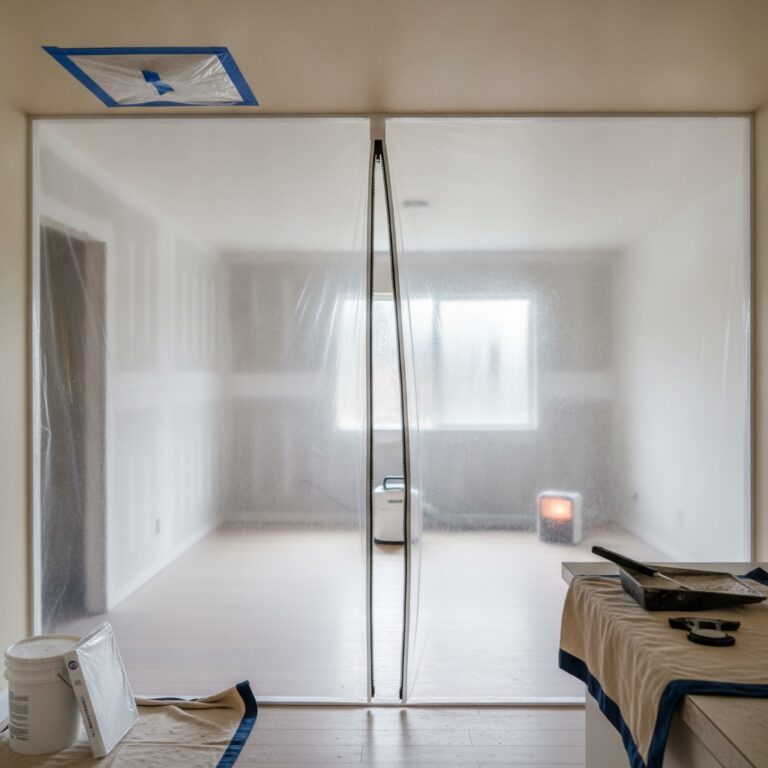
Winter work keeps dust inside. That is the real cost of the season, and it is manageable with a containment plan rather than a shrug. Expect zip-wall plastic barriers at every doorway, floor protection through the whole traffic path, and a negative-air machine any time sanding runs more than a day. Ask any bidder to describe their containment setup before you sign. If the answer sounds like a box fan in a window, keep calling.
Daylight runs shorter, so crews start earlier and wrap by 4. The two weeks around Christmas produce almost nothing, so a good schedule routes around them instead of pretending they count. Cool, damp weeks slow compound drying in rooms near the coast, from Long Beach down through San Clemente. An experienced crew runs low heat and steady air movement and builds a float day into the finish schedule so the timeline holds anyway.
Compare that with the summer alternative. Kids home all day, every day. Peak booking season, where one slipped start cascades into three. August heat pushing attic temps past 130 degrees directly above the ceiling being patched. The comparison is not close. Winter’s costs are procedural and plannable. Summer’s costs are baked into the season itself.
What Winter Does to the Invoice
Drywall pricing in Orange County holds fairly steady across the year. Hang, tape, and finish to level-4 runs roughly $2.25 to $3.75 per square foot of board, with a level-5 skim adding about $0.75 to $1.25 on top. A 12-by-16 bedroom re-rocked, finished, and painted typically lands between $3,000 and $4,800 depending on ceiling height, texture match, and haul-off. What moves in winter is not the rate card. It is everything around it.
Lead time shrinks. A summer job quoted in June might wait five or six weeks for a start date. The same job quoted in November often starts inside two. Scope changes resolve faster too, because the estimator is not buried under thirty open bids. And the market backdrop matters: with national renovation spending expected to hold near $518 billion through 2026 and cool from there, crews protect their winter calendars by quoting sharp and showing up when they said they would. Slow-season clients get the A crew, not the overflow crew.
How to Lock a January Date
Three moves this fall. First, book the assessment before October, while the winter calendar is still wide open. Second, make finish decisions early, because a level-5 smooth wall and a knockdown match are different prep paths and different schedules, and switching later is a change order. Third, if the project touches structure, get drawings moving by mid October so plan review clears before the holidays swallow December.
We run free in-home timing assessments across Orange County, Long Beach, and north San Diego County. We walk the rooms, map the project against a real calendar, and put honest numbers on each phase, from demo day to final walk. If a January start is the right call for your house, we hold the date. Request a visit now and get on the winter calendar before the quiet season stops being quiet.
Morning-context sources used: Harvard JCHS Leading Indicator of Remodeling Activity, July 23, 2026 (https://www.jchs.harvard.edu/blog/remodeling-growth-set-downshift-late-2026); NAHB, Forecasting Trends That Will Reshape the Remodeling Industry, July 2026 (https://www.nahb.org/blog/2026/07/forecasting-the-trends-that-will-reshape-the-residential-remodeling-industry); Home Renovation Trends and Forecast 2026, July 16, 2026 (https://mecktimes.com/news/2026/07/16/home-renovation-trends-and-forecast-2026/); Sea Pointe, Orange County Building Permits Guide (https://seapointe.com/orange-county-building-permits-guide/); Angi, Best Time of Year to Remodel (https://www.angi.com/articles/best-time-year-remodeling-projects.htm).